
How can tertiary education produce graduates who meet industry needs? Massey University and the New Zealand Chinese Building Industry Association explore collaboration
Businesses are eager for talent, universities need to develop graduates who meet industry needs, and research must demonstrate its value in practice. How can tertiary institutions build close relationships with businesses in related fields for mutual benefit? On 12 November, Massey University and the New Zealand Chinese Building Industry Association (NZCBIA) took their first exploratory step together.
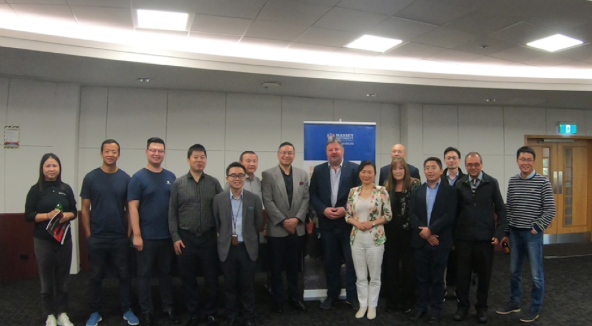
Held at Massey University’s Albany campus, the workshop was led by its School of Built Environment and attended by representatives of the Chinese Building Industry Association and nearly ten construction and related businesses among its members. Dr Gregory Chawynski, a senior lecturer in construction management at the school, co-chaired the meeting with association president Frank Xu. In a round-table discussion, the parties explored potential areas of collaboration between the association and Massey, including employers’ staffing needs, graduate quality, interview skills training and scholarship support.
{ad}
Agreement on advancing construction research
Dr Gregory Chawynski, Associate Professor Naseem Ameer Ali, the school’s international director, and Associate Professor Kenneth Tak Wing Yiu, its deputy research director, spoke in turn about the School of Built Environment’s programmes and research priorities.
Massey University’s School of Built Environment holds a leading position among New Zealand tertiary institutions for its expertise in construction and lighting. Its teaching focuses on quantity surveying and construction management, while its research focuses on smart construction, project management and environmental sustainability. Digital technologies, including computer-aided drafting (CAD) and computer modelling for buildings (BIM, AR), are widely used in its teaching and research.
The school offers bachelor’s and master’s degrees in construction. Particularly noteworthy is its Master of Construction (Construction Law), New Zealand’s only degree focused on construction law. Students study both construction and law, gaining specialist knowledge of construction law, construction contracts, construction contract administration and alternative dispute resolution, including statutory adjudication.
The academics said research and innovation were vital to the development of the construction industry, and that the school hoped to collaborate more closely and extensively on research with the industry leaders present. Associate Professor Kenneth Tak Wing Yiu outlined his two current research areas. One concerns construction health and safety, particularly how to help newly arrived migrant construction workers adapt to New Zealand’s construction environment and understand site safety rules. The other concerns employee monitoring, an international issue on which he hoped to make progress in New Zealand.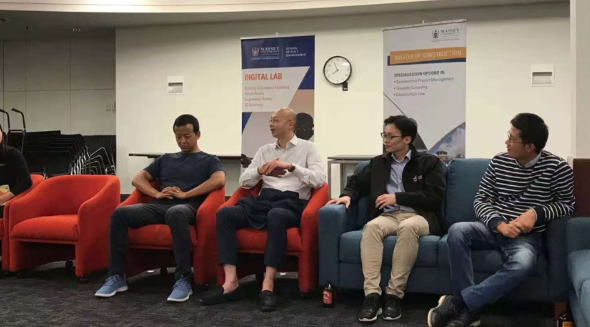
These teaching and research priorities align with areas the Chinese Building Industry Association has worked for years to promote within the industry. During the discussion, both Frank Xu and LIVEFIRM Construction Limited general manager Frederick Chua expressed a desire for closer collaboration with the school’s experts on research challenges arising in industry practice, to advance construction technology in New Zealand together. Speaking for the association, Frank Xu also offered to help facilitate the school’s research projects, share promising research ideas and exchange resources for mutual benefit.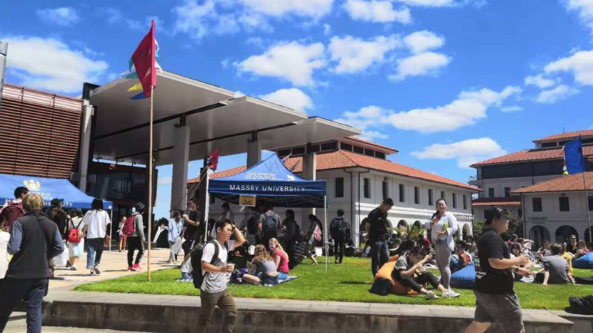
Educators and employers join forces to develop skilled professionals
Another concern raised by the school’s academics also received an enthusiastic response from the business representatives present.
As one of New Zealand’s most popular universities among international students, Massey has consistently worked to provide them with a safe, friendly, international and high-quality learning environment. Around 40% of the School of Built Environment’s students are from China. Dr Gregory Chawynski said the university took the gap between graduates’ capabilities and industry needs very seriously. NZCBIA’s professional standing and community reputation in New Zealand’s construction industry were unrivalled, and the school greatly valued its powerful platform for bringing resources together. It hoped to establish stable, long-term, two-way communication with the association and secure internship opportunities for graduates.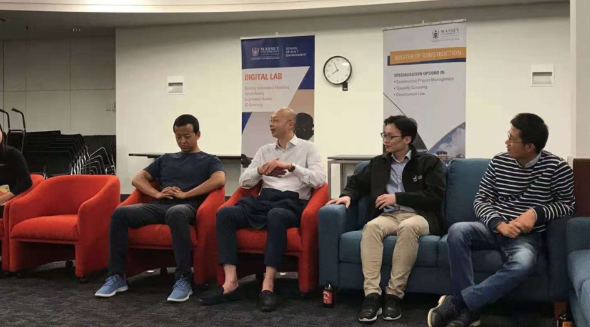
Stephanie Mazey, marketing director at Kohler New Zealand, and Jeff Ren, commercial project manager at Renoart Bathroom, said their businesses would join the association in providing scholarships to Massey University to encourage and develop more outstanding students. Further discussions on the details were understood to be under way.
Frank Xu and several other business leaders present spoke highly of Massey graduates and offered constructive suggestions on the remaining gaps between graduates’ capabilities and employers’ needs. They agreed that Massey graduates were hardworking, independent, quick to learn and adapt, and strong performers at work. Chinese international students’ command of both Chinese and English would give them a distinctive advantage in the industry. Frank Xu encouraged students to remain optimistic about the job market. He also advised the university to prioritise project planning skills in construction programmes, as many current problems in New Zealand’s construction industry stemmed from shortcomings in those skills.
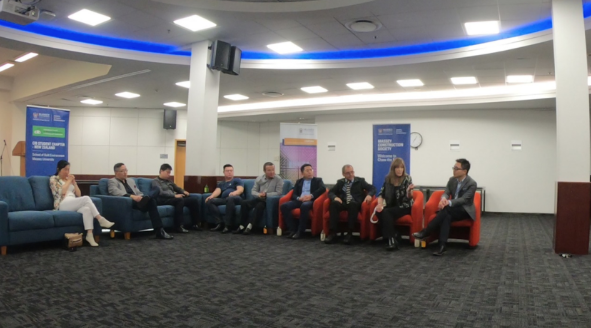
Several business leaders, including Jason Zhi, project director at China Construction New Zealand Limited, and Frederick Chua, general manager of LIVEFIRM Construction Limited, said at the meeting that they would warmly welcome Massey graduates. The head of the Auckland Architectural Design Institute emphasised the importance of contracts and regulations in construction and strongly endorsed the school’s provision of New Zealand’s only master’s degree specialising in construction law. Roy Zhao, head of Roy Building Glass, directly expressed his company’s urgent need for graduates with some experience.
Other association members present also drew on their own expertise to suggest ways to help the school’s graduates find employment. Recruitment and human resources consultant Sarah Tong shared her extensive experience of graduate job hunting and interview preparation. The school immediately expressed interest in having her deliver regular in-person talks and training on career planning and job application skills. Yuan Pei, head of BIET GROUP, whose core business is education and vocational skills training, said the company could provide specialist construction industry training between graduation and employment.