
Buying too expensive and building too much hassle? See how New Zealanders define ‘moving house’
The Government encourages medium- and high-density housing, but what should happen to older homes on land awaiting development? With buying too expensive and building too much hassle, is there a relatively simple, affordable way to make a home in New Zealand? Here, a distinctive approach can solve these problems: ‘moving house’.
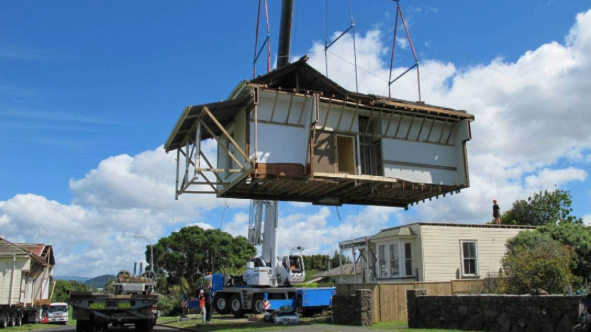
What comes to mind when you think of moving house? Leaving with your luggage? Taking your furniture with you? In New Zealand, one kind of ‘moving house’ means picking up the house itself and taking it along.
YouTube videos of New Zealanders moving houses often attract thousands upon thousands of views, with comments from viewers around the world. In New Zealand, however, there is nothing unusual about dividing a timber house into several large sections, or even leaving it intact, loading it onto a large trailer and moving it across the road, to the other side of town or even hundreds of kilometres away. The practice has given rise to a long-established industry: house relocation.
Recently, New Zealand’s booming property market has also made the house relocation industry exceptionally busy.
Selling and moving out
Changes to land-use planning and the resulting redevelopment of housing are prompting many homeowners and developers to sell and relocate houses. Kumeu-based house relocation specialist Craig Walker says Auckland’s housing construction plans encourage higher-density housing in some areas, prompting developers and homeowners to remove existing houses from larger sections to make way for townhouses and other medium- to high-density homes. ‘This has created huge profits and a market for property development.’ It has also increased business for the house demolition and relocation industry by 30% to 40%.
Buying and settling in
In the house removal market, Walker focuses on well-built older houses with architectural character and authentic features, as well as compact homes that appeal to suburban residents. His ultimate aim after buying and relocating them is to resell them. He currently has around 60 houses for sale across his three house yards.
So what motivates buyers of these older houses? Walker identifies three reasons:
- Value for money
These unused older homes are usually relatively affordable and reasonably priced, as the main costs generally lie in removing and relocating them. Walker estimates that buying such a house and moving it to the buyer’s chosen section could cost only half to two-thirds as much as a new build.
- A faster process
Buying an older house to establish a new home is also relatively quick compared with building from scratch. ‘From choosing a suitable house at the yard to obtaining council approval and transporting it to the designated section, the whole process usually takes only three to four months,’ he says.
- Personal preference
‘Among buyers of these houses, 90% are motivated by price, while the other 10% are driven by personal taste and character. Some simply say they want a 1920s bungalow or a villa from the turn of the last century,’ Walker explains.
{ad}
A home to enjoy and sell
Six years ago, graphic designer Hamish Douglas and his wife, art history teacher Danya Hewetson, used Walker’s company to move an early twentieth-century, two-storey villa from Ellerslie to Ambury Road in Mangere Bridge. For the move, the old house was divided into four sections and craned onto trucks.
The couple sold their original Mangere Bridge home to Walker’s house relocation company, offsetting some of the relocation costs. Moving the old house and installing it on site ultimately cost NZ$200,000, after which they spent another NZ$200,000 renovating it.
Douglas and Hewetson say: ‘Relocating an older house costs much less than building a new one. Of course, you still need funds for insulation, rewiring unless the existing wiring is new, and drainage work, among other things. But it is also a form of recycling, which is very good for the environment. It is usually difficult to build a two-storey house of 220 square metres for less than NZ$500,000, especially with natural timber floors and generously high ceilings.’
The relocated home now stands on approximately 600 square metres at 22 Ambury Road, overlooking Ambury Farm and Manukau Harbour. It sits alongside other older villas in the area, including Waterlea, the former home of former prime minister David Lange. The house has four bedrooms and a study, beautiful timber floors and ground-floor ceilings reaching 3.5 metres. The property is now being prepared for auction and has a current capital value of NZ$1,390,000.
Heritage preservation
Wairarapa-based heritage architect Chessa Stevens and builder Rob Tilbrook have a different reason for buying and relocating older houses. They have already carried out two house relocations themselves and are now planning a more ambitious project.
They have just expressed interest in buying the vicarage of St Matthew’s Church in Masterton.
Under the relevant rules, the two-storey heritage building must remain in Wairarapa because it is one of the region’s few surviving 19th-century buildings. It has undergone two rounds of alterations and renovation, in the 1930s and again in recent years.
‘This house needs a fairly spacious setting. We are looking for a suitable location,’ Stevens says. She believes it is important to relocate a house of this size carefully to the chosen site. For a heritage building, retaining a street frontage is also ideal.
The Greytown couple are not doing this because it is cheaper than buying or building a new home.
‘The reason is that I am an architect specialising in the conservation of historic buildings,’ Stevens says.
She adds that restoring the building with matching materials will be very expensive. But ‘finding a way to use authentic timber and building materials will give it another 100 years of life’.
Buying an older house looks like an interesting and potentially profitable option. So how should people new to the idea of house relocation get started? Stevens also offers her advice: visiting a relocation company’s house yard to choose a home is a good starting point, as many house relocation companies have extensive experience, can offer valuable guidance and suggestions, and can help with essential approvals。