Buying a home getting more expensive? Salaried workers could buy land and build their dream home!
The recent frenzy at auctions is well known, and auction sale prices have put many people off. For first-home buyers, soaring prices are making home ownership increasingly difficult. But buying land and building a home can also be a good option.

Today, we invite an expert to discuss buying land and building a home as a salaried worker.
New Zealand’s booming property market has reportedly spawned a popular new phrase: ‘everyone’s building’. And ‘everyone’ naturally extends beyond developers and investors. Yes, as an ordinary salaried office worker, you too could consider buying a small section and building your own home. The cost is often lower than buying an existing house. With good design, a home you build can also better meet your needs and aspirations, while avoiding many of the age-related shortcomings of older houses. With so many benefits, why not?
In fact, many people have considered it, but a limited budget or unfamiliarity with the process means the idea never goes any further.
What you may not know is that loans are available for more than buying a home. You can also apply for a construction loan to buy land and build, or to extend an existing house. And salaried workers are among those most likely to secure a loan!
Compared with small developers whose income is unstable, or people earning commission-based income, salaried workers have an advantage when applying to banks because their income is steady over the long term. Here is how salaried workers can apply for a construction loan.
What documents do you need?
- Evidence of the applicant’s stable, long-term income
- Details of liabilities, including any other loans
- Resource consent
- Building consent
- Valuation report
- Fixed-price construction contract
What if you have no building experience?
That is fine: simply find an experienced building contractor and provide a comprehensive fixed-price contract. After all, you cannot realistically build an entire house yourself as a DIY project, can you?
Case study:
Mr Wang works as a marketing manager at a large company, earning an annual salary of $80,000 and an annual performance bonus of $10,000–20,000. He plans to borrow to buy a serviced section of 340 square metres, priced at $400,000, and build a home there to live in.
- Based on the client’s income, financial position and the bank’s requirements, we first collected and prepared the necessary documents, then promptly submitted an application. We successfully secured a land loan of $320,000 at a loan-to-value ratio of 80%.
- Once the client had prepared the comprehensive fixed-price contract, showing construction costs of $450,000, we successfully secured a loan of $360,000 at a ratio of 80%, drawn down in stages as detailed in the diagram below. The construction period was one year.
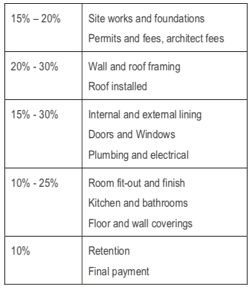
A little explanation is needed here, as construction loan calculations are relatively complex:
Case study calculations:
The bank sets the LVR, or loan-to-value ratio, according to the project’s valuation on completion.
LVR = loan required / (land value + construction cost)
For example: land purchase price $400,000 + construction cost $450,000 = total property cost $850,000 (the valuation should equal or exceed the total property cost).
- Assuming the applicant borrows from the bank for both the land and construction: the bank’s LVR = 80%, and $850,000 × 80% = $680,000. That is: The total loan is$680,000
- Of this, the initial land loan amount (80% of the land value) is: $400,000 × 80% =$320,000(meaning a deposit of $80,000)
- The available construction loan (covering 80% of the costs shown in the comprehensive fixed-price contract) therefore amounts to: $680,000 − $320,000 =$360,000
Finally, let us look at some distinctive features of construction loans. With building a home becoming so popular, these practical insights are essential for aspiring homeowners!
Construction loans are paid out very differently from home loans:
Home loans involve a lump-sum payment (single drawdown), meaning the lender, such as a bank, transfers the entire loan amount to the applicant’s solicitor’s account in preparation for settlement.
Construction loans involve payments in stages (progressive drawdown)。Funds are released step by step according to the building programme, with invoices and photographs of progress on site required as evidence at each stage.
For the bank’s final payment (the last 10%), what documents are required?
- Code Compliance Certificate (CCC);
- A valuer’s report confirming completion of the property;
- Conversion of construction insurance to home insurance.
Although construction loans are much more complex than home loans, help from a professional team can make the process far more effective. Do not let rising house prices delay your dream of home ownership. Consult Huarong Finance and let its professional team help finance your way home.
About the expert
York Zhang (Zhang Yong)
Chairman of Huarong Finance

In 2006, York Zhang (Zhang Yong) founded Huarong Finance to provide the Chinese community with loans for homes, construction, businesses, land development, vehicles and heavy equipment.
Combining his expertise as a mortgage broker with his personal experience of living in New Zealand, York Zhang hopes to use Huarong Finance to bring more products tailored to the Chinese community’s circumstances and needs to market, develop more outstanding mortgage brokers, and release more funds from Chinese clients’ assets for reinvestment.