
NZCBIA news
Massey University and NZCBIA explore university–industry collaboration in construction Businesses are eager for talent, universities need to develop graduates who meet industry needs, and re

Massey University and NZCBIA explore university–industry collaboration in construction
Businesses are eager for talent, universities need to develop graduates who meet industry needs, and research needs to demonstrate its value in practice. How can higher education build close ties with businesses in relevant fields and collaborate for mutual benefit?
On 12 November, Massey University and the New Zealand Chinese Building Industry Association (NZCBIA) took the first step in exploring this together.
The discussion on university–industry collaboration was led by Massey University's School of Built Environment. Participants included representatives of NZCBIA and nearly ten of its member businesses in construction and related industries.
In a round-table discussion, the two sides explored numerous potential areas of collaboration between the association and Massey University, including employers' talent needs, graduate quality, interview skills training and scholarship support.
The meeting was co-chaired by Dr Gregory Chawynski, the school's senior lecturer in construction management, and NZCBIA President Frank Xu.
{ad}
Agreement on advancing construction research
Massey University's Dr Gregory Chawynski, the school's International Director Associate Professor Naseem Ameer Ali, and Associate Research Director Associate Professor Kenneth Tak Wing Yiu each spoke, introducing the School of Built Environment's programmes and research areas.
Massey University's School of Built Environment holds a leading position among New Zealand universities for its expertise in construction and lighting. Its teaching focuses on quantity surveying and construction management, while its research focuses on smart construction, project management and environmental sustainability.
Digital technologies such as computer-aided design (CAD) and computer modelling for buildings (BIM and AR) are widely used in the school's teaching and research. The school offers bachelor's and master's degrees in construction. Of particular note, its Master of Construction (Construction Law) is New Zealand's only degree focused on construction law. Students study both construction and law, gaining specialist knowledge of construction law, construction contracts, construction contract administration and alternative dispute resolution, including statutory adjudication.
The academics said research and innovation were vital to the construction industry's development, and the school hoped to work more closely and extensively on research with the industry leaders present.
Associate Professor Kenneth Tak Wing Yiu outlined his two current research areas. One is health and safety in construction, with a particular focus on helping newly arrived migrant construction workers adapt to New Zealand's construction environment and understand safety rules on local sites. The other concerns employee supervision, an international issue on which he hopes to make progress in New Zealand.
These teaching and research areas align with the priorities NZCBIA has actively promoted in the industry for many years. During the discussion, both Frank Xu and Frederick Chua, General Manager of Livefirm Construction (N.I.) Ltd, expressed hope for closer collaboration and engagement with the school's experts on research challenges arising in industry practice, to jointly advance construction technology in New Zealand. Speaking on behalf of NZCBIA, Frank Xu also offered to help facilitate the School of Built Environment's research projects, share promising research ideas and exchange resources for mutual benefit.
Educators and employers join forces to develop professional talent
Another issue of concern to the school's academics also drew a positive response from the business representatives present.
As one of New Zealand's most popular universities among international students, Massey University has consistently worked to provide overseas students with a safe, friendly, international and high-quality learning environment.
About 40% of the School of Built Environment's students come from China. Dr Gregory Chawynski said the university took the gap between graduates' capabilities and industry needs very seriously.
NZCBIA's professional standing and public reputation in New Zealand's construction industry are unrivalled. The school places great value on this powerful platform for bringing resources together and hopes to establish a stable, long-term, two-way exchange with the association. In particular, it hopes the association can provide internship opportunities for graduates.
Stephanie Mazey, Marketing Director of association member Kohler New Zealand, and Jeff Ren, Commercial Project Manager at Renoart Bathroom, both said their businesses would work with the association to offer scholarships to Massey University, encouraging and developing more outstanding students. The details were still being discussed.
Frank Xu and several business leaders at the meeting spoke highly of Massey graduates and offered thoughtful suggestions on the remaining gap between employers' needs and university graduates' capabilities.
Participants agreed that Massey graduates were hardworking and independent, with strong learning and adaptation skills and excellent work performance. Chinese international students, in particular, would have a distinctive advantage in the industry through their command of both Chinese and English.
Frank Xu recommended that the university prioritise project planning skills training for construction students, as many current problems in New Zealand's construction industry stem from a lack of these skills.
Several business leaders, including Jason Zhi, Project Director of China Construction New Zealand Ltd, and Frederick Chua, General Manager of Livefirm, said at the meeting that they would warmly welcome Massey graduates.
Dylan Huang, founder of Archiland Architecture, emphasised the importance of contracts and regulations in construction and strongly endorsed the school's provision of New Zealand's only master's degree specialising in construction law.
Roy Zhao, head of Royal Building Glass, directly expressed his company's urgent need for graduates with some experience.
Other association members at the meeting also drew on their expertise to suggest ways to help School of Built Environment graduates find work. Recruitment and human resources consultant Sarah Tong shared her extensive experience on how graduates could find jobs and handle interviews. Yuan Pei, head of BIET GROUP, whose core business is education and vocational skills training, said the company could provide specialist construction industry training for students after graduation and before they started work.
Successful New Zealand satellite event for the Shenzhen International Fully Fitted Housing Exhibition
Jointly organised by the New Zealand Chinese Building Industry Association (NZCBIA), YIJU New Zealand and 3A Events, with Germany's BRAVAT as naming sponsor, the New Zealand satellite event for the Shenzhen International Fully Fitted Housing Exhibition was successfully held in Auckland on 31 October. It was also the first major gathering of New Zealand's Chinese industry community since the pandemic began. The event aimed to build a bridge between New Zealand's Chinese construction industry and the world, giving professionals across different fields an opportunity to explore how the latest global home design trends could be applied to the New Zealand market and creating more opportunities for collaboration and exchange.
Nearly 200 professionals from New Zealand's property, construction and related industries gathered that day to learn from one another, exchange knowledge and resources, and discuss topics of shared interest. These included applying the latest international construction technologies in New Zealand, prospects for the local prefabricated construction market, and early-stage considerations for subdivision projects. The attendance of numerous prominent guests further affirmed the indispensable role of Chinese developers and construction companies in New Zealand's construction sector and in addressing the local housing crisis.
Prominent guests share their hopes for the Chinese construction industry
Sarah Tong hosted the New Zealand satellite event, with NZCBIA President Frank Xu delivering the opening welcome.
Former New Zealand Minister for Housing and Building and Construction, Hon. Jenny. Salesa, National MP Melissa Lee, National MP and former Air New Zealand CEO Christopher Luxon, former MP and former chair of Parliament's Justice Committee Raymond Huo, National Party list candidate Nancy Lu, Employers and Manufacturers Association Chief Executive Brett O'Riley, New Zealand China Trade Association Deputy Chair and former New Zealand Trade Commissioner in Guangzhou John Cochrane, and New Zealand Guangdong Business Association Executive Vice-President Alex Zhang were among the many prominent guests who attended and spoke at the satellite event.
The guests strongly affirmed the indispensable role of Chinese developers and construction companies in New Zealand's construction industry and their significant contribution to addressing the country's housing crisis. They hoped the Chinese construction industry, which had seized opportunities and worked to grow amid the pandemic crisis in 2020, would achieve even greater success in future.
Shenzhen–Auckland connection and on-site interaction. From the rapid construction of Leishenshan and Huoshenshan hospitals on Wuhan's outskirts at the start of the year to a New Zealand company's assembly, two months ago, of three China-prefabricated townhouses in a single day, the enormous potential of prefabricated construction is gaining increasing recognition and attention within the industry.
The biggest highlight of this year's Shenzhen International Fully Fitted Housing Exhibition was the “Challenge the Impossible” project, led and personally designed by Japanese housing expert Sadao Tsuchiya. Bringing together several renowned Chinese and international companies and hundreds of industry workers, it set out to build a liveable home on vacant land within 24 hours. Ultimately, a fully fitted, prefabricated steel-framed home ready for immediate occupation was unveiled to the public 5 hours and 45 minutes ahead of schedule.
Although Auckland's second lockdown had delayed the New Zealand satellite event, preventing direct interaction with Shenzhen, attendees watched a vivid replay of the “Challenge the Impossible” project. It transported them across time and distance back to those tense, exciting 18 hours to witness the remarkable achievement.
Many prominent Chinese construction professionals based in New Zealand shared their views at the event on introducing and applying integrated prefabricated construction locally. They discussed adapting it to New Zealand's construction environment, ensuring quality and compliance with New Zealand standards, reducing costs through integrated construction in China, and local market prospects. There was near-unanimous agreement that prefabricated construction would secure a place in New Zealand's future housing market.
Attendees also heard keynote presentations from leading industry figures in China, including Guan Yongkang, chief curator of the Shenzhen International Fully Fitted Housing Exhibition and head of the Shenzhen Furniture Association's Fully Fitted Housing Research Institute; Zhou Yanmin, a professor at Tsinghua University's School of Architecture; and Zhang Feng, chief engineer of Shenzhen Jinxin Green Building Co., Ltd. Topics included: the guests strongly affirmed the indispensable role of Chinese developers and construction companies in New Zealand's construction industry and their significant contribution to addressing the country's housing crisis. They hoped the Chinese construction industry, which had seized opportunities and worked to grow amid the pandemic crisis in 2020, would achieve even greater success in future.
• “Integrated design as the starting point”: an approach to industrialising fully fitted housing grounded in industrial design;
• Rethinking residential design during the pandemic;
• Building the main structure of a two-storey steel-framed home in 6 hours — an introduction to, and application of, a prefabricated steel-frame and lightweight-panel building system.
NZCBIA member wins three architecture awards
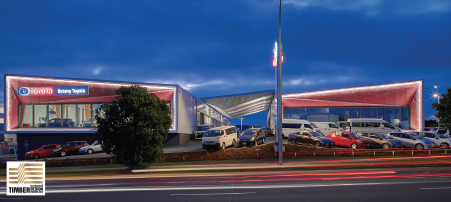
NZCBIA member practice WMZA (Woodhams Meikle Zhan Architects) has won three architecture awards for its outstanding, innovative design of Botany Toyota: the New Zealand Institute of Architects' 2020 commercial architecture design award (NZIA . 2020. Auckland. Architecture Award in the Commercial Category), the NZ Wood commercial design award (NZ Wood Resene Timber Design Awards2020 Commercial Design Award) and the Engineered Wood Products Innovation Award.
Botany Toyota is located on Te Irirangi Drive in East Auckland. Its “highly advanced facilities seamlessly integrate a vehicle servicing workshop with a high-end showroom conveying Toyota's brand culture”.
In WMZA's design, the showroom and workshop occupy two separate “display. boxes”, with clear signage and entrances. Customers can move between the two buildings and easily enter either, while an entrance canopy suspended above creates a visual connection between them.
The showroom design boldly departs from convention. In traditional car showroom design, vehicle servicing areas are treated as ancillary spaces. At Botany Toyota, WMZA's innovative design showcases both Toyota's latest vehicles and its servicing offering. This effectively embodies Toyota's customer-first brand ethos and greatly enhances the interaction between people and technology in vehicle servicing.
The V-shaped timber doors and the design echoing a car roof also give stronger expression to Toyota's brand and allude to the company's heritage.