
Bernard's Property Picks | School zones, location and total price! The logic of buying in central Auckland's luxury suburbs
In late autumn, YIJU's long-planned property viewing column finally makes its debut. For our many readers, this is a fresh venture alongside our in-depth reporting. We hope this platform will bring you some different perspectives.

Bernard's Property Picks is a property viewing and investment column we have developed with care this year, aiming to help everyone interested in property investment as well as first-home buyers. We are honoured to welcome Bernard Leung to our team to create this column together. A well-known, experienced investor in New Zealand's property sector, Bernard has more than twenty years of property investment experience, has viewed countless properties and brings his own distinctive insights into locations, homes and the industry. We hope his wealth of experience will offer some help along your path to buying property in New Zealand.
Join us at YIJU every Friday for Bernard's Property Picks!

Who is Bernard?
In 2002, Bernard Leung bought his first New Zealand property at the age of 20. He has since been active in the property market for 19 years and is a well-known property investment expert and experienced residential and commercial property manager.
Bernard believes success and good fortune come to those who persistently seek opportunities. For 20 years, he has personally attended open homes every week, viewing countless properties.
YIJU has teamed up with Bernard to launch Bernard's Property Picks, sharing worthwhile investment properties as they become available. Alongside case studies, we will share with YIJU readers the golden rules for choosing property that Bernard has distilled from years of practical experience. We believe this column can help you become a winning property investor too!
{ad}
In New Zealand, a property worth NZ$3,000,000–4,000,000 already falls within the traditional luxury-home price range. But the luxury homes sought after by wealthy Aucklanders are defined by more than their value. The suburb, location and access to top school zones also matter. Central Auckland is precisely where these scarce advantages come together.
Central Auckland has a concentration of wealthy residents. We have also observed that homes in Auckland's top school zones can cost around a million dollars more than those in surrounding areas. One dataset shows central Auckland has the country's highest school-zone property premiums, with the premium around Epsom reaching 97%, the highest in New Zealand.
This area not only occupies a central location in Auckland's CBD, but also enjoys access to some of New Zealand's finest schools. These include the nationally renowned state school Auckland Grammar School and leading private schools St Cuthbert's College, King's School and Diocesan School.
Research has found that, in Auckland, each 1-point increase in an area's average school rating, on a scale with a maximum of 10, adds approximately NZ$22,500 to house prices. School ratings directly affect surrounding property prices.
Why are central Auckland house prices so high?
Education is the property market's real drawcard
Whether in the United States, Britain or China, successful people worldwide, from aristocrats to the elite, pursue private schooling with an intensity that rivals people's obsession with money. Top private schools are both symbols of wealth and sought-after social circles.
Whatever their cultural background, many parents hold a particular belief about education: “Giving children the chance to befriend prominent people from all walks of life, or become their fellow alumni, is the best gift and a perfect start.” Private schools and prestigious schools have become places the elite and aristocracy compete to enter.
Former Real Estate Institute chief executive Bindi Norwell said: “House prices in some popular New Zealand school zones are currently rising faster than prices across their cities as a whole.”
A nationwide New Zealand poll in 2018 asked participants whether they would leave their current area to move into a particular school zone. Of more than 1100 respondents, 45.4% said they would, while nearly 11% said they had already done so, demonstrating how highly New Zealanders value school-zone properties.
How much scope is there for school-zone properties to gain value?
Taking Auckland's Epsom as an example, a home in a top school zone typically costs NZ$2,000,000–3,000,000, while average prices in surrounding areas are roughly NZ$1,000,000–1,500,000. According to local mainstream media reports, an Epsom school-zone property could gain NZ$500,000 in value over two years, with some homes potentially gaining even more.
In 2021, Auckland's average house price was around NZ$1,200,000. A gain of NZ$500,000 over two years would mean a home priced at the average of NZ$1,200,000 had appreciated by 42% within that period. Such remarkable growth is achievable only in top school zones such as Epsom.
Are homes in New Zealand's top school zones astronomically expensive?
Detached school-zone houses in the Epson area currently average around NZ$2,000,000, while apartments there can still be bought for under NZ$2,000,000. According to ecoprofile.infometrics.co.nz
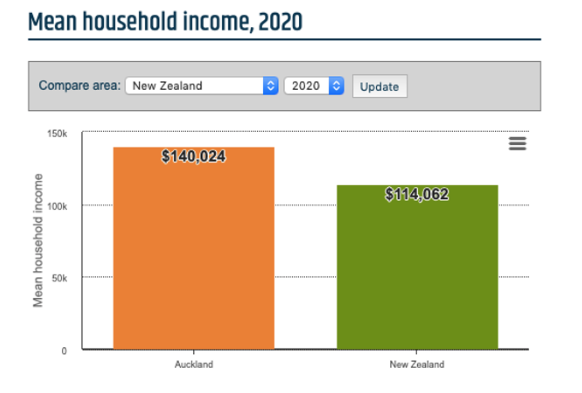
statistics, Auckland's average annual household income is around NZ$140,000. Relative to local incomes, this is not an astronomical gap.
Compared with some school-zone homes in Beijing and Shanghai whose prices have been driven up to RMB 300,000 per square metre, New Zealand's elite face far less pressure over education than their counterparts in China.
A prime location backed by prestigious schools
Exploring Greenlane and the scarcity of its location
A scarce location necessarily means occupying a city's core and enjoying access to its key resources—advantages that cannot be replicated.
Auckland's prestigious schools are concentrated almost entirely in the central suburbs, particularly around Mt Eden and Epsom. These include some of New Zealand's best-known private schools—St Cuthbert's College, ACG Parnell, King's School and Ficino School—as well as state schools Auckland Grammar School and Epsom Girls Grammar School. Central Auckland has some of the finest educational resources in the country.
Google Maps shows Greenlane's excellent location. It neighbours Epsom, is just a few minutes' drive from the city centre and offers immediate access to State Highway One for travel north and south. Most importantly, like Epsom, it is in the Double Grammar Zone, as well as the zones for Cornwall Park District School and Remuera Intermediate School.
With an excellent location and top schools behind it, an area offering scarce advantages like Greenlane can hardly fail to be popular!
Today's Bernard's Property Picks recommendation is the property at 16 Mapau Road, Greenlane, within the Double Grammar Zone. It occupies a flat, regular-shaped site of 784 square metres. Properties like this are sought after by investors and owner-occupiers alike, while developers have excellent scope for townhouse or apartment development.
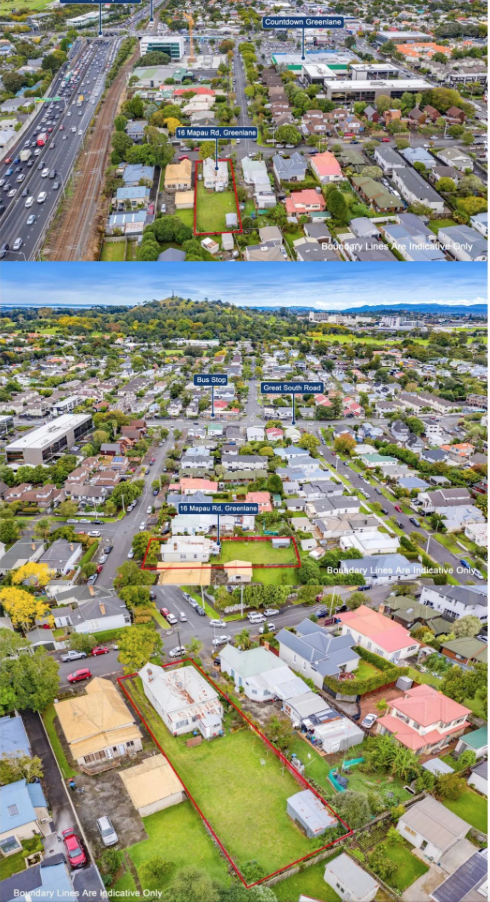
- Development features: Flat, regular-shaped and easy to subdivide
- Transport convenience:
Within walking distance of Greenlane train station、Several nearby bus routes and stops, close to Cornwall Park, with immediate access to State Highway 1、Only a few minutes' drive to Newmarket and the CBD.
- Amenities: Local shops, cafés and a Countdown supermarket
4. Top school zones:
The property enjoys outstanding educational resources within Auckland's renowned Double Grammar Zone for Auckland Grammar School and Epsom Girls Grammar School, as well as the zones for Cornwall Park District School and Remuera Intermediate School. It is a top school-zone property in every sense.
4. Capital value
Price range: NZ$2,800,000–3,500,000
- Development zoning: A mixed residential area of detached houses, townhouses and apartments, suitable for medium- and high-density housing development.
- Property summary:
The property is in an area designated for intensive development, allowing a mix of houses, townhouses and apartments. Planning provisions allow apartment buildings of 5–7 storeys. It is also one of Auckland's four residential zones encouraging townhouses and apartments.
The area also has some restrictions. Sites must meet size requirements for different types of development, and the council currently imposes density limits here. Beyond these restrictions, the zoning is very flexible and offers considerable development potential.
In this edition of Bernard's Property Picks—A closer look at property subdivision and planning: 7 essential tips
Whether you are an owner-occupier, investor or developer, thorough preparation is essential before subdividing or developing. Understanding every important stage, from finances to the overall development process and government zoning, will help you save costs and avoid pitfalls. Here are Bernard's 7 development planning tips:
1. Before planning or developing, check the area's zoning maps on the council website to understand the applicable development rules, especially those for mixed housing and townhouse and apartment areas.
2. Follow up your online research with a call to the council. Most council service centres offer free advice, and the duty planner can provide more information about what you can and cannot do and what requires council approval. A phone call can clarify the details you need.
3. The appropriate type of development depends on your location and whether the land is rural or urban. If you have an urban site, development and subdivision may be more attractive.
4. A pre-application meeting with the council is strongly recommended. The Auckland Unitary Plan contains many nuances that can be tricky and sometimes costly. Engaging council staff early can help reduce costs, and consider having a consultant with extensive development experience attend the meeting.
5. Talk to your neighbours and hear their views. Maintaining good relationships with them can also help the development process run smoothly.
6. Do your own research into the types of homes nearby and local sales activity, particularly in your immediate area. Observation and research can help you decide whether to build a 4-bedroom house or a standard 2-bedroom townhouse.
7. Understand your costs. Be very clear from the outset about the total cost of subdivision and development. Many people initially think only of resource consent costs, but these are just a small part. Other costs to consider include utilities, transport permits, surveying and LINZ costs, legal fees, building consent fees and accessway costs.
Note: If you prepare these 7 planning steps before development, the whole process will run much more smoothly!
That concludes this edition of Bernard's Property Picks. Each week, we will carefully select the properties most worth recommending, hoping to offer useful guidance for your property journey. We also welcome your feedback on the column and want to hear your needs so we can bring you more practical information.