Major news! Former immigration officer reveals a “special” announcement may be coming for applicants who have already submitted an EOI!
Immigration policy has recently become a hot topic, with even Immigration New Zealand seemingly unsure what to do. Today, we have invited Sonny, a former New Zealand immigration officer and now an immigration lawyer, to give an in-depth analysis of the deeper implications behind Immigration New Zealand’s announcement of a so-called “immigration reset”.
Sonny has years of hands-on experience with immigration cases as well as a thorough knowledge of immigration policy. In interpreting this “immigration reset” plan, his first view is that NZ will not close its doors to immigration. As for the widely anticipated resumption of EOI selections, he expects they may not reopen until after 2022/4/30 has passed.
{ad}
The following links present the Tourism Minister’s and Prime Minister Jacinda Ardern’s versions of
the “immigration reset” announcement:
1. 17 May 2021: Tourism Minister Stuart Nash announces an “immigration reset”
https://www.rnz.co.nz/news/political/442754/government-announces-reset-of-immigration-system
2. 18 May 2021: Prime Minister Jacinda Ardern attempts to clarify the “immigration reset”
https://www.rnz.co.nz/news/political/442787/pm-defends-immigration-reset-rejects-suggestion-kiwis-are-work-shy
You can also use the links above to study and analyse the implications for yourselves.
Below is former immigration officer and now senior immigration lawyer Sonny’s analysis of the current immigration situation:
1 Speculation about Immigration New Zealand’s “immigration plan” and what it may involve
“Clearing out “applications will not happen …
On 14 May, numerous media outlets circulated rumours speculating that Immigration New Zealand would “clear out” all unfinished visa applications. You may have noticed that I made no comment on this “rumour”. Based on my many years of familiarity with New Zealand immigration policy, such a move is almost impossible. However, the following points deserve your attention:
1. Reform of New Zealand’s immigration policy has been under way for a long time. As far back as 2016, we could see Immigration New Zealand continually changing immigration criteria. By now, further changes are nothing new to us.
2. From a professional perspective, this week’s “immigration reset” announcement has been criticised by major media outlets and industry professionals as unfocused and difficult to make sense of. In my view, it actually reflects Immigration New Zealand’s prolonged inability to reach a decision on the new Skilled Migrant Category.
This tells us that the policy team is afraid to make a decision in case it gets things wrong and affects New Zealand’s entire labour market and domestic economy.
3. Whatever changes are made to policy, I do not believe Immigration New Zealand will decide to close immigration categories permanently. Immigration patterns have changed in successive waves over different periods, dating back to 1989–1991, 1995–1998, 2001–2005 and 2010–2015. During those periods, changes to immigration policy reached historic peaks.
4. The new work visa policy changes released this month (see my previous article, published on 10 May 2021) make clear that INZ does not want to close work visa categories. It has simply changed some procedures in an attempt to make it harder for work visa holders to apply for residence.
2 The “immigration reset” plan explained
Looking at Tourism Minister Stuart Nash’s remarks on the “immigration reset” on 17 May, I have selected the key points for analysis as a reference for readers:
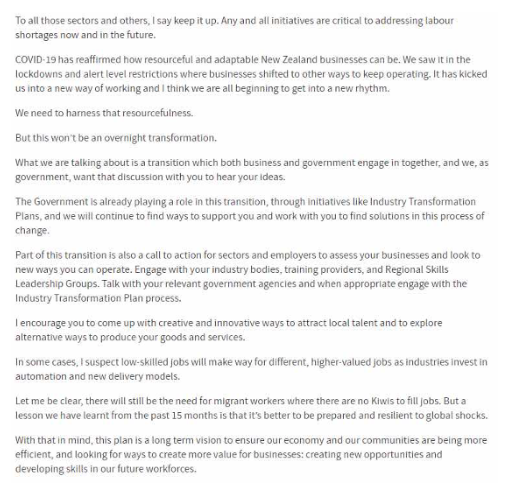
Lower-skilled jobs will be replaced by other, higher-value jobs …
Migrant workers remain important to this country because they are needed to fill many jobs that local New Zealanders are unwilling to do. However, the lessons Immigration New Zealand has learnt over the past year or so — during the pandemic — show that it needs to be well prepared for global crises to safeguard New Zealand’s economic and community development. It aims to address these issues by finding ways for businesses to create more value, such as creating new opportunities and developing skills in the future workforce. It is therefore trying to encourage high-value migration to bring greater change to the country.
The following important points can be found in sections of the earlier briefing for the incoming Minister of Immigration from November 2020:
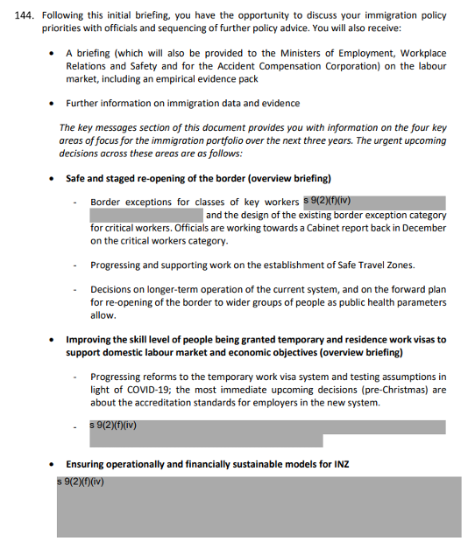
1. Raise the skill levels of people granted temporary and residence work visas to support the domestic economy and labour market;
2. Progress the temporary work visa system and its reform during COVID-19;
3. Make decisions soon, before Christmas, on employer accreditation standards under the new system.
We can see that these policies did not change between November 2020 and April 2021. The most likely explanation is that INZ has no clear idea of what it wants to do. It is worth noting that ANZSCO focuses on raising applicants’ skill levels. If your job is at ANZSCO’s highest level, Immigration New Zealand will always have places for applicants like you.
We can see this on the following website:
https://www.beehive.govt.nz/release/productivity-commission-inquiry-immigration-settings
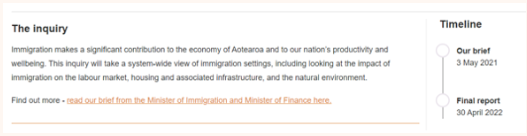
The report was actually due on 30 April, but the New Zealand Government has been slow to act. It delayed by 4 days and only sought public comment on 3 May 2021.
https://www.beehive.govt.nz/release/productivity-commission-inquiry-immigration-settings
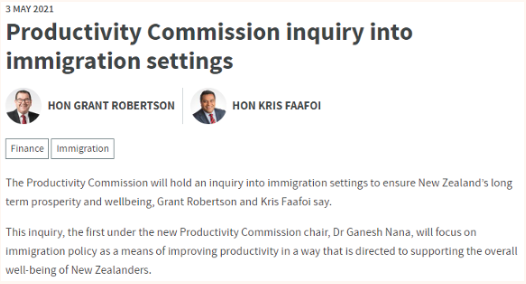
The report must be submitted no later than 30 April:
Immigration New Zealand is expected soon to give applicants who have submitted an EOI a “special” update …
NZ will continue to delay the decision to reopen EOI selections. My prediction, following this week’s new announcement, is that INZ wants to refine the system it has announced but does not know how to improve it. For now, it can only listen to expert advice.
Applicants who have already submitted an EOI should note that Immigration New Zealand is expected to provide a “special” update soon. Exactly what this entails will depend on its decision. As I have said before, please be patient.
Below is my advice for applicants at different stages, for reference only
1. For applicants who have already applied and are waiting:
Applicants currently in New Zealand need to wait patiently. If necessary, you can engage an experienced professional to help with your application and avoid pitfalls and difficulties along the way.
An experienced and capable immigration lawyer can help with your application and offer more informed professional insights. A good immigration lawyer or adviser can submit many applications to INZ, communicate with others in the industry and share more information. Like a good doctor or midwife, their aim is to help you through a long, stressful and difficult time.
A reminder: the reality everyone currently faces is that places are limited while applicant numbers are very high. New Zealand is governed by the rule of law. Immigration New Zealand will reject an application only if “problems” arise during the application process, and all procedures will be carried out within the law.
2. For those who will need to apply in future:
If you are not in a highly skilled occupation or one experiencing skill shortages, you need to improve your employability to meet the current application criteria, as INZ (Immigration New Zealand) will focus on highly skilled applicants in future.
If you are already in a highly skilled role, this is an opportunity to consider how to make your application plan “better”. Professional immigration lawyers have many ways to help you achieve this. For specific information, please contact the author, Sonny.
3. For applicants outside New Zealand:
This article discusses skilled migration. There are currently many other pathways to New Zealand residence, including business migration and family reunification. Both of these pathways remain open. If you need assistance, please contact an immigration lawyer for professional advice.
Conclusion
Immigration policy is constantly changing. The one consistent way to respond is to keep improving yourself. Both work skills and English proficiency are criteria every country considers when assessing migrants. New Zealand has now closed its low-skilled migration pathway, so migrants currently in lower-skilled roles need to keep working towards higher-skilled employment. For those who have already applied and are waiting, we believe Immigration New Zealand will ultimately provide a reasonable explanation.
About the author

Sonny Lam
has 10 years of litigation experience and previously worked as an immigration officer at Immigration New Zealand. He is currently an immigration lawyer at Forest Harrison Lawyers.
After leaving Immigration New Zealand in 2015, he began specialising in immigration , bringing a distinctive perspective on professional immigration matters and how to prepare application documents effectively , and offering sound professional advice from the perspectives of both applicants and the immigration officers assessing their cases.