Major news! New Zealand's housing shortfall reaches 130,000! The property market enters a golden age of ‘development for everyone’!
With New Zealand's housing market facing a supply shortage lasting several times 10 years, and housing affordability in Auckland deteriorating rapidly, the Government's solution is now clear: cracking down on investors and stepping up support for new home construction are powerful ways to tackle the current housing crisis.

Soaring house prices push New Zealand home ownership to its lowest level in 70 years
Figures show that Auckland's median house sale price reached a record NZ$1,120,000 in April this year, up 18% on the same period last year. Meanwhile, New Zealand's home ownership rate has fallen to 64.5%, its lowest level since 1951.
A 2020 study of home ownership in New Zealand by Stats NZ found that 64.5% of households owned their own homes at the 2018 Census. This was down from the peak of 73.8% in the 1990s, and the lowest level since 1951.
Notably, Auckland recorded the largest decline in home ownership. From the figure in 1991 of 72.7%, it fell by 2018 to 59.4%。
This is not confined to Auckland: home ownership rates in all New Zealand's major cities are currently below the national average. Falling home ownership means more New Zealand households are renting. Figures show that 31.9% of households currently live in rental homes, equivalent to nearly 1,400,000 people renting in the period ahead. These people will also form a large pool of future homebuyers.
{AD}
High house prices drive Auckland's construction boom
The most direct cause of Auckland's soaring house prices is a shortage of housing.
The latest Stats NZ figures show that Auckland's property market has experienced a construction boom over the past two years, with new home building in full swing. More than 17,000 new homes have been completed across the city. Hobsonville in the northwest alone accounted for 1795 new buildings, while Flat Bush in the southeast recorded around 1383 new homes, making it the area with the second-highest completion rate.
Stats NZ says more new homes were approved nationwide over the past year than ever before, including 17,495 in Auckland. In the 12 months to February this year, Auckland Council issued 12497 ACCs (certificates of compliance) for new buildings.
According to figures for 2019 published by New Zealand's Ministry of Business, Innovation and Employment (MBIE), in 2019 New Zealand's nationwide housing shortfall stood at 130,000 homes, with Auckland currently facing the most severe housing crisis.
Encouraging development——The Government invests $3,800,000,000 to rescue the market
New Zealand's next housing plan, published on the Labour Party's website (www.labour.org.nz), shows that the Government has introduced several housing market controls this year to address housing problems. These include extending the bright-line period, tax changes and committing $3,800,000,000 to New Zealand's Housing Acceleration Fund. Together, these measures encourage and support new home construction.
Councils are generally unable to fund essential infrastructure needed for new housing, such as water networks. To address this challenge, the New Zealand Government launched a NZ$3,800,000,000 Housing Acceleration Fund this year to increase the pace and scale of home construction. The funding is helping more homes to be built nationwide.
Giving new homes the “green light”——ASB announces an ultra-low interest rate
Last week, ASB led the way by announcing another mortgage rate cut to 1.79%, causing a stir across the industry. This latest ASB rate cut is primarily aimed at new homes.
ASB's executive general manager Craig Sims said the initiative would use funding obtained from the Reserve Bank for a ‘special’ purpose. By encouraging more new home construction, it aims to address New Zealand's longstanding housing supply problems and help build a more sustainable housing market.
In other words, both the Government and banks are encouraging more New Zealanders to participate in new home construction to address the current housing crisis.
New Zealand's housing shortfall reaches 130,000,
“development for everyone” enters its best period
The best period necessarily arises from ‘special’ market conditions and is linked to current market demand and policy priorities. New Zealand's housing shortfall has now reached 130,000 homes. With house prices high, nearly a third of the country's population (1,400,000 people) are choosing to rent. The housing crisis has become extremely serious.
To address this problem, the New Zealand Government has repeatedly extended an olive branch to new home construction. Examples include exempting new builds from the extension of the bright-line test to ten years, establishing a $3,800,000,000 Housing Acceleration Fund to encourage new home construction, cracking down on residential property investors to redirect their funds towards new housing, and working with banks on ‘special’ funding programmes offering ultra-low mortgage rates for new homes. With these significant advantages, the best opportunity to undertake your own development has arrived, whether you are a developer, investor or first-time owner-occupier.
In an era of subdivision for ‘everyone’:
How can you control costs?
How can you avoid mistakes during subdivision?
How can you correctly identify land with subdivision potential?
How can you manage site safety during construction?
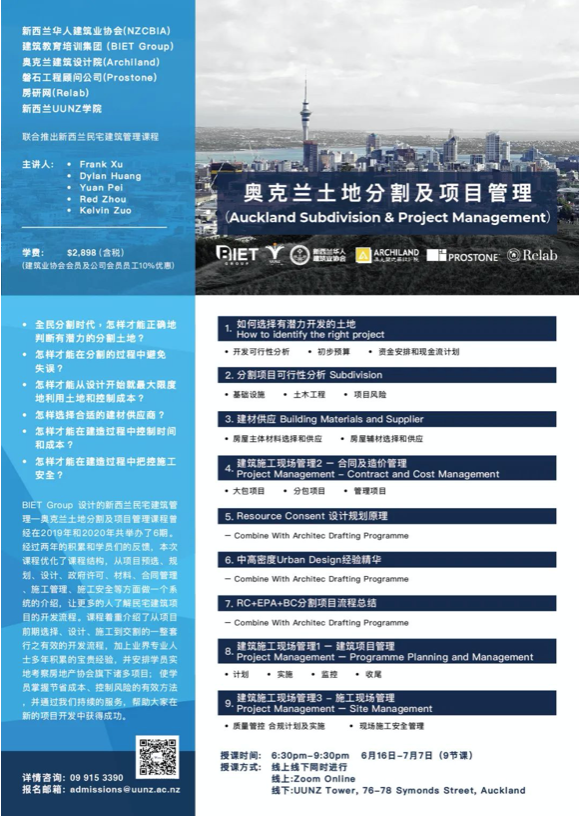
Jointly developed by well-known teams and experts from New Zealand's construction industry——
2021's first “Auckland Land Subdivision and Project Management” course is starting soon.
Course name: New Zealand Residential Construction Management - Auckland Land Subdivision and Project Management
Class schedule: 16 June–7 July (9 classes), 18:30–21:30
Delivery: Online and in person simultaneously
Online: Zoom Online
In-person venue: UUNZ Tower,76 – 78 Symonds ST, Auckland
Course fee: $2,898.00 (including tax)
This course was jointly designed by BIET Group, UUNZ Institute, the New Zealand Chinese Building Industry Association (NZCBIA), Relab, Auckland architectural practice Archiland, and engineering consultancy Prostone.
Course purpose
Launched in 2019, the course has now run 8 times. Drawing on two years of experience and participant feedback, this latest version introduces the fundamentals and key aspects of subdivision projects to construction industry newcomers, investors and anyone interested in residential construction. It provides a systematic introduction to project screening, planning, architectural design, building materials, contract management, construction management and site safety, helping more people understand the residential construction process. From initial project selection through planning, design, construction and settlement, a lawful, efficient and safe process is essential to achieving sensible cost savings, reducing risks and increasing returns.
Course highlight: taught by industry experts
Presenter 1: Frank Xu
Frank is deputy general manager and executive project manager at Shundi Group. He is also president of the New Zealand Chinese Building Industry Association, a senior development manager, project manager, and construction and property analyst.
He has 29 years of project management and property development experience, comprising 8 years as a design engineer and project manager in China, 13 years in project management and planning at New Zealand's largest construction company, Fletcher Construction, and 8 years managing property development projects. His projects include high-rise office buildings, medium- and high-rise apartment buildings, shopping centres, supermarkets and retail shops, large industrial developments and warehouses, and residential property developments.
Presenter 2: Dylan Huang
Lead lecturer Dylan Huang Haixin has accumulated extensive practical experience over more than ten years in architectural design in New Zealand. Starting at a design practice in the capital, Wellington, he went on to establish Auckland architectural practice Archiland in 2010 and has handled thousands of design projects. He is currently a chief examiner for Architectural Designers New Zealand, secretary-general of the New Zealand Chinese Building Industry Association, a New Zealand government-registered designer, a senior member of New Zealand's prefabricated building association, and a member of Unitec's architecture expert panel.
Presenter 3: Red Zhou
Red is a senior quantity surveyor who has worked at Hawkins Construction since 2005. He has participated in many major mixed-use commercial and residential developments in Auckland, including the Britomart development, Auckland International Airport's A380 terminal and Hobsonville Point PPP Schools, and has construction experience across numerous office complexes, hospitals and government public-service projects.
Presenter 3: PlaceMakers – Peiyuan Yuan Pei
PlaceMakers belongs to the Flecture Group and is New Zealand's largest building materials supplier. The group has 48 different building materials manufacturers and suppliers, and two building materials merchants, PlaceMaker and Mico Plumbing. Materials supply and demand are under pressure in 2021, and this is unlikely to change in the short term. How can project materials be organised sensibly in these circumstances? How can suppliers' market information be used early in the design process to coordinate efficiently with site management?
Partners:
Relab- Relab
Thank you to Relab for its support! During this course, all participants can try the following free of charge: Relab-Relab Pro (annual fee $347.00+GST) 。
CEO Knight will explain how to use a Relab trial effectively to analyse and select development projects with potential. We look forward to it.
UUNZ Institute of Business Institute
UUNZ Institute is New Zealand's only private tertiary institution offering foundation, diploma, bachelor's, postgraduate and master's qualifications. It also offers short certification courses, such as the internationally recognised British WSET Level One and Level Two wine-tasting courses. It has successfully run 30 wine-tasting courses, attended by more than 400 participants.
UUNZ is providing classrooms and teaching facilities for all participants in this course.
A major highlight is that these participants will receive a special discount when they later attend WSET wine-tasting courses.