
A global “population crisis”: China's fertility rate keeps falling, while South Korea's population could nearly halve
“Population and the economy, are interdependent concepts that constrain, permeate and influence each other.” A recent report in The Economist shows that fertility rates have fallen sharply in recent years in both China and developed economies worldwide. China's latest census figures indicate that its population growth has almost stalled.
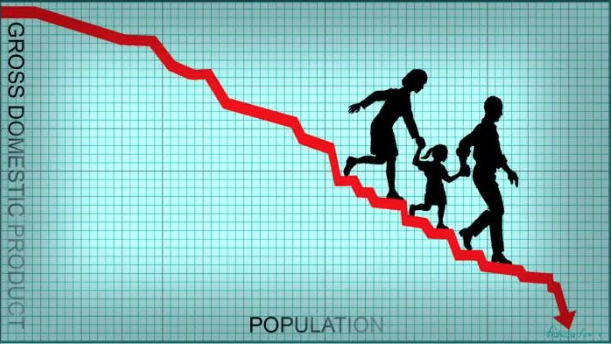
Fertility rates are falling across the world's developed economies, reaching their lowest level in 50 years
Statistics put China's fertility rate in 2020 at approximately 1.3 children per woman. That figure also means its population decline will begin earlier, in 2027. The data shows 17,230,000 births in 2017, 15,230,000 in 2018 and 14,650,000 in 2019… Over 3 years, births fell by 30,000,000. China's birth rate is falling sharply: this is now an indisputable fact.
{ad}
This is not confined to China: fertility rates are now falling substantially in every developed country.
The Economist's report noted: “The current fertility rate is 1.66 in Australia, 1.64 in the United States and 1.47 in Canada…Across all developed Western economies, fertility rates have been low since the 1970 s or 1980 s, and have remained at that level for the subsequent 50 years.”
The report noted that only poorer countries, concentrated in Africa and the Middle East, have fertility rates far higher than those of developed countries.
Research has found that fertility rates in some prosperous parts of India have consistently been lower than in poorer areas. Statistics put India's national fertility rate at 2.2 in 2018, but a National Family Health Survey found that Indian women wanted an average of 1.8 children.
Half a century of evidence shows that fertility rates among well-educated women in developed countries who can freely make reproductive choices are markedly lower than in poor countries. If this pattern spreads worldwide, the global population will eventually face a substantial decline.
Britain's Financial Times commented: “China's declining birth rate threatens economic growth.” Indian media commentary, meanwhile, approvingly noted that “India's population will soon overtake China's”.
Sociology holds that “population and the economy constrain each other, and population decline inevitably also means declining economic growth”.
The Financial Times, however, said: “Claims about the threat posed by a stable or declining population are often exaggerated, and in some circumstances are entirely wrong.”
Although a stable or steadily declining population is widely considered harmful to economic growth, it also offers many benefits for the environment.
When population growth stops, the number of retirees falls, and healthcare and public health spending rises as a share of GDP. However, this is also offset by reduced demand for infrastructure and housing investment. China currently invests 25% of GDP each year in roads, apartment buildings and other urban infrastructure. As the population declines, some of this will be worthless.
Prominent energy researcher Adair Turner said:
“As the population declines, reducing waste and investing more in healthcare and advanced technology can allow automation to offset the effects on productivity and sustain a thriving economy.”
“Likewise, stable and declining fertility rates will make it easier for the world to reduce greenhouse gas emissions to avoid climate change, while easing the growing pressure that population growth places on biodiversity and fragile ecosystems,” Adair Turner said.
Over the next 30 years, China's population aged 20–64 could decline by around 20%, but productivity growth will continue to support economic prosperity. India's population in this age group, meanwhile, is growing by approximately 1000 people a year, and its population growth will not stabilise until 2050.
Many expected China's fertility rate, then around 1.65, to rise after the one-child policy was abolished in 2015, but that did not happen. Among Asia's developed economies, fertility rates stand at 1.07 in Taiwan, 1.1 in Singapore, 1.38 in Japan and 1.09 in South Korea. It is worth noting that women in these economies have the right to make reproductive choices freely, yet fertility rates remain very low.
The Economist noted: “At this rate, population decline will be abrupt rather than gradual.”
The report said that if South Korea's birth rate does not rise, its population could fall from today's 5100 to 2700 by 2100. No level of automation could offset or replace the substantial reduction in retirees and workers.
If South Korea's population continues to “develop” in this way, the consequences will be unimaginable. Japan has already treated population decline as a new “national crisis”, demonstrating how crucial population is to a country's development.
In addition, some surveys show that many families in countries with low fertility rates would like to have more children. However, high house prices and inadequate access to social welfare prevent women from fulfilling their hopes of having children. In other words, policymakers have failed to make it as easy as possible for couples to have their desired number of children. If housing affordability could be addressed and social welfare could allow every family to have children without financial worries, I believe population decline might gradually ease.