
Auckland house prices rise 21.9% in June! Sales exceed May! Quality homes are hard to find as buyers pack open homes!
The arrival of winter and new government rules aimed at making property purchases less attractive to investors have dampened neither house prices nor Auckland home sales in June.
“Sales volumes usually begin to ease slightly in June, but this year we sold 1243 homes, up 3.8% on the previous month, with both the average and median sale prices higher than in May,” said Barfoot & Thompson managing director Peter Thompson.
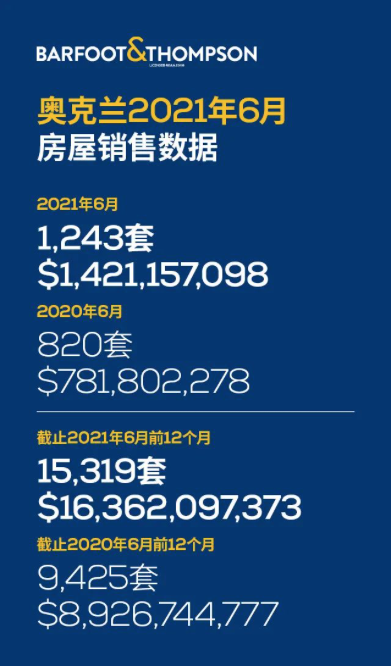
▲ Overview of Auckland home sales in June 2021
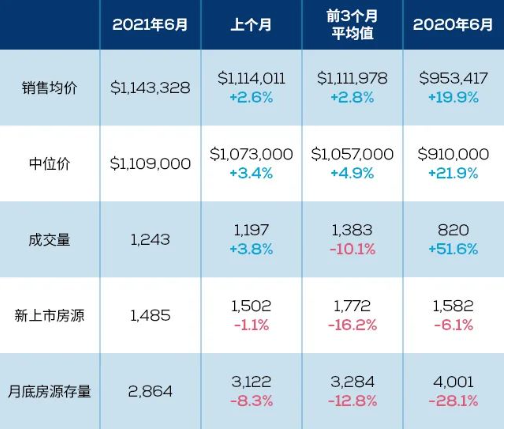
There were 1485 new listings in June, but total stock at month-end was just 2864 homes, the lowest level in 5 years.
Demand and competition for homes have never been more intense, with stock at month-end down by a quarter on the same time last year.
The average sale price was$1,143,000 NZ dollars, up 2.6% on May, while the median price was$1,109,000 NZ dollars, an increase of 3.4%.
House price growth did ease slightly in June, but prices remained high。
The median price in June was up year on year by 21.9%. According to the Real Estate Institute of New Zealand, Auckland’s house price index in May rose year on year by 26.3%。
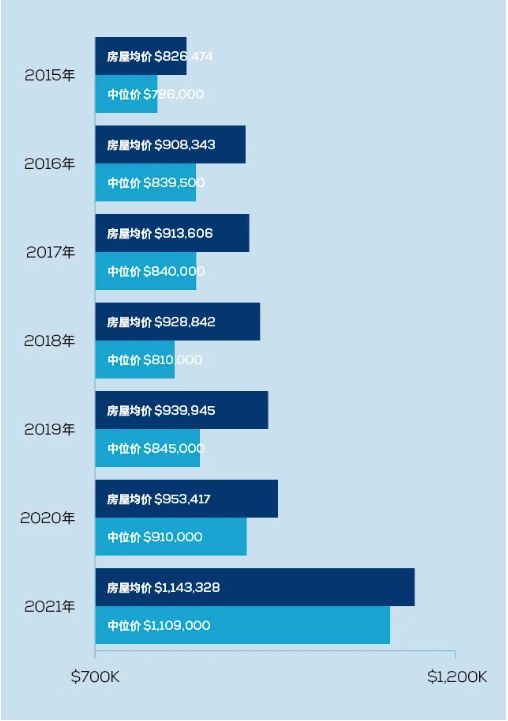
▲ Auckland house price trends for June, 2015–2021
Housing demand, low supply and record-low mortgage rates continue to strongly counteract the new government rules intended to curb the pace of house price growth.
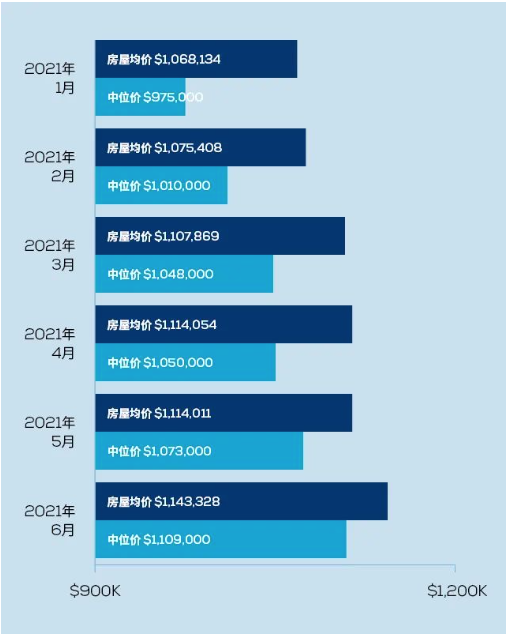
▲ Auckland house price trends over the past 6 months
Demand for higher-end homes continues to grow. In June, sales of homes priced at$2,000,000 NZ dollars or more reached 120 homes. The only month last year to exceed that sales figure was December.
Throughout last year, we sold an average of 61 homes a month priced above NZ$2,000,000.
In June, 170 homes sold for less than NZ$750,000, accounting for 13.8% of the month’s total sales.
The rural and lifestyle property market attracted strong buyer interest, with further sales growth constrained by a lack of new listings.
There are currently more buyers than sellers in the rural and lifestyle property market.
Of particular interest to buyers is bare land zoned for residential use or with potential for future rezoning。
Undeterred by rising prices, buyers remain active in the market
Even with house prices across New Zealand at or near record highs, buyers who can afford mortgage repayments and have secure employment remain enthusiastic about entering the property market.
Winter’s arrival and colder weather have done little to dampen buyers’ enthusiasm for weekend open homes. At one property in the sought-after Double Grammar Zone, at least twenty groups of buyers attended a weekend open home at the same time, illustrating the intensity of demand and competition.
Contrary to the widespread view that house prices are spiralling out of control, 2021 has actually seen the pace of house price growth slow.
According to the REINZ House Price Index, national house prices rose 4.3% over the three months from March to May, a marked slowdown compared with the 29.8% increase over the 12 months from June 2020 to May 2021.
The main drivers of this slowdown are natural market forces, reflecting buyers’ actual responses to house prices and their influence on the market.
The government intervened in March with new policies changing the bright-line test and interest deductibility rules, but these changes had little effect on house prices or sales volumes in April and May.
At the time, Treasury forecast that house price growth would fall to 0.9% over the following 12 months, with annual growth of just over 2% in subsequent years through to 2025.
Well-regarded economists were less optimistic than Treasury. They agreed that house price growth would slow, but not to the extent Treasury predicted.
At present, the economists’ view appears more accurate than Treasury’s, but everyone clearly agrees on one point: although house price growth will slow, house prices themselves will not fall。
Buyers waiting on the sidelines for house prices to “eventually fall” may be disappointed.
Looking back at Barfoot & Thompson’s data from 1961 to 2020, house prices fell only 6 times over those 60 years: in 1963, 1971, 1991, 1992, 1999 and 2009.
The largest house price fall was 8.5% in 1963, while the longest downturn lasted 3 years, from 2009 to 2011.
For homeowners unsure whether prices will rise or fall at a particular point, consider how long you have owned your property. If you have reached REINZ’s average home ownership period of 7 years, then your sale price will exceed your purchase price。
If you are still waiting for house prices to “halve”(for example, a fall of 10% or more), you may have to wait forever。
Two other factors also provide a buffer against a sharp fall in house prices.
First, although home construction has been at record levels in recent years and may remain so, data analysis shows that housing supply will take ten years to catch up with demand。
Second, judging by the 5-year interest rates offered by the major commercial banks, they believe that, before 2026, mortgage rates will not rise to 4.5%。
Buying a home is by no means risk-free, and there is no rule saying that something which has not happened in the past cannot happen in the future. However, for buyers with secure employment who can afford mortgage repayments at interest rates slightly above current levels, buying at today’s prices carries no greater risk than previous generations took when buying homes over past decades.
Barfoot & Thompson is the real estate agency that knows Auckland best.
In Auckland, 1/3 of home sales are through Barfoot & Thompson,
far ahead of every other real estate agency.