
Bloomberg releases its latest global pandemic resilience rankings! New Zealand plunges 26 places! Overnight, New Zealand becomes the world’s most tightly locked-down country!
On 26 August, Bloomberg released its August global pandemic resilience rankings. Low vaccination coverage, stringent lockdown restrictions and sharply reduced flights weighed on New Zealand’s economic resilience during the pandemic, leaving it in position 29, down 26 places from July.

Delta The virus strikes, sending New Zealand tumbling down the rankings
Since the pandemic began last year, New Zealand has earned a strong international reputation for its excellent response, spending a long period at the top of the rankings. A surprise Delta incursion in August triggered a community outbreak. New Zealand’s approach not only faced questioning from global media for the first time, but the country also plunged 26 places in these global pandemic resilience rankings, losing its crown.
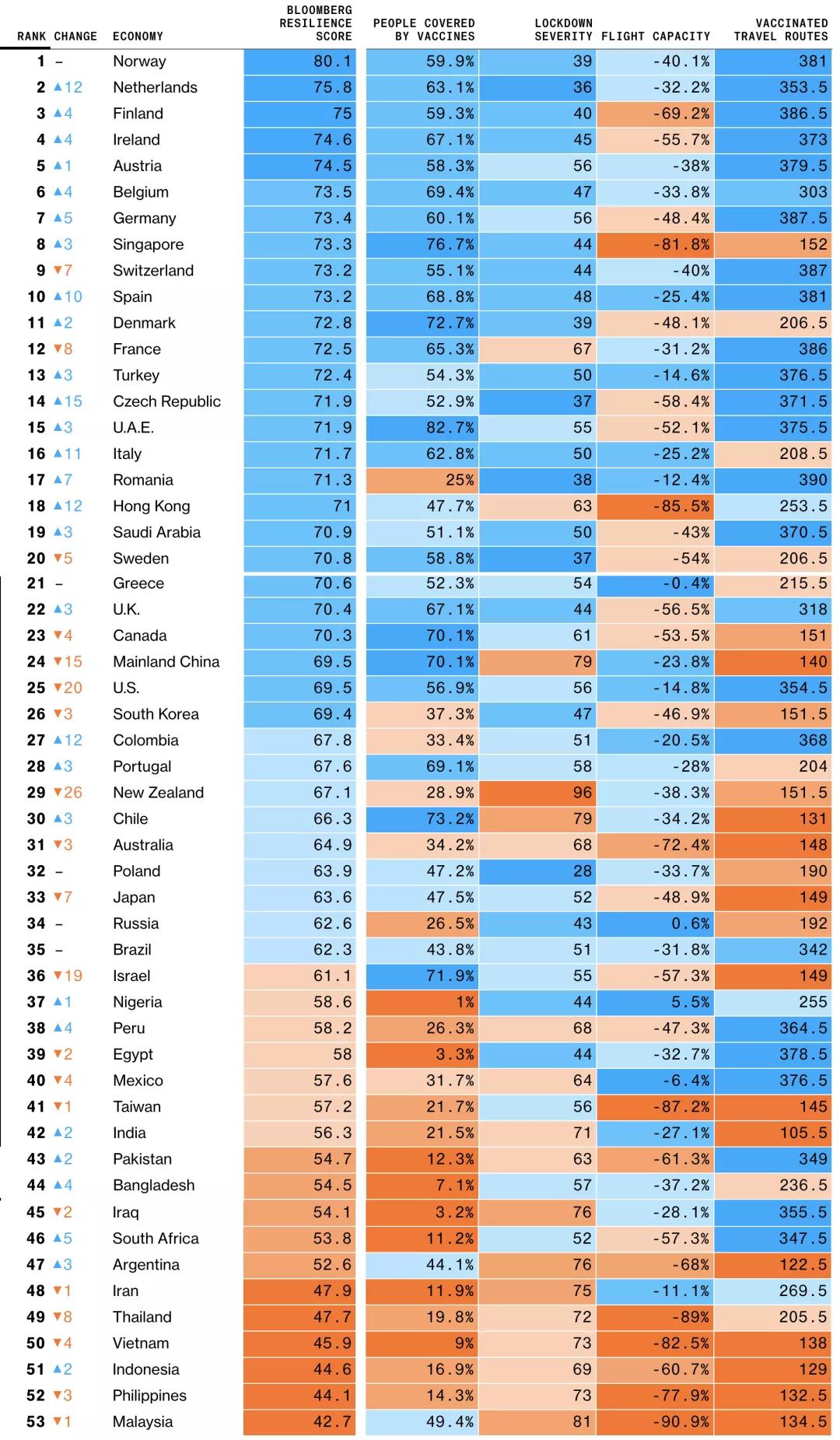
Bloomberg’s criteria for this round of pandemic resilience rankings Each location was scored against four criteria: vaccination coverage, lockdown stringency, reductions in international flights and openness to vaccinated travellers. New Zealand’s position was affected mainly by low population vaccination coverage and stringent lockdown restrictions.
Norway topped the global pandemic resilience rankings, with vaccination coverage of 59.9%, a flight reduction of 40.1%, a lockdown stringency score of just 39 and an overall score of 80.1. The Netherlands came second with 75.8 points, followed by Finland in third with 75. Hong Kong, China, was in position 18. Mainland China scored 69.5 and ranked 24, down 15 places from July. The United States scored 69.5 and ranked 25, plunging 20 places. South Korea ranked 26 and India 42. Malaysia performed worst in this round, ranking 53, with a pandemic response weaker than those of other Southeast Asian countries, including Thailand, Vietnam, Indonesia and the Philippines.
Mainland China fell to position 24, mainly because of its lockdown stringency score of 79. However, high vaccination coverage of 70.1% and a relatively small reduction in international flights of 23.8% lifted its score. However, it is worth highlighting that New Zealand’s lockdown stringency score reached 96 in August, making it the most tightly locked-down of the 53 countries and territories in the rankings. A higher score in this category indicates stricter lockdown measures, and stricter lockdown measures lead to a lower ranking.
{ad}
02
9 of the top 10 countries are European
Although Europe has long been a pandemic hotspot, its countries’ performance since vaccines became available has impressed the world. In August, 9 of the ten highest-ranked countries were European. Singapore scored 73.3 overall and ranked 8, making it the only Southeast Asian country in the top 10.
Bloomberg’s top ten countries were Norway, the Netherlands, Finland, Ireland, Austria, Belgium, Germany, Singapore, Switzerland and Spain. High vaccine uptake and relatively relaxed lockdown restrictions boosted their scores. Singapore’s vaccination coverage in particular was approaching 80%, while coverage in the 9 European countries remained above 50%.
Bloomberg said Delta the new variant was upending previous pandemic response models and bringing renewed turbulence to economies worldwide. Its high transmissibility had left some countries facing strict border controls and lockdown restrictions, while weakening the protection offered by the vaccines available in those places.
Source: www.bloomberg.com
03
Bloomberg: high vaccine uptake fuels enthusiasm for travel in Europe
Bloomberg noted that New Zealand had spent a long period in first place since November last year. Delta’s arrival sent residents overnight from life with the fewest restrictions back into the strictest lockdown, and the country plunged 26 places. The United States and Israel, among the countries with the highest vaccination coverage and greatest reopening, also fell sharply in August because of high infection and severe illness rates driven by Delta.
European countries performed best in August, adopting sound pandemic strategies that combined widespread vaccination with reopening in line with vaccination progress. Norway, in particular, had held first place for two consecutive months.
Vaccination coverage in the five Nordic countries has reached around 60%. These countries have kept death rates very low and opened their borders to vaccinated travellers. Enthusiasm for travel is now high across Europe.
04
“Living with the virus” could become countries’ future pandemic response slogan
The report said that widespread vaccine rollouts around the world were weakening the link between infections and deaths, prompting policymakers to reassess their approaches to the coronavirus pandemic.
On 29 August, Singapore’s Prime Minister Lee Hsien Loong said in his National Day Rally speech that vaccination coverage had reached 80% and the country was gradually moving towards a new normal. In the fight against the pandemic, he said, “We initially pursued a zero-case strategy, but are now gradually shifting to living with the virus.” The speech highlighted Singapore’s change in pandemic strategy.
On 1 September, Malaysia’s new Prime Minister Ismail Sabri also announced a shift to a “living with the virus” strategy. Following the United States, Europe, Canada and Australia, these were among the first Southeast Asian countries to announce such an approach.
Bent Hoie, health minister of top-ranked Norway, said vaccines would help bring the pandemic under control, but “we need to continue living with the virus”, just as we live with other infectious diseases. Eliminating the virus completely was impossible.
Explainer
Bloomberg’s global pandemic resilience rankings use three main categories:
- Reopening progress, including vaccination coverage, lockdown stringency, flight volumes and openness to the outside world, meaning whether international travel has resumed;
- The pandemic situation, including confirmed cases per 100,000 people, the fatality rate over the past three months, deaths per million people and the test positivity rate;
- Quality of life, including community mobility, economic growth, public health protection and the Human Development Index.