
Jasmin Hsu: When lives hang in the balance, every second counts
Can I receive an earthquake warning in time, before the earthquake strikes? Can the electronic systems in my home shut down automatically beforehand? Can I quickly find out whether my house may have been damaged? If the answer to all these questions is yes, can I afford it?
New Zealand lies on the boundary between the Pacific and Australian plates and experiences thousands of earthquakes each year. Those living here would surely like to know the answers to these questions.
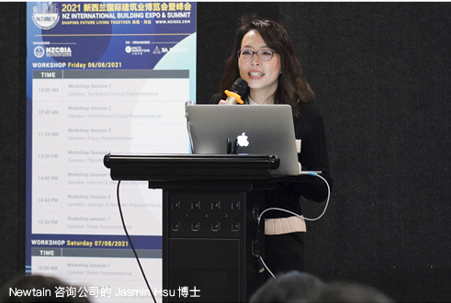
Speaking at an NZIBES workshop in 2021, Dr Jasmin Hsu of consultancy Newtain explained that people feel the ground shake during an earthquake mainly because the energy generated travels as seismic waves to the surface, where people are.
There are several types of seismic waves. P-waves travel fastest and reach the surface first, while S-waves travel more slowly but are more destructive. When an earthquake begins, people therefore feel slight vertical vibrations, followed by a brief lull that makes it seem as though the earthquake has stopped. More violent side-to-side shaking usually follows as the S-waves reach the surface. These waves can cause serious structural damage to houses, putting people’s safety at risk.
{ad}
OEEWS The earthquake early warning system works by exploiting the difference in speed between P-waves and S-waves. Once its seismic sensors detect P-waves, it uses the first 3 seconds of P-wave signals collected to calculate and estimate the seismic forces when the S-waves arrive. OEEWS The system uses artificial intelligence to calculate and estimate potential seismic forces based on previously collected earthquake records. Newtain has established two seismic monitoring stations, in Wellington and Christchurch, and collected 40,000 earthquake records over the past two years. Using these records, its AI model predicts the seismic forces when S-waves arrive with accuracy as high as 94%. As more earthquake records are collected, accuracy is expected to reach 98%.
With lives at stake, predicting earthquakes and sending people warning signals is the OEEWS system’s primary function. In other words, if the predicted seismic force exceeds the set threshold, the OEEWS system issues alerts in various ways, allowing people to take shelter as quickly as possible before the more destructive S-waves arrive. Usually, the OEEWS system can provide only a few seconds’ warning. Yet even those few seconds may allow people to find shelter quickly, making them crucial to saving lives.
However, the OEEWS system’s applications extend beyond sending warning signals. In fact, many major earthquake disasters worldwide involve secondary hazards: subsequent disasters that occur after the earthquake and are often more serious than the damage caused during the shaking itself. Examples include ruptured essential service lines, damaged production equipment, people trapped in lifts, fires and even nuclear power plant accidents. Because natural disasters cannot be predicted, disaster prevention and mitigation must minimise every possible hazard. The OEEWS system therefore has another important application: automatically controlling equipment, such as opening house and garage doors, controlling lifts, shutting off water, electricity and gas, and shutting down factory equipment. This service can be used across all sectors in earthquake-prone areas, including households, apartment building managers, small and medium-sized businesses, factories, schools, hospitals, utility companies and government agencies.
Because each user’s earthquake early warning requirements differ, Newtain works with Jenlogix to tailor solutions to customers’ risk profiles, industries and locations. For example, some office and residential buildings and large hospitals have installed our early warning and post-earthquake structural health monitoring systems. As well as receiving alerts and automatically controlling equipment such as lifts in the seconds before an earthquake, they can obtain a safety assessment report within 15 minutes afterwards. Supported by monitoring data and structural analysis and diagnostics, this report allows management to decide quickly whether people can reoccupy the building and business activities can resume.
Over the past 7 years, our team has developed specialist expertise in earthquake early warning services, structural health monitoring and vibration monitoring in New Zealand. Our professional equipment is now used by airports, ports and major construction companies in many countries, including China, the Philippines, Indonesia, India, the Solomon Islands, the United States, Mexico, Peru, Türkiye, Greece and Italy.
Technological advances and the new wave of 5G are driving a trend towards integrating the internet with smart homes and smart cities. People will benefit from better services delivered by more advanced technology in their everyday lives, and real-time earthquake early warning is undoubtedly an essential part of smart home safety. Alongside continuing to provide earthquake early warning solutions for customers across different industries, we will therefore use the internet to bring our equipment and services into safety and disaster management in every New Zealand home, providing greater protection for everyone’s lives and property.