A full recap: what key issues were discussed at the medium-density housing planning policy seminar?
Last Friday, the much-anticipated public seminar on medium-density housing planning policy, organised by the New Zealand Chinese Building Industry Association (NZCBIA), went ahead as scheduled. The webinar examined, discussed and interpreted the Housing Supply Bill, new housing construction legislation jointly proposed the previous week by the Labour Government and the National Party.

The seminar brought together a wealth of professional expertise, with NZCBIA inviting several leading industry figures:
Guest legal adviser:
- Raymond Huo (Huo Jianqiang) — director at Shieff Angland Lawyers and former chair of Parliament’s Justice Committee
Guest planners, all NZCBIA members:
- John Yan — planning team leader, Envivo design consultancy
- Katherine Hu — planner at Hamilton City Council
- Lucy Ji — independent resource management planner, CLC Consulting Group Ltd
- Kanye Kang — senior planner and head of design, Dreamhome Design Ltd
NZCBIA president Frank Xu and secretary-general Dylan Huang hosted the entire event, also delivering engaging presentations and commentary respectively. Although the webinar was held on the Friday afternoon immediately before Labour Day weekend, nearly 400 construction industry colleagues watched online and joined the discussion. Join YIJU as we revisit the highlights.

{ad}
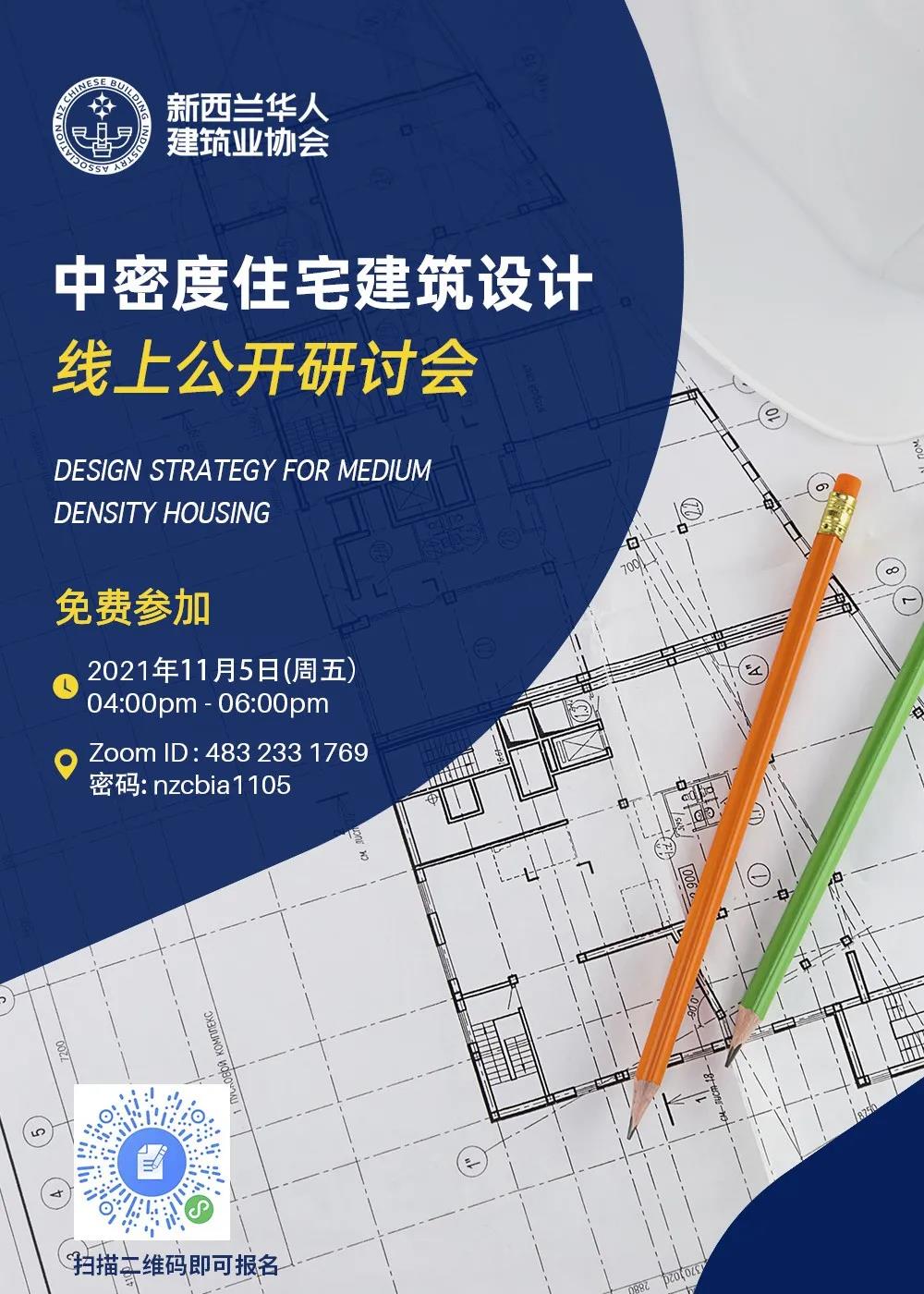
*If you missed this webinar, here is another opportunity! NZCBIA will hold another webinar next Friday (5 November), exploring how medium-density homes should be designed under the new policy. See the “Universal Registration” mini programme and event poster at the end of this article for registration details. Everyone is welcome to register and take part.
Q1
With New Zealand’s construction industry facing labour shortages, building material shortages and insufficient government infrastructure funding, what broader effects will this sudden, radical new housing policy have on the industry?
Frank Xu:This is the fourth new policy closely connected to construction announced since the current Delta outbreak, following the Government’s “immigration amnesty”, tax deductibility policy for new builds, and shared-equity purchase scheme for first-home buyers. Prolonged lockdowns and border closures will negatively affect New Zealand’s economy. We have also seen plenty of bad news: persistently rising inflation, global raw material shortages, soaring energy and shipping costs, and interest rate increases triggered by a higher OCR. I believe this is the only positive stimulus measure the Government can offer for New Zealand’s economic future to ensure the economy continues developing healthily during the pandemic, while also hoping to address the housing shortage.
Q2
How should the jointly proposed Housing Supply Bill be interpreted from a legal and parliamentary perspective?
Raymond Huo: Many people may think the policy announced by the two parties is a standalone policy. In fact, it supplements the familiar Unitary Plan and National Policy Statement on Urban Development (NPSUD), introducing a new concept called the Medium Density Residential Standards (MDRS). The details are as follows:
Another misconception is that the new policy takes effect as soon as it is announced. Implementation is still some way off: the bill has not yet been introduced to Parliament and must pass its first, second and third readings before it can take effect. Because both parties have jointly proposed it, passage is only a matter of time. Unlike previous measures, this is a bill to amend the Resource Management Act (RMA). In terms of timing, implementation in Auckland and “tier-one” cities begins in August 2022, while other areas may begin in August 2023. Another change is the removal of “Demand” from the third provision of the NPS-UD. This means that selecting a development site only requires accessibility to community infrastructure centres.
Q3
How should development in Auckland’s Single House Zone be planned? Will resource consent (RC) no longer be required?
John Yan:The new policy will not greatly change planning in Auckland, but will have a major impact elsewhere. It encourages medium-density housing development rather than targeting resource consent requirements. Avoiding RC is unrealistic. Subdivision, for example, requires RC. If more medium-density homes are built without subdivision, they cannot be sold separately. Without RC, the more likely option is therefore to plan three homes on one site.
I think there are two possible ways to open up single-house zones. First, Auckland may introduce numerous special planning overlays. Through a plan change, MDRS overlay requirements could be added to existing Single House and Mixed Housing Suburban zones, excluding flood-prone and heritage areas, creating new density and development rights. Alternatively, Auckland could substantially increase density across areas through a comprehensive plan change, although I think the first approach is more likely. I predict the market will demand higher-quality design. Planning rules may be relaxed, but basic design requirements will remain, so design quality will need to improve.
Kanye Kang:I also think John’s first possibility is more likely: adding an overlay to low-density areas, increasing the floor area ratio from 35% to 50%. Planning provisions for recession planes, outdoor living space, outlook space, garden and landscaped areas, and impervious surfaces would all be updated. The second approach would be costly and disruptive, requiring considerable time and effort. Given councils’ current circumstances and very slow approval processes, they are unlikely to choose it. Many people have also asked me whether RC will no longer be necessary. In fact, there is little change. The bill itself will not begin to have legal effect in Auckland until next August, and will not add a great deal to Auckland’s Unitary Plan.
Q4
When will the new policy have legal effect, how does it differ from the NPS-UD, and what is councils’ timetable for implementing the new bill?
Katherine Hu:In theory, plan changes under the new bill must go through three stages:
Stage one: from now until August 2022 — preparing evidence, evaluating options, engagement, drafting plans and notification
Stage two: submissions, hearings and decisions — 2022–2023
Stage three: appeals, mediation and court proceedings — 2024
I think it differs from the NPS-UD in the following policy areas: well-functioning urban environments (policy 1), intensification (policy 3), non-compliant development (policy 8) and removing car parking (policy 11). Councils need to undertake detailed assessments and amend their plans to implement these policies. Councils in different areas have different implementation timeframes; policy 11 has a shorter timeframe and takes legal effect sooner. We know that tier-one cities must notify plan changes before 22 August 2022. The new bill has yet to pass formally, and councils are preparing for the submission stage. However, introducing MDRS is unlikely to fundamentally change the permitted baseline for all residential zones and land zoned for residential use.
Q5
What impact will the new bill have on cities outside Auckland?
Lucy Ji:Like many others, I think the new bill will have little impact on Auckland, because we have all seen medium-density housing develop here. The difference is simply that medium-density areas will expand. For councils outside Auckland, however, the change is substantial. They may feel that government policies are arriving too frequently, with a new one appearing before they have understood the previous one. The bill also divides New Zealand into tier-one and tier-two cities, giving everyone a new framework for thinking about future development.
Q6
What negative effects could the new bill bring?
Frank Xu:Those living in luxury seaside homes may need to take note: neighbours can now build a three-storey home that blocks your view without your written consent. Labour and building material shortages may also worsen, affecting more areas for longer. If you want to subdivide land, you may find planners already booked up until 2023. Local infrastructure will also face enormous pressure. We can already see that parking is unavailable in many parts of Auckland, and congestion will worsen. I would like to urge all Chinese developers to place greater emphasis on quality and social responsibility when planning developments, whatever the policy allows. That is how we can improve our living environment rather than see it deteriorate.
Raymond Huo: To judge whether a policy is good, we can look at who will oppose the bill. At present, environmentalists and heritage preservation advocates are likely to oppose it.
Kanye Kang:The impact on urban planning will also be significant. Excessive urban development will negatively affect the city’s overall planning and development.
Q7
Will connections to public water pipes also no longer require neighbours’ signatures?
Katherine Hu:Even if RC is no longer required to approve house construction in future, connecting to public water pipes takes place during building work under the building consent (BC), so neighbours’ consent will still be needed.
Q8
Can a bill jointly put forward by both parties become law without local government support?
Raymond Huo: Local government support does not matter, because this is legislation at central government level.
Q9
Will financial contributions still be payable if RC is no longer required?
Katherine Hu:That is currently uncertain, but possible. Financial contributions (FC) may still be charged even if RC is no longer required.
The webinar generated a strong response, with audience members keen to ask questions. Alongside the issues above, the new policy’s impact on the Single House Zone attracted considerable attention. In Auckland, this zone may be the most affected. The guests agreed that a property in the Single House Zone without Special Character status should be able to be subdivided into 3 titles, with detailed rules dependent on local government interpretation of the new policy.
On another much-discussed property issue, cross-leases, lawyer Raymond Huo advised converting the tenure to freehold before applying the new policy.
Finally, Raymond Huo reminded investors to stay clear-headed and alert to risks when positive news arrives. He brought along his latest book, New Zealand Investment and Business Law and Taxation, which YIJU covered in an article on 29 September. Written jointly by eleven leading New Zealand law firms and industry specialists, the book covers almost every legal and tax issue that may arise during property development in New Zealand, making it a highly practical reference.
Disclaimer: The guest presentations at this seminar do not constitute advice for actual cases. Neither the New Zealand Chinese Building Industry Association nor the speakers accept any related liability.
Given the enthusiastic response to this event, NZCBIA will hold another public webinar next Friday (5 November) at four in the afternoon. The discussion will focus on how medium-density homes should be designed under the new policy. NZCBIA will invite several designer members to present and analyse past projects, discuss current challenges and problems, and offer constructive suggestions for architectural design under future medium-density policy, including living environments, neighbourhood design, material selection and construction technology. Guest speakers, all NZCBIA members, include the following, with more industry guests to be announced:
- Bo Wang — director, Infusion Arch
- Frank Zheng — director, Sustainable Development Solutions
- Noah Bian — design leader, Flourishing Property
The seminar will again be hosted by association secretary-general Dylan Huang, with president Frank Xu providing commentary throughout. Attendance is free, and everyone is welcome to register!