
VRF or traditional split-system air conditioning: which should a savvy developer choose?
YIJU's article published on 30 November, titled ‘The fastest-growing segment in the future Australian and New Zealand HVAC market may surprise you!’ (click to read), attracted considerable attention from local developers. Readers asked what distinguishes variable refrigerant flow (VRF) multi-split air conditioning from the split AC systems so widely used in New Zealand.

Which system is better suited to townhouse and apartment developers? With these questions in mind, this article compares the two systems, examining their operating principles and costs to give developers and builders a clearer understanding.
{ad}
After nearly 40 years of technological development, VRF technology is now accepted in a growing number of markets worldwide. Although growth slowed for a time in 2019, new residential and light commercial projects in many countries and regions increasingly favour multi-split VRF systems, with market growth far outpacing comparable products such as split-system air conditioners.
2018 and 2019 comparison of market share growth across cooling technologies
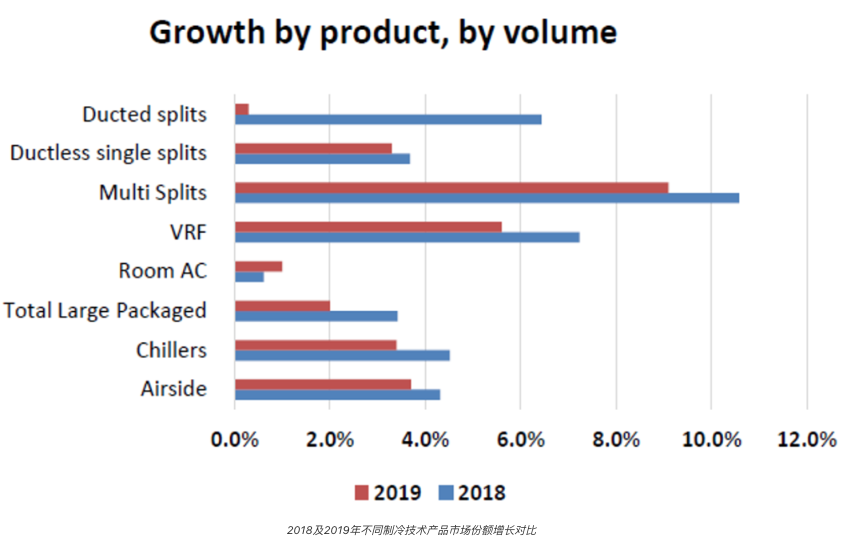
Data source: BSRIA (also applies below)
Compared with traditional chillers, rooftop units and commercial split-system air conditioners, VRF offers groundbreaking advantages as a new technology. These include efficient DC inverter technology, straightforward installation and maintenance, and independent temperature control for different rooms. VRF already has mature markets in Europe and Asia and is spreading rapidly in the Middle East and India. Even the North American market, traditionally dominated by chillers, is gradually accepting VRF products.
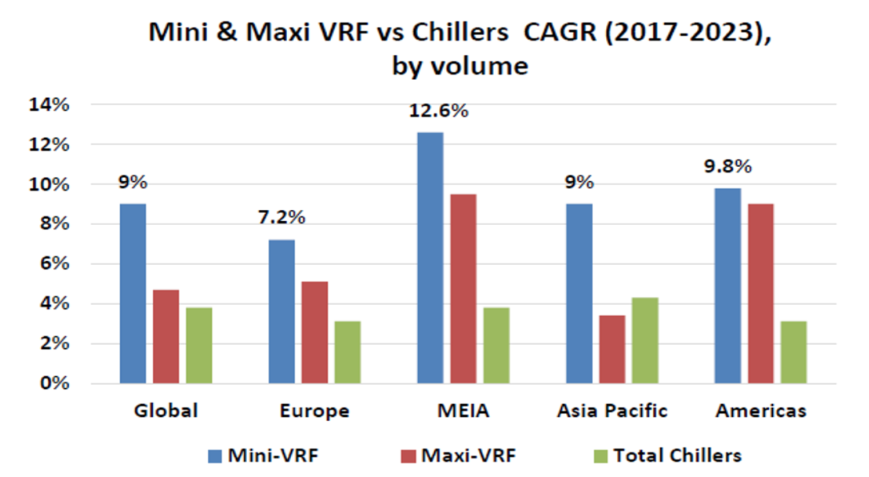
Forecast growth rates for cooling technologies across different regions
Notably, driven by both energy-saving and emissions-reduction policies and investment costs, increasing numbers of new buildings in many emerging markets are switching from traditional cooling systems to more energy-efficient VRF systems. VRF systems offer more competitive solutions, delivering high efficiency while substantially reducing investment costs.
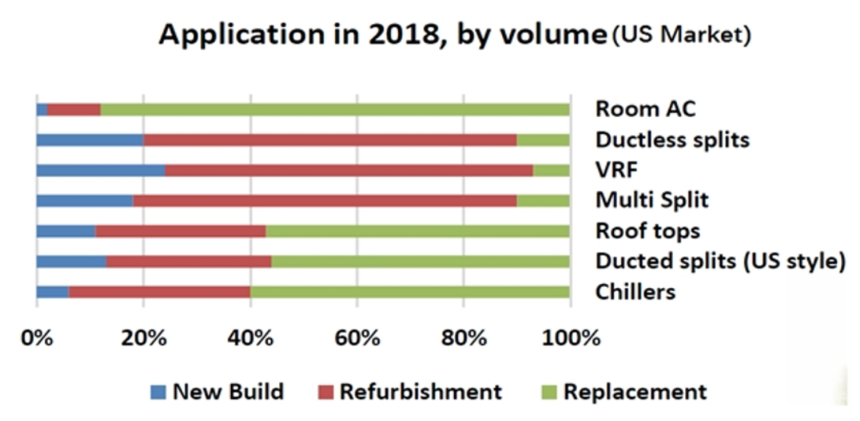
2018 comparison of market shares for cooling technologies across building types in the US
Comparison of sales volumes across cooling technologies in Australia's air conditioning market
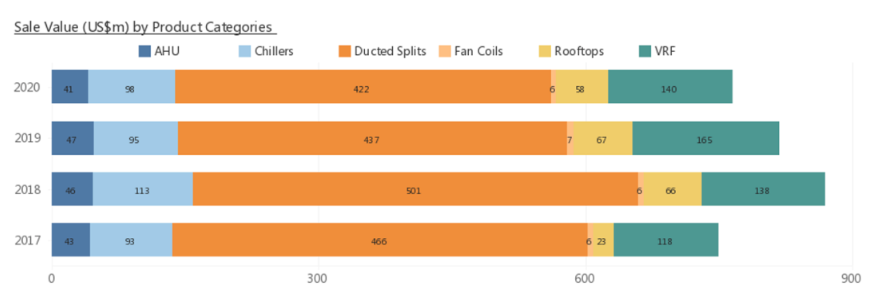
The chart above clearly shows that VRF products' share of the Australian market is continuing to grow. Mini VRF accounts for around 50% of Australia's VRF market, primarily serving local apartment, villa and small hotel developments and refurbishment projects.
A comparison of technology and data
- Greater energy savings
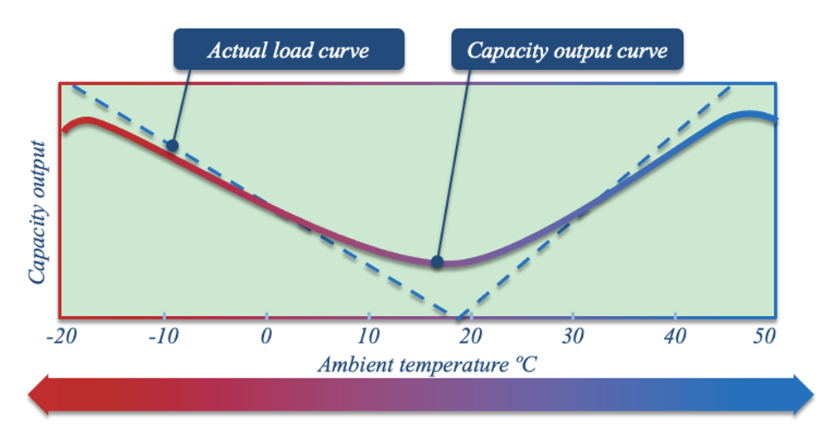
Compared with split-system air conditioning, VRF systems can precisely control their output according to actual load requirements, saving more electricity.
- Greater efficiency
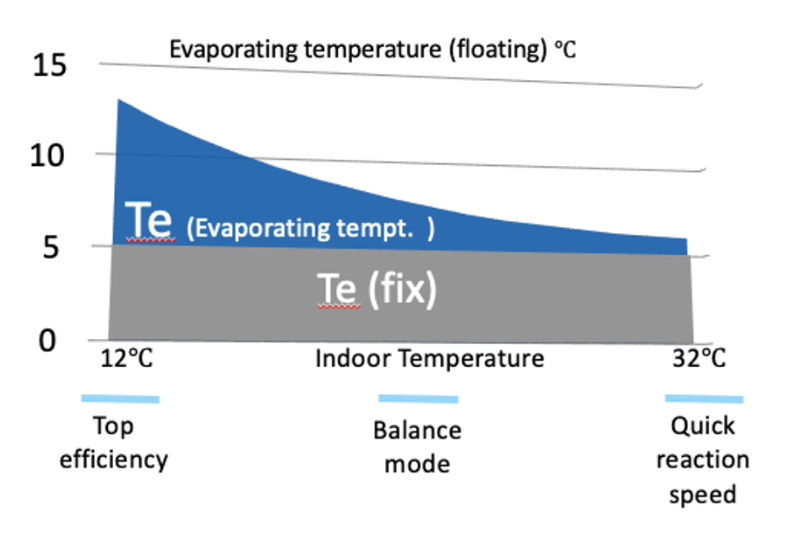
Compared with similar products, VRF's variable evaporating temperature technology is designed to improve energy efficiency and provide comfortable air conditioning with rapid cooling and heating. Between switching on and reaching the set temperature, the technology offers three modes: rapid cooling at start-up; adjustment of the evaporating temperature as the room temperature changes, making the supply air more comfortable and saving energy; and, once the set temperature is reached, an evaporating temperature at the point of peak efficiency. This ensures efficient, energy-saving operation throughout the cooling or heating process.
- A wider capacity range
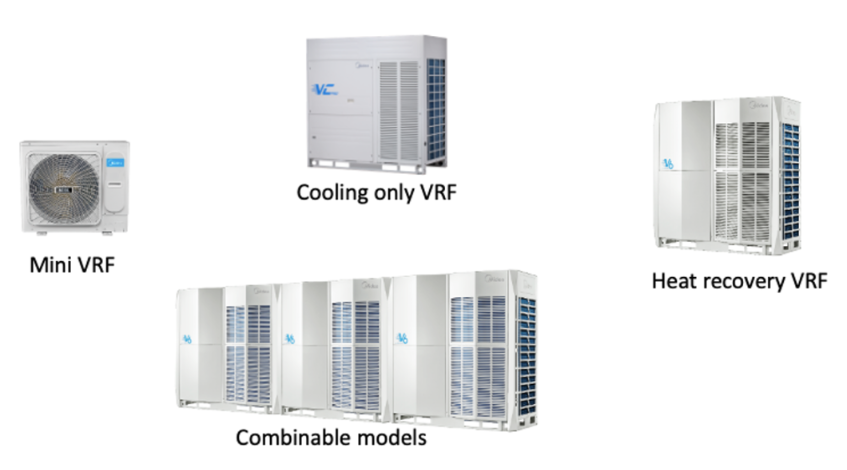
Individual units range from 8 kW to 84 kW. Up to 3 units can be combined, with a maximum capacity of 2688 kW. Compared with traditional systems, VRF's broad output range and variety of outdoor units can meet all requirements.
- Wider applications
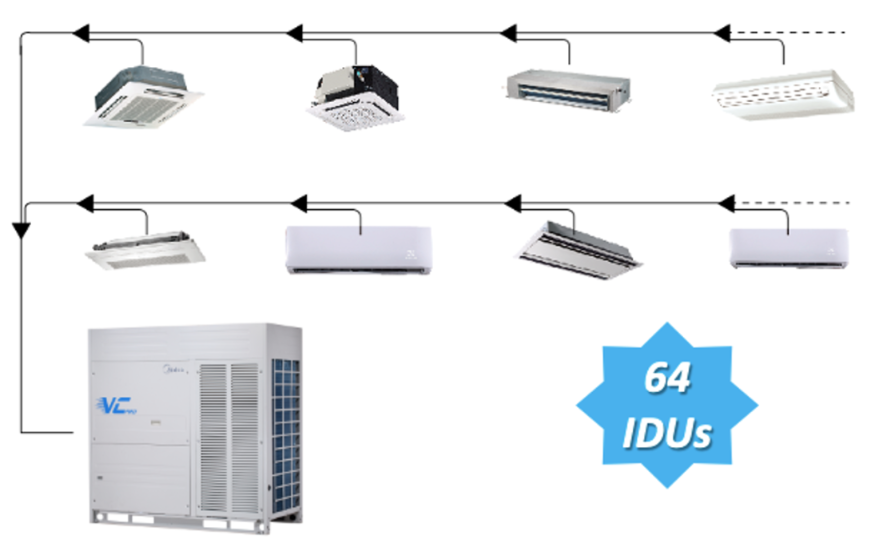
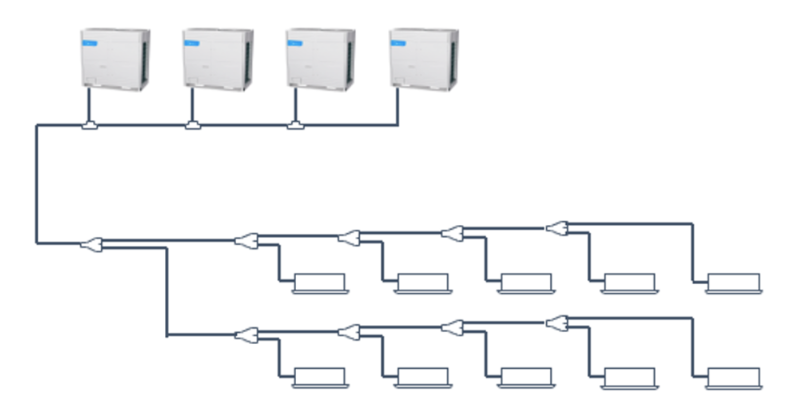
Compared with traditional split-system air conditioning, a single VRF outdoor unit can connect to as many as 64 indoor units.
- More space savings
Split-system air conditioning: Each room requires space for an outdoor unit, with associated costs for the installation space. We often see buildings with assorted units installed haphazardly on their external walls. This is unsightly, and poorly arranged outdoor units can interfere with one another's heat dissipation, impairing cooling performance, reducing energy efficiency and increasing electricity use.
VRF:An apartment or townhouse needs only one outdoor unit, so developers do not need to incur extra costs for multiple outdoor installation spaces. Standardised positioning of outdoor units improves the building's appearance. Greater spacing between units prevents interference from one another's heat dissipation, improving air conditioning efficiency.
- Lower piping and installation costs
Unlike traditional split-system air conditioning, which requires connections between multiple sets of indoor and outdoor units, a VRF system needs to connect to only one set of outdoor units. This saves installation labour and material costs, while making troubleshooting and repairs simpler and more convenient.
- More control options
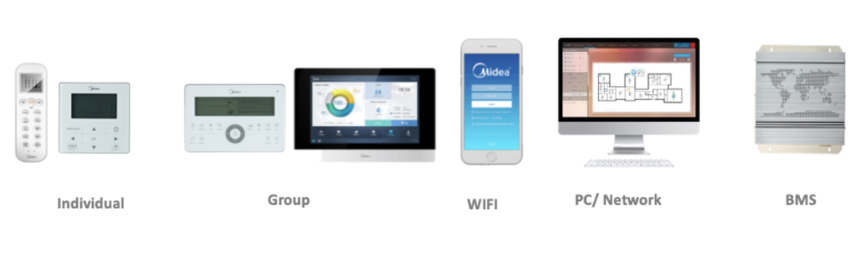
VRF systems can be controlled individually, centrally, through Wi-Fi or via computer networks and building management systems (BMS). They can also allocate electricity consumption for separate billing of individual air conditioning systems, something split systems cannot do.
Widely used around the world
Mini VRF systems are widely used worldwide in the development and upgrading of commercial and residential projects, including small offices, villas, apartments, townhouses, restaurants, shops and banks.

Why choose Argus Engineering?
Argus recently held two online training seminars on Midea's Atom series Mini VRF multi-split air conditioning systems, attracting many New Zealand HVAC professionals, local developers and builders. Participants were full of praise for this revolutionary, high-tech Midea product that can replace multiple outdoor air conditioning units.
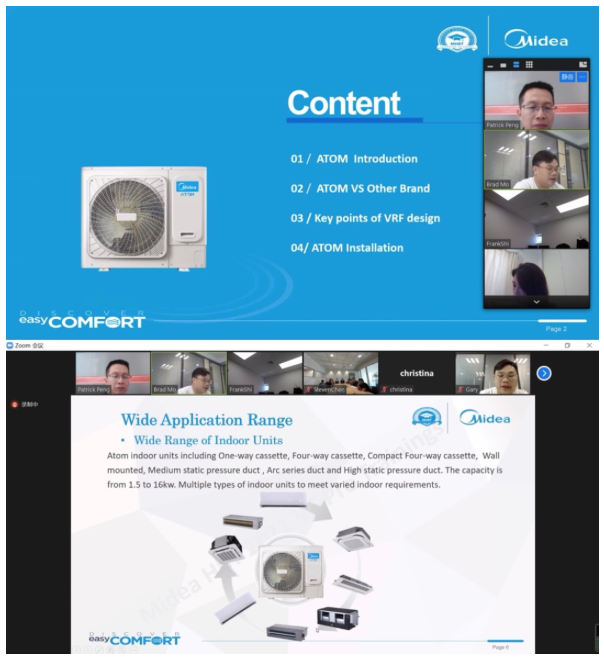
The online seminar in progress
As the New Zealand commercial products distributor for China's Midea brand, Argus Engineering tailors products and services to local projects, supporting the entry of Chinese brands and Chinese-made products into New Zealand. As part of Midea's overseas network covering 200 countries, it provides stable, reliable solutions and services for local projects, offering customers the best solutions throughout budgeting, design, installation and maintenance.
Before purchase/Less hassle
A professional liaison team with extensive experience in New Zealand construction projects saves communication time and improves operational efficiency.
During purchase/Confidence
As the New Zealand distributor for premium German bathroom brand Bravat and China's Midea brand, Argus Engineering provides strong support for local construction projects through outstanding products and services.
After purchase/Peace of mind
Professional installation supervision and after-sales service teams provide strong support for project operations.
All in all, Argus Engineering provides a one-stop solution.

Argus welcomes prospective partners.
Scan the QR code
to discuss the details of working together.