
The Accredited Employer Work Visa is launching! Still struggling with staff shortages? An experienced lawyer explains how to strengthen your application
The New Zealand Government has confirmed that the Accredited Employer Work Visa (AEWV) will officially take effect on 4 July 2022

The New Zealand Government has confirmed that the Accredited Employer Work Visa (AEWV) will officially take effect on 4 July 2022. It will replace the following 6 work visas:
- Essential Skills Work Visa
Essential Skills Work Visa
- Essential Skills Work Visa – approved in principle
Essential Skills Work Visa – approved in principle
- Talent (Accredited Employer) Work Visa
Talent (Accredited Employer) Work Visa
- Long Term Skill Shortage List Work Visa
Long Term Skill Shortage List Work Visa
- Silver Fern Job Search Visa
Silver Fern Job Search Visa
- Silver Fern Practical Experience Visa
Silver Fern Practical Experience Visa
From 4 July, when the policy officially takes effect, New Zealand employers wishing to hire migrant employees and sponsor their AEWV applications will first need to obtain employer accreditation before they are eligible to employ migrant workers.
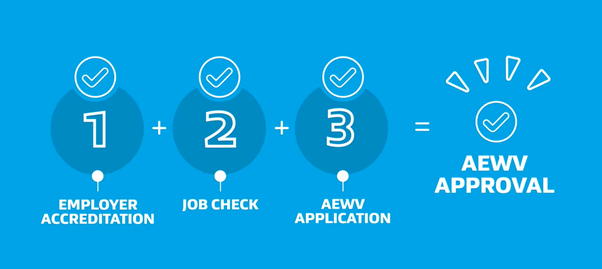
Under the AEWV system, the process for employers hiring migrants will involve three steps:
- Employer Check: the employer applies for accreditation
- Job Check
- Migrant Check: the AEWV application
If your business plans to hire migrant employees, your immediate task is to apply to Immigration New Zealand for employer accreditation. (Applications for employer accreditation opened on 23 May 2022.)
For low-risk applicants, applying for employer accreditation is straightforward. However, Immigration New Zealand has its own internal assessment system for determining whether an employer is high risk. What makes an employer high risk?
For example, employers will be classified as high risk if they have previously employed people working illegally, have an adverse record with the Labour Inspectorate, or have key personnel with an adverse immigration history or a criminal record. For these employers, obtaining accreditation will be more difficult.
The biggest pitfall in applying for employer accreditation is that it is valid for only a year and must then be renewed. Many people may find applying easy now, only to discover that renewal the following year is much harder, without understanding why. Ultimately, this comes down to Immigration New Zealand's enormous workload: extreme time pressure leaves it with little choice. The biggest difficulty is that employers who have already applied for accreditation will still face scrutiny from Immigration New Zealand later. The agency is expected to become very busy, with applications processed very slowly.
So how can you obtain employer accreditation quickly and smoothly? The following advice should prove useful.
{ad}
Where possible, hire migrant employees from different countries and backgrounds.
Immigration New Zealand favours diversity. A workforce with a wide range of backgrounds will lower your risk rating. Having employees from different countries and regions working together also makes the workplace more interesting and supports personal development. As one of the world's most culturally diverse countries, New Zealand has long embraced this in every aspect of life.
Establish a good payroll system.
If your company pays employees in cash, Immigration New Zealand will audit the company, investigate you personally and ask you to provide additional information. This may not happen now, but it is very likely when you apply for renewal. New Zealand employment law requires companies to keep proper records, and a good payroll system helps you meet this requirement.
Always have a lawyer present when communicating with Immigration New Zealand, so the agency will be more mindful of how it proceeds.
Please remember this golden rule! New clients often come to me for help after they have already spoken with Immigration New Zealand. Sometimes individuals or companies have an immigration adviser but do not have that adviser present during those conversations. If problems arise, some situations can be resolved, but sometimes it may already be too late.
Prepare in advance! Think of it as doing your homework.
You cannot do nothing all year and then scramble to prepare just before your accreditation renewal is due. Accreditation rules require employers to provide settlement support for employees. This includes information they need to settle in New Zealand, such as how to apply for an IRD number, accommodation options and living costs, driving and driver licences. Employers must also ensure all new employees complete the basic training provided by Immigration New Zealand. These requirements may sound simple, but when employers are rushing to hire new staff to tackle a large backlog of work, some of these tasks will inevitably be forgotten.
I recommend that all employers review their existing employees at least every six months. This is the most economical approach. Otherwise, once a problem arises, the cost could be 5 times what it would be now.
Avoid employment disputes and communicate promptly with employees when problems arise.
Remember this: if your company becomes involved in an employment dispute, such as a personal grievance, and the Employment Relations Authority rules against you, you may well be unable to obtain employer accreditation. The best way to prevent this is to identify problems early, communicate promptly and resolve them as soon as possible.
Do your best to plan ahead for 6 months or 12 months.
Just as a good driver pays attention to where their car will be in the next 12 seconds, a good business needs a development plan for the next 12 months. Of course, events such as the pandemic or the Russia–Ukraine war cannot be predicted. But good business leaders do their best to identify weaknesses in their business's development and make changes in advance. This is also why I publish fresh news and updates every few months.
One final piece of advice——Seek professional advice.
These 7 recommendations are necessarily broad, because every company is unique. A restaurant might excel in health and safety but fall short in recording working hours. A factory might have a very culturally diverse team without realising that some employees do not hold the correct work visas. Employers are now expected to get everything right and make no mistakes. Immigration New Zealand has already declined work visa applications because of employers' poor records of working hours, and this is not uncommon.
Employers are not lawyers, nor do they need to become lawyers. They are not accountants either, and can hire accountants to manage their finances. As a business grows, employers need to consider handing specialist work to professionals so they can focus on the business itself and its profitability. Taking everything on yourself is not cost-effective.
Overall, the coming year will be challenging. If you need help, I can lend a hand.
About the expert
Sonny Lam
Sonny is an independent consultant lawyer at Queen City Law, a leading New Zealand law firm specialising in immigration, investment and construction. He specialises in immigration and employment matters and has extensive inside experience and knowledge from his many years working at Immigration New Zealand. He can provide businesses with professional advice on employer accreditation and checks from an immigration adviser's perspective.
Sonny has helped more than 1000 applicants successfully obtain residence and provides high-level advice to other immigration advisers and lawyers. To contact Sonny, email him directly at sonny@qcl.co.nz.