
Former immigration officer examines new policies: is later better for parent residence submissions? Does simpler skilled migration mean easier applications?
Just yesterday, New Zealand Immigration Minister Michael Wood announced in a speech to business and migrant community leaders that skilled migration and parent residence would reopen in mid-November 2022!
Just yesterday, New Zealand Immigration Minister Michael Wood announced in a speech to business and migrant community leaders: In 2022, month 11 will see skilled migration and parent residence reopen mid-month!
{ad}
No sooner had Michael Wood finished speaking than the major news swept through the Chinese community. Long awaited! Wonderful news! Cause for everyone to celebrate! No words seem enough to describe prospective applicants’ excitement.
Once the excitement subsides, however, the real priorities are understanding the policies fully, making the most of them, preparing complete application documents and ultimately securing permanent residence.
YIJU New Zealand therefore interviewed senior immigration lawyer Sonny Lam, who has 15 years of litigation experience and previously worked as an Immigration New Zealand officer. Now at Queen City Law, he offers YIJU readers an in-depth interpretation of Michael Wood’s new policies and answers frequently raised questions, in the hope of helping you on your immigration journey:
Skilled migration 11 / 9 reopening
“As the world recovers from Covid-19, labour shortages will remain a global issue,” Michael Wood said. “We are listening closely to businesses’ concerns. Many have been approved to hire migrants but face difficulties recruiting overseas in a constrained labour market.”
Skilled migration selections were suspended in early April 2020, and nobody in the EOI pool received further invitations. Nearly three years later, reopening skilled migration will reconnect New Zealanders with the world and help New Zealand businesses attract talent during a global labour shortage, further easing workforce pressures.
The new policy
The Skilled Migrant Category will reopen under its current settings, with the first selection beginning on 9 November. The threshold will remain 160 points, with no cap on numbers. A second selection will take place on 18 January next year, with the threshold rising to 180 points to better align with the category’s future direction and New Zealand’s immigration rebalancing objectives. Subsequent selections will take place on the third Wednesday of each month, selecting applicants with 180 points or more.
Once invited, applicants have 4 months to submit their formal application documents. Requirements include having a job or job offer in New Zealand, earning at least the median wage or 1.5 times the median wage for highly skilled occupations, and meeting English language requirements.
Sonny’s analysis
Within less than a day of the new policies being announced, I received many questions reflecting common concerns. I will answer them here:
Q: Does an employer need accreditation to sponsor a skilled migrant?
A: We do not yet know for certain. If the rules remain the same as before, accreditation will not be required, but this rule could change.
Q: What are the specific pay requirements?
A: If an EOI is submitted before 27 February 2023, the median wage should be NZ$27.76. If it is submitted after 27 February 2023, the median wage should be NZ$29.66.
Q: Once skilled migration reopens, will INZ continue processing 2021 residence applications (2021 Residence) and Green List (Green List) applications?
A: Yes. But this will further increase INZ’s already enormous workload, and I am very concerned that it will be unable to cope with the reopening. I foresee many mistakes and oversights by immigration officers. There are also common problems in skilled migration applications already submitted. Based on my years of experience as an immigration officer, these mainly concern evidence of relevant experience in skilled work, evidence that the current job constitutes skilled employment, and the completeness of paper applications. I therefore do not recommend applying without professional assistance.
Parent residence thresholds significantly lowered
New Zealand’s parent residence category closed in 2016 and stopped accepting new applications. New criteria briefly introduced in 2019 set income requirements beyond most applicants’ reach. The category was suspended again in March 2020 because of the pandemic, leaving countless families unable to reunite for six years.
Alongside reopening the parent residence category, the Government has reduced barriers to obtaining these visas, fulfilling a 2020 election promise. Changes include increasing the number of parent resident visas issued annually and lowering income thresholds.
“We recognise the importance of migrants being able to settle here and have their parents join them,” Michael Wood said.
The new policy
More visas: The number of visas issued annually will increase from 1000 to 2500.
Lower income thresholds: To sponsor one parent, an individual sponsor must earn 1.5 times the median wage, while joint sponsors must earn 2 times the median wage. The previous thresholds were 2 and 3 times respectively.
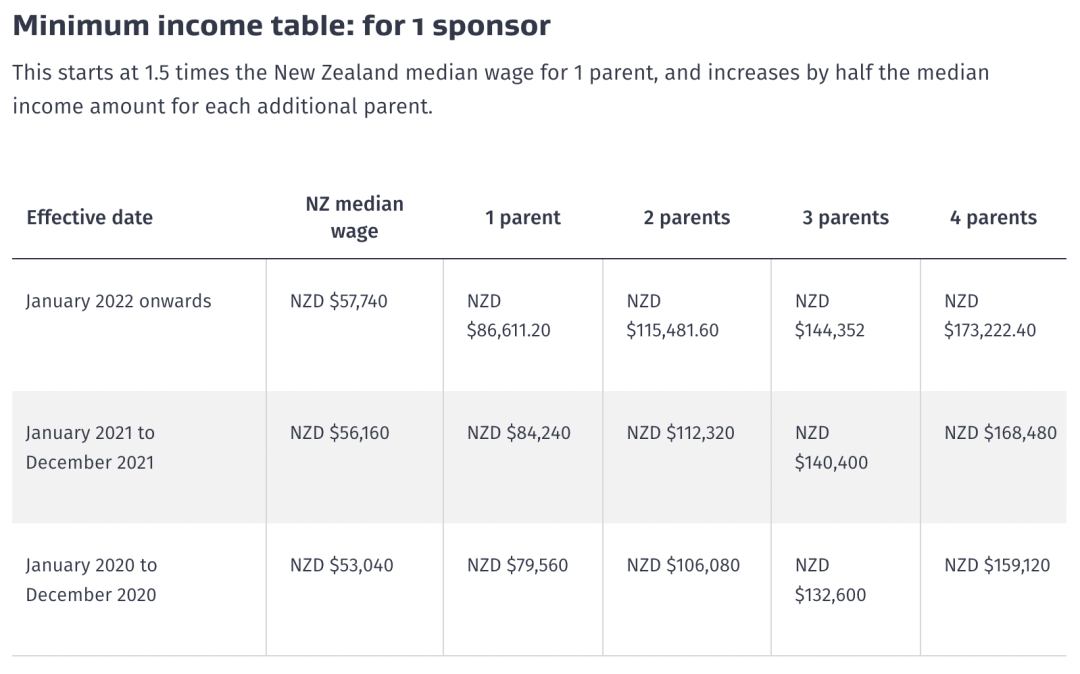
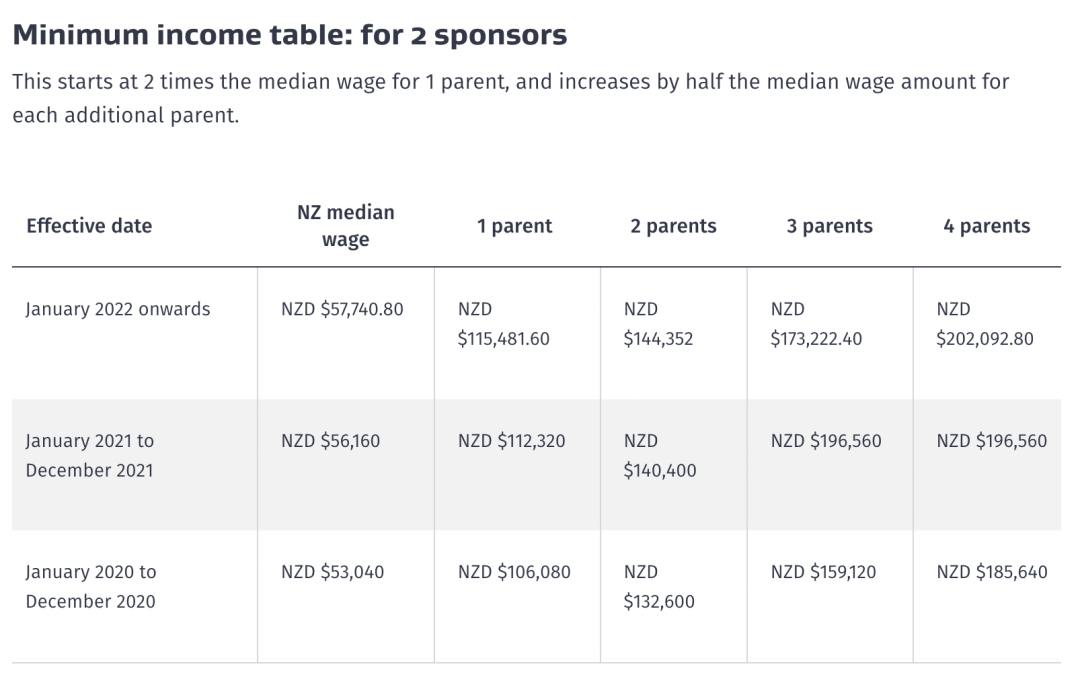
Siblings can also apply jointly. A joint application can sponsor up to six parents, with the income requirement increasing by 0.5 times the median wage for each additional parent.
Sonny’s analysis
From 14 November, parent residence applications will open to those who have already submitted an expression of interest (EOI), with selection based on submission order. Subsequent selections will take place every three months, with up to 2000 visas issued annually.
New EOIs submitted from 12 October will enter a new pool rather than being added to the existing queue. Random selections from this pool will begin in August 2023 and take place every three months thereafter (August, November, February and May), providing an additional 500 visas annually.
A particularly important reminder: parent residence EOIs are valid for two years, and new EOIs will no longer be selected on a first-come, first-served basis. So do not rush to enter the pool! Do not rush to enter the pool! Do not rush to enter the pool! Important advice bears repeating three times! Submitting as close as possible before the first selection in August 2023 maximises the time your EOI remains valid in the pool, giving you the greatest number of selection opportunities and improving your chances.
Because the new income requirements are very reasonable, I expect the pool to contain more than 10,000 EOIs by July 2023. A ballot selecting 500 people at a time is like buying a Lotto ticket: the cost is low, at just NZ$550, but you do not know when you might win. If you truly want to reunite with your parents as soon as possible, I would recommend applying for a Parent Retirement Visa.
I would also like to highlight a rule in the Immigration Instructions that prevents people sponsoring one parent while attempting to obtain residence for the other through the Partnership Category:
If the principal applicant’s partner was considered eligible for inclusion in the Parent Category EOI but was not included in the application, that partner will not be granted residence under the Partnership Category through a subsequent partnership application (see F2.40.5).

Skilled migration points system to be simplified
Because of limitations in the previous system, only 40% of Skilled Migrant Category applications were processed in 2019. Skilled migration has now reopened temporarily and is in a transition phase. A new, simplified 6-point system may be adopted in future to “establish a clear, fair and transparent threshold and provide people with multiple ways to demonstrate their skill level”. Feedback on the system is being sought through MBIE’s website.
The new policy
Under this new system, skilled migration applicants must have at least 6 points to qualify. Points can comprise:
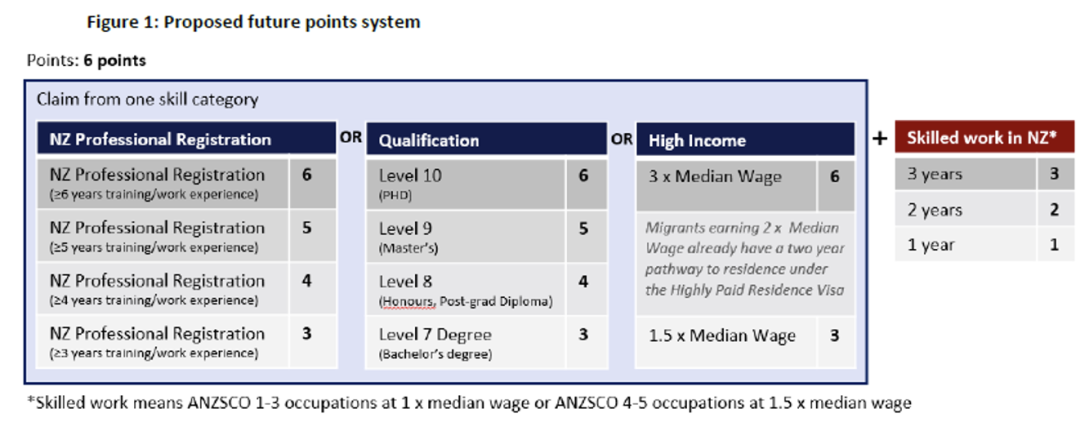
3 to 6 points based on New Zealand occupational registration, qualifications or income. Applicants may choose the skill category that gives them the most points for their circumstances, but may select only one;
and
- 1 point for each year of skilled work experience in New Zealand that meets Immigration New Zealand’s requirements, up to a maximum of 3 points.
- All skilled migration applicants must have a job or job offer in New Zealand and earn at least the median wage.
Sonny’s analysis
The new system is very favourable to some people. For example, applicants with New Zealand occupational registration and at least 6 years of training or experience, or the rare PhD applicant with a job offer, can qualify immediately. Someone with just 3 years of work experience (3 points) who earns 1.5 times the median wage (3 points) can also reach 6 points. They might be a chef or carpenter who has worked in New Zealand for 3 years.
For most people, however, the new system’s requirements for years of New Zealand work experience will make applying harder. Based on this calculation, I estimate that most applicants will need at least 2 years of local work experience, unless they hold a master’s degree (5 points) plus one year’s work experience (1 point), or New Zealand occupational registration involving at least 5 years of training or experience (5 points) plus one year’s work experience (1 point).
It must be emphasised, however, that this is only a proposed future system currently open for consultation. I expect the final version to look very different.
Whatever happens, there will be a skilled migration system that is easier to administer, because our economic development will need it. The Government has said there is no cap on migrant numbers, indicating that it believes a very large workforce will be needed in future.
The biggest question is when the new system will begin. With next year being an election year, we can expect it to take effect no earlier than 2024, and most likely in 2025.
I believe Immigration New Zealand cannot process its existing workload quickly and efficiently. Any new immigration changes will need to wait until at least 80% of the 2021 residence category (2021 Residence Category) has been completed.