
Latest: house price falls slow! Economists predict mortgage rates could reach 9.5%?
Recent house price falls and rising mortgage rates have put New Zealand’s property market under pressure and fuelled negative commentary.
Are house price falls slowing?
Recent house price falls and rising mortgage rates have put New Zealand’s property market under pressure and fuelled negative commentary. However, CoreLogic’s newly released House Price Index suggests the economic downturn may be starting to ease.
CoreLogic’s House Price Index (HPI) shows that house prices continued falling last month, but at a slower pace.
The national average house price fell 0.6% in November, from NZ$964,202 in October to NZ$958,622.
The pace of decline has slowed. By comparison, the fall in October was 1.3%, with last month’s decline less than half that. The quarterly figures also show this clearly: the quarterly fall in November was 3.3%, compared with 4.5% in October.
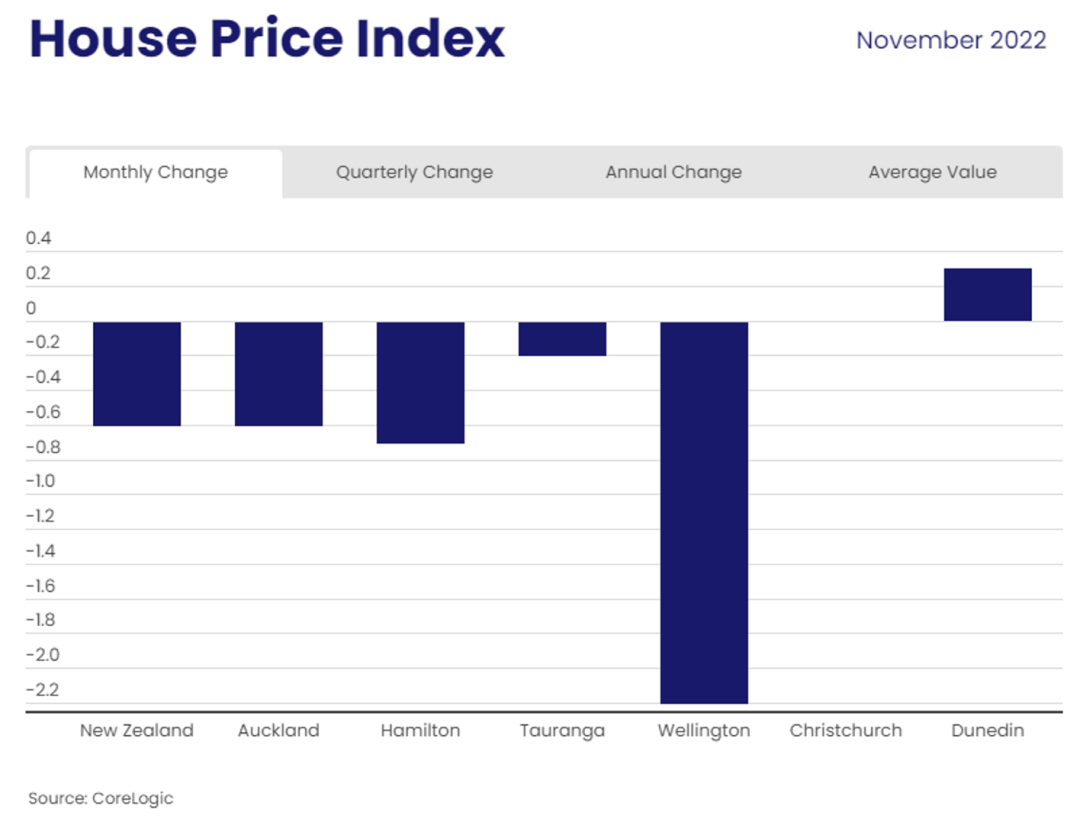
House price rises/falls vary across New Zealand’s main cities:
Wellington recorded a 15.9% fall last month. Its house price declines have slowed month by month, but remain greater than in other major cities, leaving it at the centre of the economic downturn.
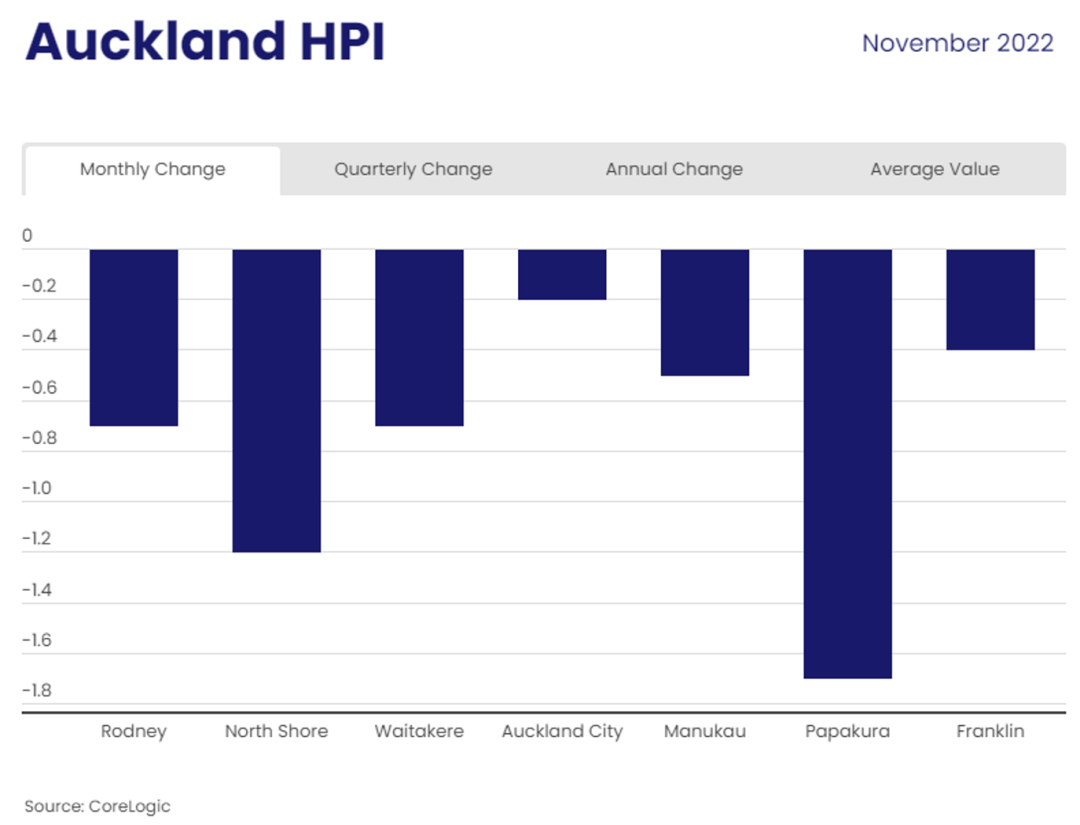
The Auckland region’s average house price fell 3.1% annually to NZ$1,300,000, but its monthly decline slowed to 0.6% in November. Property prices continued to fall across the city, although average values in Rodney and Franklin remained above last year’s levels.
Christchurch, by contrast, recorded annual growth of 4.9%, while Dunedin also performed better than most cities, rising 0.3%.
Although the declines are becoming more moderate, CoreLogic NZ head of research Nick Goodall said caution was still needed, because many November sales took place before the market was hit by the latest wave of pessimism and continuing interest rate rises.
He said housing affordability would remain an issue in 2023.
“Falling house prices are starting to improve many of the indicators we track, but continuing interest rate rises are affecting the ability to service mortgages.”
After several New Zealand banks announced interest rate increases, the market still does not know where mortgage rates will peak.
Goodall believes mortgage rates could rise to 8% next year. Some economists also predict that mortgage rates could reach as high as 9.5%.
Economists predict rates could reach 9.5%
Last week, the Reserve Bank raised the Official Cash Rate by 75 basis points to 4.25%, its highest level since 2008.
Independent economist Tony Alexander offered his own forecast: floating mortgage rates could reach 9.5% by the middle of next year, while popular one-year and two-year fixed rates could remain higher for longer.
He said that once the latest cash rate increase was factored in, and if the Reserve Bank raised rates by another 125 basis points to 5.5% as forecast, floating rates could rise to around 9.5% next year.
He also predicted that rates would remain high for longer. “I do think that when rates start falling, they will come down relatively slowly, because I don’t see a severe recession like the one in 2008/09 or during the Asian financial crisis in 1997/98.”
He said longer-term fixed rates, such as three- to five-year mortgage rates, could start falling before the middle of next year.
When will the Reserve Bank ease monetary policy? The market currently expects this around 2024.
“As we get closer to that point (2024), the cost of fixing for two, three or five years will fall. I think there is a good chance banks will lower their three- to five-year fixed rates before the middle of next year. But one- to two-year rates will take longer. Floating rates may be the last to turn.”
What exactly will next year bring?
As December began, Valocity director of valuations James Wilson set out his predictions for next year’s property market.
1
Reduced sales activity
There is no sign that sales volumes will rise substantially next year. We have seen more properties listed after spring and expect this to continue into summer, but they will not necessarily sell. More people may view properties while waiting to see what happens, but whether that translates into sales remains to be seen.
2
Fluctuating figures
If there are many sales one month and hardly any the next, the figures could really start to fluctuate. The performance of individual submarkets will be key to understanding what is happening. In Auckland, for example, newly built townhouses priced below NZ$1,500,000, typically the kind first-home buyers purchase, are performing strongly. But the market for large townhouses priced above NZ$3,000,000 in Auckland shows a different level of demand.
3
Who will buy and sell?
First-home buyers will be looking for opportunities next year. Less competition from investors means first-home buyers will be able to be more active in the market and maintain a higher share, even if the actual number of transactions falls. Investors are very sensitive to interest rate rises. Their market share will not necessarily fall substantially, but they will face pressure.
4
The election
No date has been set for next year’s general election, but historically people have tended to put property market decisions on hold before an election. In a hot market, FOMO, or the fear of missing out, dominates. With that effect now absent, the pause could be more pronounced than during recent elections. A change of government could boost the investor market, given National has said it wants to address some of Labour’s changes aimed at curbing investor activity. Watch for policies to take shape: the bright-line period could be shortened, and interest deductibility could also return.
5
OCR/Interest rates
Interest rate rises may continue. In its final statement of the year, the Reserve Bank made clear that the OCR could rise further to ease inflation. Last month’s 75-basis-point increase was the largest in the bank’s history, but the statement’s forecasts of recession and rising unemployment could have an even greater impact, causing prospective buyers and sellers to pause.
6
Inflation
Inflation is the elephant in the room—an obvious issue that is collectively ignored—and will not disappear overnight. Although cost-of-living pressures affect almost every aspect of daily life, we have not actually seen a significant fall in spending. This may be because many people have not yet had to make mortgage repayments at higher rates. Once they do, and mortgage rates really start to bite, spending could dry up. Clearly, that has wider implications for the economy, but the key question is: will conventional policy contain inflation, or will an economic hard landing do the job?
7
Property values
Property values have softened, and this trend may continue into next year, but at a slower pace. The market may become more stable rather than continuing to decline, although it could take several quarters for this to become clear.