
With mortgage rates climbing and properties generating negative cash flow, what options do investors have?
The Reserve Bank of New Zealand held its latest monetary policy meeting and released its new policy on 23 November. In line with market expectations, it raised rates by 75 basis points (0.75%), taking the Official Cash Rate (OCR) to 4.25%.
Another 75-basis-point rate rise: how many more will there be next year?
The Reserve Bank of New Zealand held its latest monetary policy meeting and released its new policy on 23 November. In line with market expectations, it raised rates by 75 basis points (0.75%), taking the Official Cash Rate (OCR) to 4.25%.
{ad}
Further rate rises are expected. The Reserve Bank said the OCR would peak at 5.5%, about 0.5% above its previous policy announcement in October and nearly 1.25% above its previous policy report in August: a striking increase. The red line in the chart below shows the projected OCR path released at this meeting.
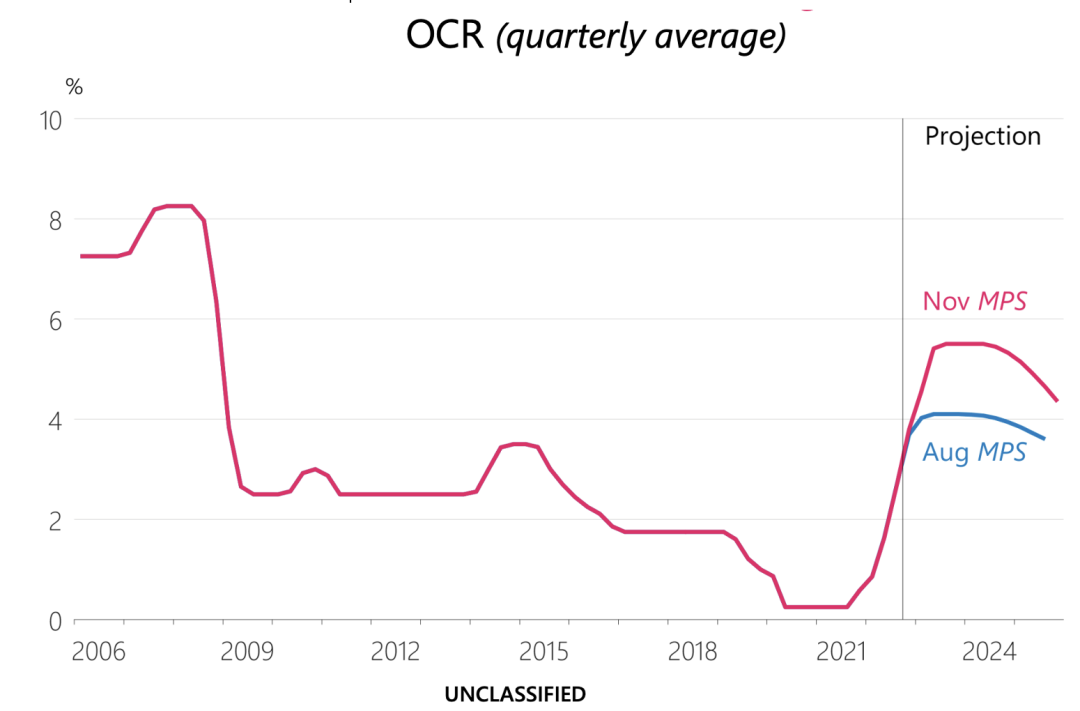
This means there could be 1 further increase of 0.75% in February next year, followed by another 0.5% before May, to reach the Reserve Bank's stated OCR of 5.5%.
Short-term mortgage rates reach 7%
The OCR underpins all interest rates, and mortgage rates always maintain a certain margin over it. Commercial banks use wholesale interest rate trends and factor in expected rises or cuts over the next 1–2 years to calculate rates for fixed terms of 1–5 years.
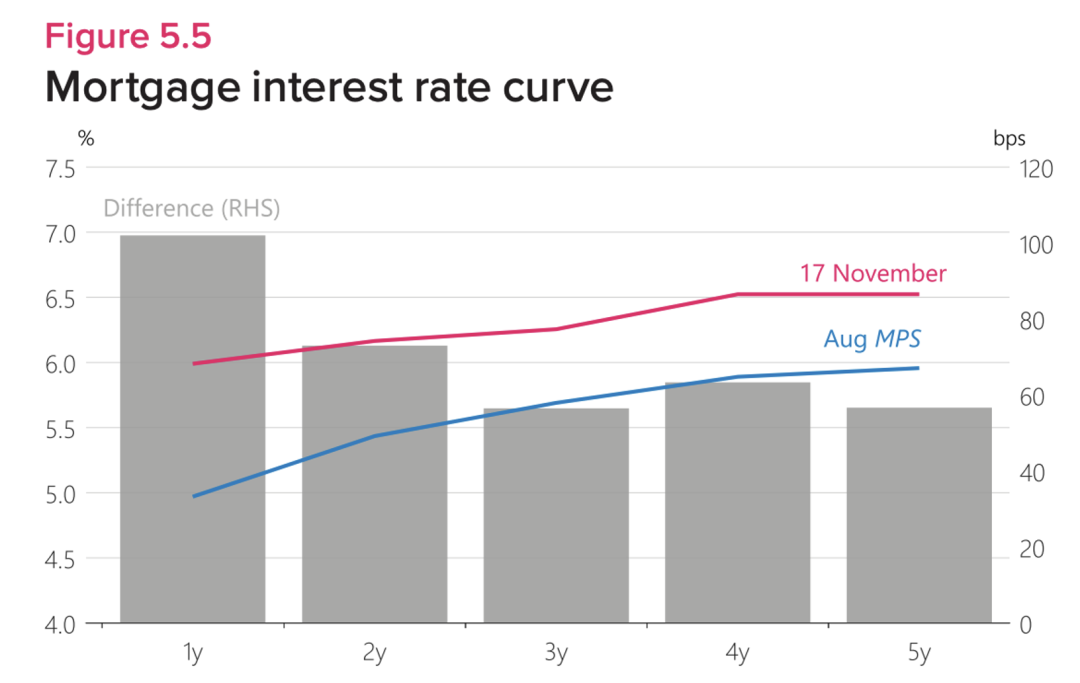
Current mortgage rates are around 6%, with the 1-year rate already approaching 7%. These already price in expectations of the OCR rising to 4.75–5%. The new monetary policy announcement will lift market expectations for the eventual peak in interest rates.
Market interest rates will rise over the days and weeks following the announcement as the new monetary policy report is priced in, and fixed mortgage rates will follow. If the Reserve Bank's projected peak OCR of 5.5% materialises, mainstream mortgage rates will generally approach 7% next year.
The grey section in the chart below shows mortgage rates for 1–5-year terms before this monetary policy report. Following its release, rates for 1–2-year terms are expected to rise by approximately 0.25–0.5%.
Negative cash flow for property investors
As rate rises continue, discussion about how to handle negative cash flow from property investments has become increasingly common. The forum discussion shown below, for example, has attracted considerable interest.

Property investors generally rent out their properties while holding them. Their annual income comes from rent, while their main expense is mortgage interest, alongside council rates, insurance and other costs. If income does not cover expenses, the result is negative cash flow. How much pressure have continuing rate rises placed on property owners, and what lies ahead? Here, we use a simple calculation to analyse the market through the numbers.
Rental yields are starting to rise
Rental yield is calculated by dividing annual net rental income by a property's market value, so it generally moves in the opposite direction to house prices: the higher market prices are, the lower the yield. Nationwide rental yields in New Zealand currently hover around 3–4%, with Auckland at 2.5%. The chart below shows property yields nationwide, with blue representing Auckland and red representing the rest of the country. Rental yields are now rising as house prices fall.
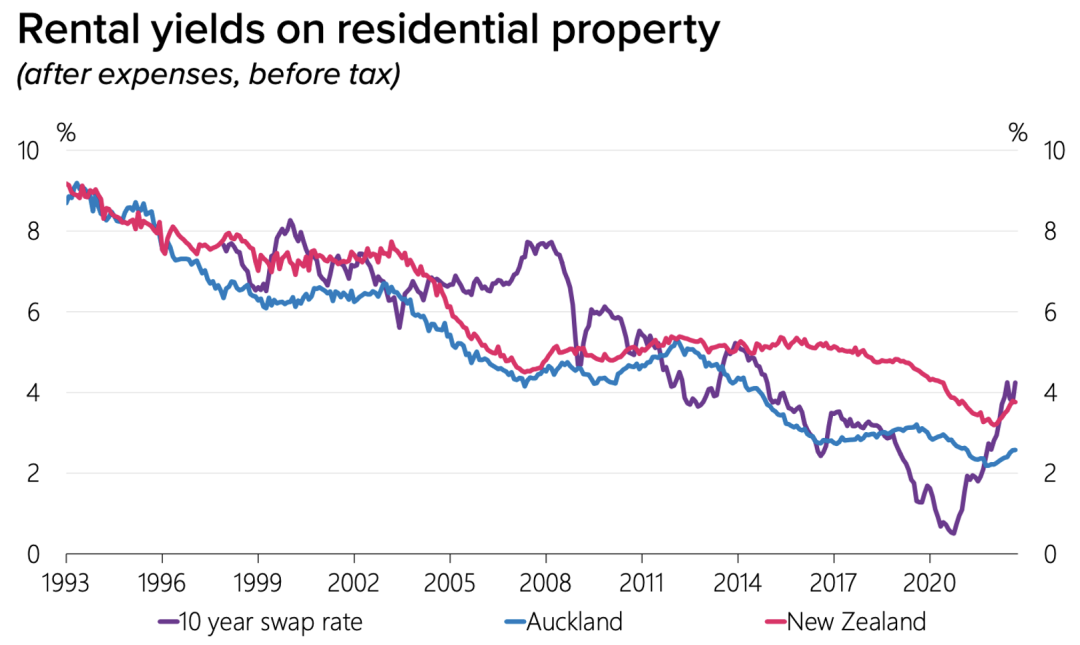
New Zealand house prices rose sharply over the past 3 years. Even after widespread falls of 10–15%, they remain around 25–30% higher than 3 years ago. Rents have also risen, but have not kept pace with house prices: nationwide rents increased by about 10–12% over the past 3 years. Rental yields therefore generally remain below their pre-pandemic level of 4.5%. Auckland, where house prices rose the most, also has the lowest rental yields, although the trend has begun to change.
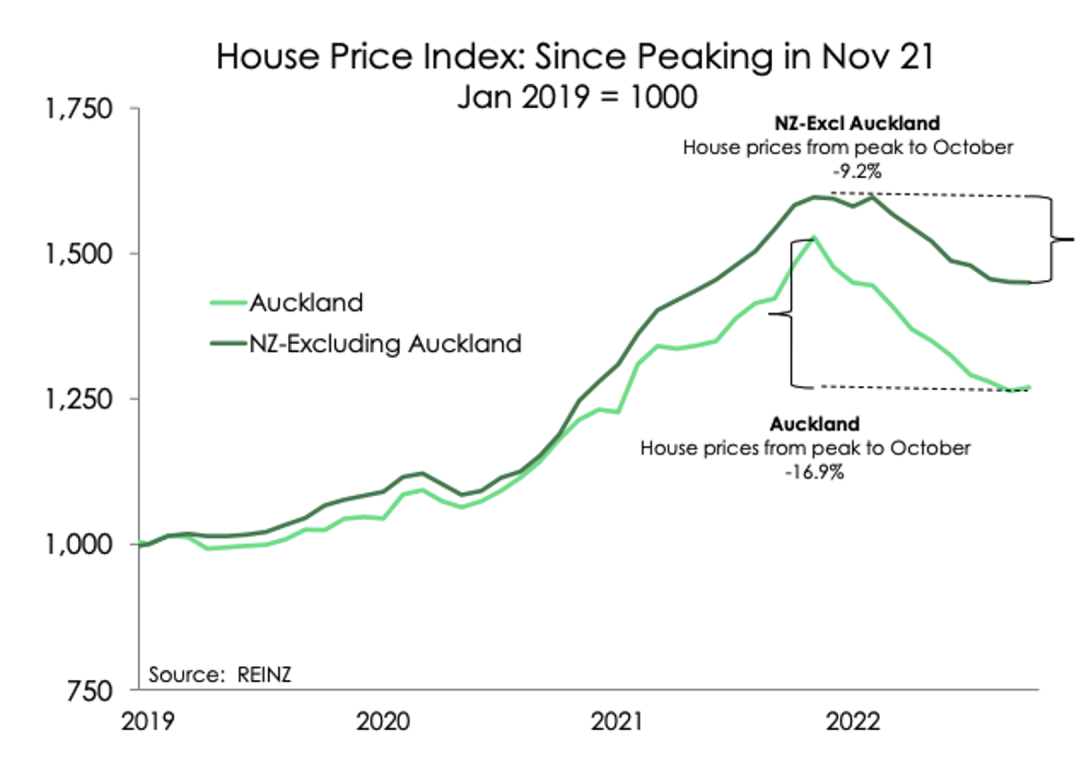
If an investor spent $1,000,000 on a rental property in the second half of 2021—with current house prices roughly back at second-half 2021 levels—their rental income, based on rental yields outside Auckland, would be around $35,000–40,000. Assuming a mortgage of $700,000 at an interest rate of 6%, annual interest expenses would exceed $42,000. Including council rates, insurance and other costs, total expenses would be expected to reach $46,000. After expenses, this would leave a rental shortfall of $8000–$10000, with a somewhat larger shortfall in Auckland.
This excludes any potential tax. Under current policy, tax on an existing property must be calculated and charged before deducting interest costs, and could amount to 20–30% of rental income. New builds do not face this problem, as their mortgage interest can be deducted before tax for 20 years.
Clearly, the good days when property investors enjoyed both capital gains and positive cash flow are gone. However, this situation may be limited in scope and short-lived.
Negative cash flow is not severe
The example above assumes the property was bought during the rapid price increases in the second half of 2021. Had the same property been bought before the second half of 2020, it might have cost only $850,000–900,000, with the mortgage correspondingly 10–15% smaller. Negative cash flow might then not arise. Negative cash flow therefore affects only those who bought in 2021, at the top of the cycle.
Relative to the amount invested, negative cash flow of close to 1% may still be manageable if it does not last long, even for those who bought in the second half of 2021. The Reserve Bank's monetary policy report indicates that rates will remain at their peak for about 1 year from next year, before falling as inflation is brought under control. If investors choose an appropriate fixed mortgage term, the difficult period may last only a little over 1 year. From an investment perspective, negative cash flow lasting just 1–2 years would not create a serious financial burden.
Tourism is recovering and net population inflows are beginning
As New Zealand's borders continue to reopen, tourists are returning, and arrival and departure numbers have changed markedly recently.
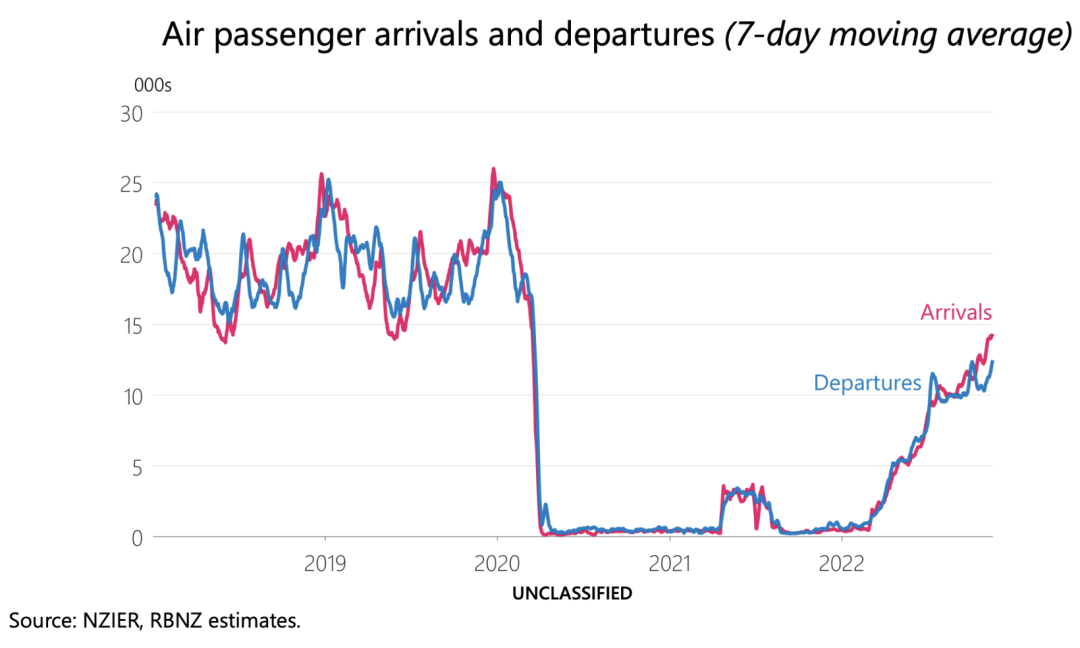
The chart above shows changes in arrivals and departures. Since the borders opened at the beginning of 2022, arrivals, shown in red, have gradually overtaken departures, shown in blue. The gap continues to widen, indicating a net inflow of people across the border. This will stimulate the residential rental market in 2022–2023. At the same time, strong demand for accommodation offering high daily rental returns, such as Airbnb, will continue to absorb existing rental housing stock.
Rents may therefore maintain a clear upward trend over the coming year. If rents rise by 4–5%, existing negative cash flow will also shrink.
The long-term trend has not changed
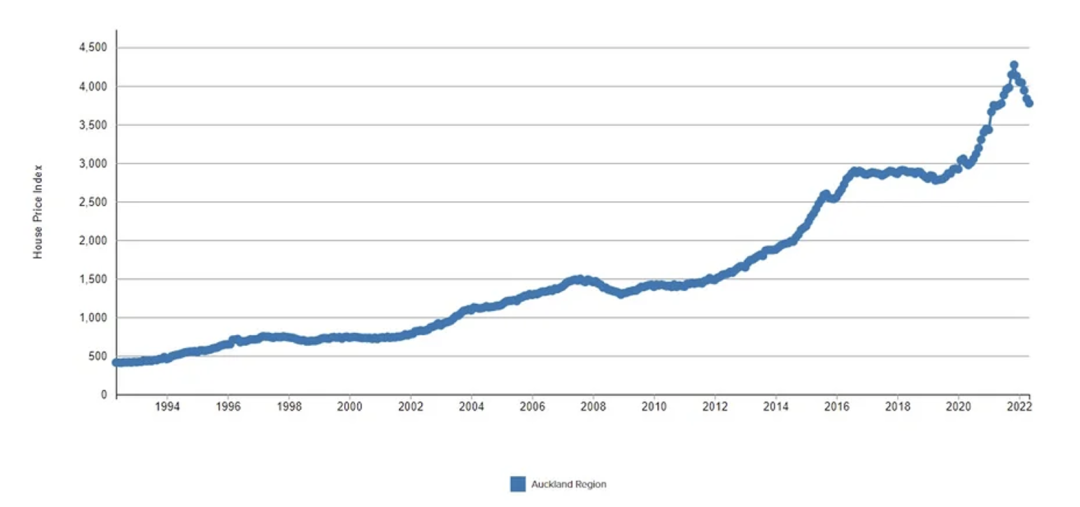
During a cycle of interest rate rises, almost all asset classes experience substantial volatility, leaving investors vulnerable to heavy losses regardless of where they invest. For example, stock markets worldwide generally fell by 20–30% in 2022, while commodity prices also fluctuated greatly. As an income-producing asset, property still offers valuable long-term stability and growth, particularly in New Zealand. Looking at New Zealand's house price history over the past 30 years, prices have risen steadily and consistently, with a compound annual growth rate of approximately 7%.
One cause of the current inflation is continuing geopolitical turmoil in the Northern Hemisphere, which may persist for some time. Far from these ongoing conflicts, New Zealand offers stable, dependable social development and will continue to attract high-income migrants from around the world.
Assuming incoming population numbers continue to grow, we believe New Zealand house prices will maintain their long-term upward trend once short-term volatility has passed. Continuing to invest in property remains a reliable way to achieve steady wealth growth.
Therefore, being able to withstand short-term negative cash flow of 1% could deliver long-term compound growth of 7%. Investors' persistence will be rewarded in the future.
Options available to investors
For investors, weathering volatility is part of the journey towards success. Beyond passively accepting external changes, property investors still have a range of actions available.
Increase rental income
Property investors can increase rental income by changing a home's internal layout or improve rental returns through short-term letting during peak seasons. Those with plenty of vacant land may even be able to add dwellings using various low-cost options exempt from approval requirements.
Control interest expenses
When high interest rates are nearing their peak, relatively short fixed terms should be chosen based on rate expectations. Once inflation is under control, rates will fall rapidly. When that decline begins, the expense outlook will improve significantly for borrowers who have not locked in high rates.
New builds offer greater tax advantages than existing homes
On tax, the National Party says it will scrap Labour's current policy preventing interest deductions for existing homes, but policy changes are unpredictable. Compared with existing homes, new builds allow interest expenses to be deducted before tax for 20 years. The bright-line period is also only 5 years for new builds, compared with 10 years for existing homes. From an investment perspective, new builds therefore have the advantage on tax costs. In the current market, many developers are eager to free up capital, so new builds may cost little more than existing homes. This deserves close attention.
Returning to the monetary policy outlook, interest rates are expected to begin falling in 2024. In fact, there is no need to wait until 2024: once expectations of future rate rises change, a new property cycle will quietly begin. Investors' short-term persistence will deliver long-term results. This summer marks the initial stage for investors to prepare and position themselves for that new cycle.