
Latest inflation figures released, and still high! What direct effect will this have on the OCR and mortgage rates?
At 10:45 this morning, Stats NZ released the latest CPI (Consumers Price Index) figures as scheduled.

Stats NZ releases the latest inflation rate
At 10:45 this morning, Stats NZ released the latest CPI (Consumers Price Index) figures as scheduled. New Zealand's annual inflation rate in the fourth quarter of last year was 7.2%, unchanged from the third quarter and slightly below the second quarter's annual rate of 7.3%.

Although the result was slightly above earlier outside forecasts, the figures also suggest that New Zealand's high inflation may be losing momentum. Stats NZ said rising housing and household costs, including water, electricity, internet and gas, made the largest contribution to inflation in the fourth quarter of last year, driven by higher home construction costs and rents. Meanwhile, rising prices for food, vegetables, meat and poultry pushed up food prices overall. Transport costs were the second-largest contributor to price rises, driven by higher international and domestic airfares.
Notably, on the day the figures were released, Jacinda Ardern left Parliament for the last time as prime minister, while Chris Hipkins was sworn in as the new prime minister at New Zealand's Parliament.
New Prime Minister Hipkins says tackling inflation and the soaring cost of living will be among his top priorities. Last weekend, he said his government would focus on the bread-and-butter issues that most directly affect people's lives. However, a range of domestic and global factors still appear to be influencing inflation in New Zealand, meaning the new prime minister faces a major challenge from the moment he takes office.
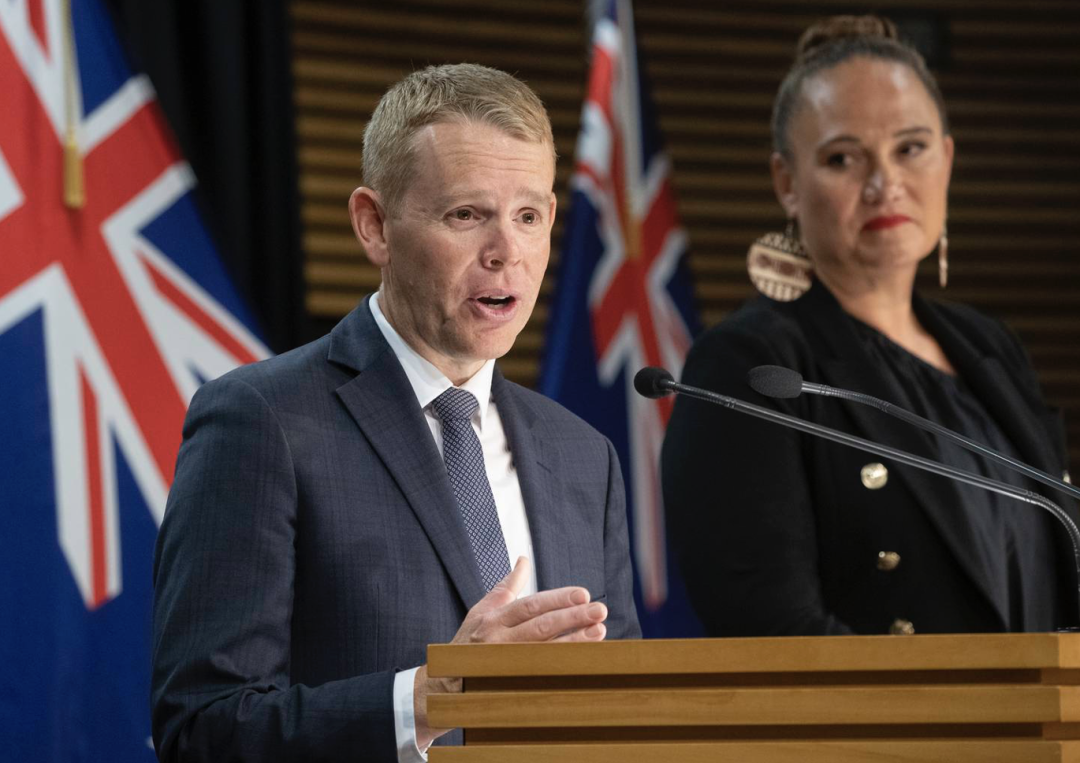
Sharply rising prices are an urgent top priority for new Prime Minister Chris Hipkins
Stats NZ revealed last week that food prices jumped 1.1% in December last year, leaving them 11.3% higher than a year earlier. This was the highest food price increase in 32 years, with fruit and vegetable prices up a striking 23% on a year earlier.
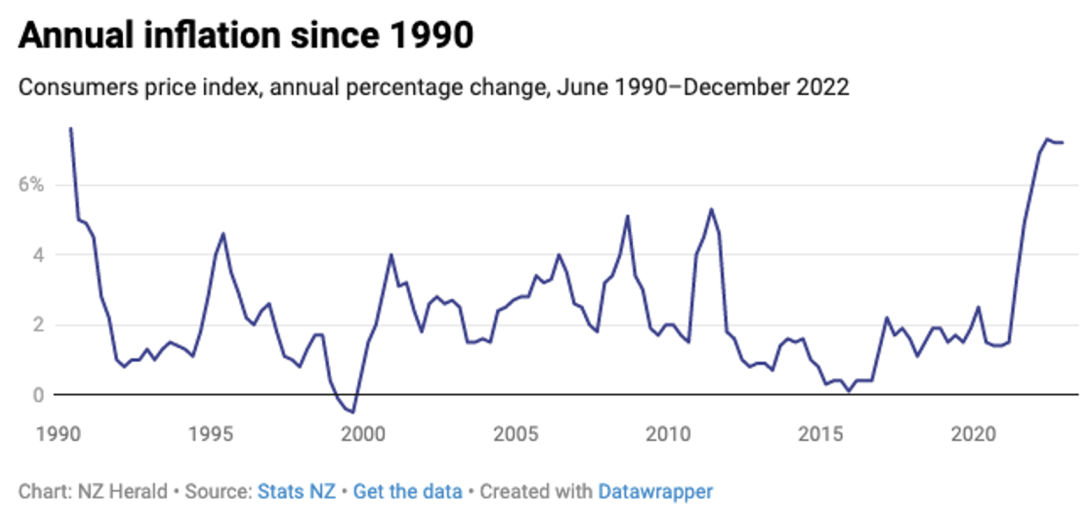
Consumers Price Index (CPI) trend from 1990 to December 2022
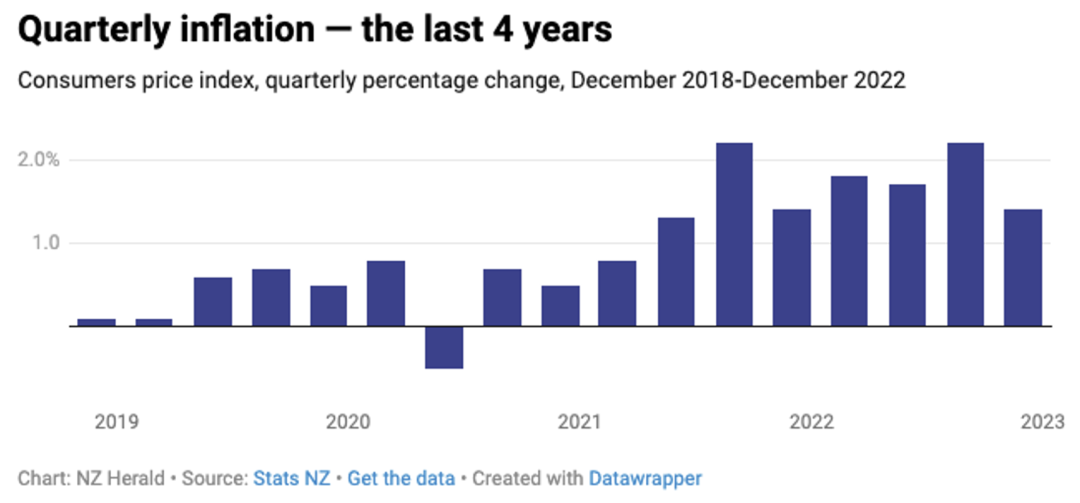
Quarterly Consumers Price Index (CPI) trend over the past four years
Will the OCR rise by another 75 basis points?
Before today's CPI release, many commentators had speculated that, after inflation remained stubbornly high at 7.2% in the third quarter of last year, an even worse result might follow. They suggested CPI inflation could reach 7.5% or even approach 8%, a 32-year high. That would validate the Reserve Bank of New Zealand's earlier forecast that inflation would remain high for longer in 2023.
In recent years, the Reserve Bank of New Zealand has been raising the Official Cash Rate to curb domestic inflation. It has repeatedly reaffirmed its determination to tackle high inflation and return it to the 1%–3% target range. It said the OCR would rise by another 75 basis points at the next monetary policy review on 22 February, matching the 75-basis-point increase at the last review in November and taking the OCR to 4.25%. It also said the OCR could peak at 5.5% around the middle of this year.
{ad}
Kiwibank's economists have a different view on the size of the next OCR increase. They believe current market conditions call for an increase of only 25 basis points, or a middle-ground increase of 50 basis points. In Kiwibank's weekly economic publication First View, chief economist Jarrod Kerr, senior economist Jeremy Couchman and economist Mary Jo Vergara have been focusing on the “far-reaching effects” of the Reserve Bank of New Zealand's rate rises on mortgage rates, which have almost tripled.
They say that if the next OCR increase is only 50 basis points, it will affect the “terminal cash rate”. They forecast that the OCR could reach only 5.25% at the April monetary policy meeting, with a lower peak of 5%. They believe the Reserve Bank of New Zealand's rate increases to date have already provided sufficient restraint on inflation, and that a terminal cash rate of 5% or lower could also meet the Bank's inflation-fighting requirements.
Undeniably, economists, business owners and households still share the goal of getting through this period of high inflation safely this year. The Reserve Bank has no room to retreat in its “war” against inflation. It is eager to win that “war” this year, so it can only continue raising interest rates.
The good news is that expectations for further rate rises are being scaled back. With goods inflation slowing, global inflation may already have peaked, making 2023 a year of sharp reversal in price pressures. They forecast that by the end of this year, New Zealand's inflation rate will be “slightly above” the upper limit of the Reserve Bank of New Zealand's 1%–3% target range, before falling to around 2% early next year. The decline may be slow, but the downward trend has begun…