
Why do property bargains exist? How can you find a home below its true market price in New Zealand today?
In mid-February, REINZ released its house price report covering the period to January 2023, showing that New Zealand’s property market was still declining

In mid-February, REINZ released its house price report covering the period to January 2023, showing that New Zealand’s property market was still declining. Based on REINZ’s median figures, Auckland house prices had returned to their September 2020 level of about $950,000. The median house price was 21.7% below its peak, and sales volumes had also fallen sharply. See the chart below for details:
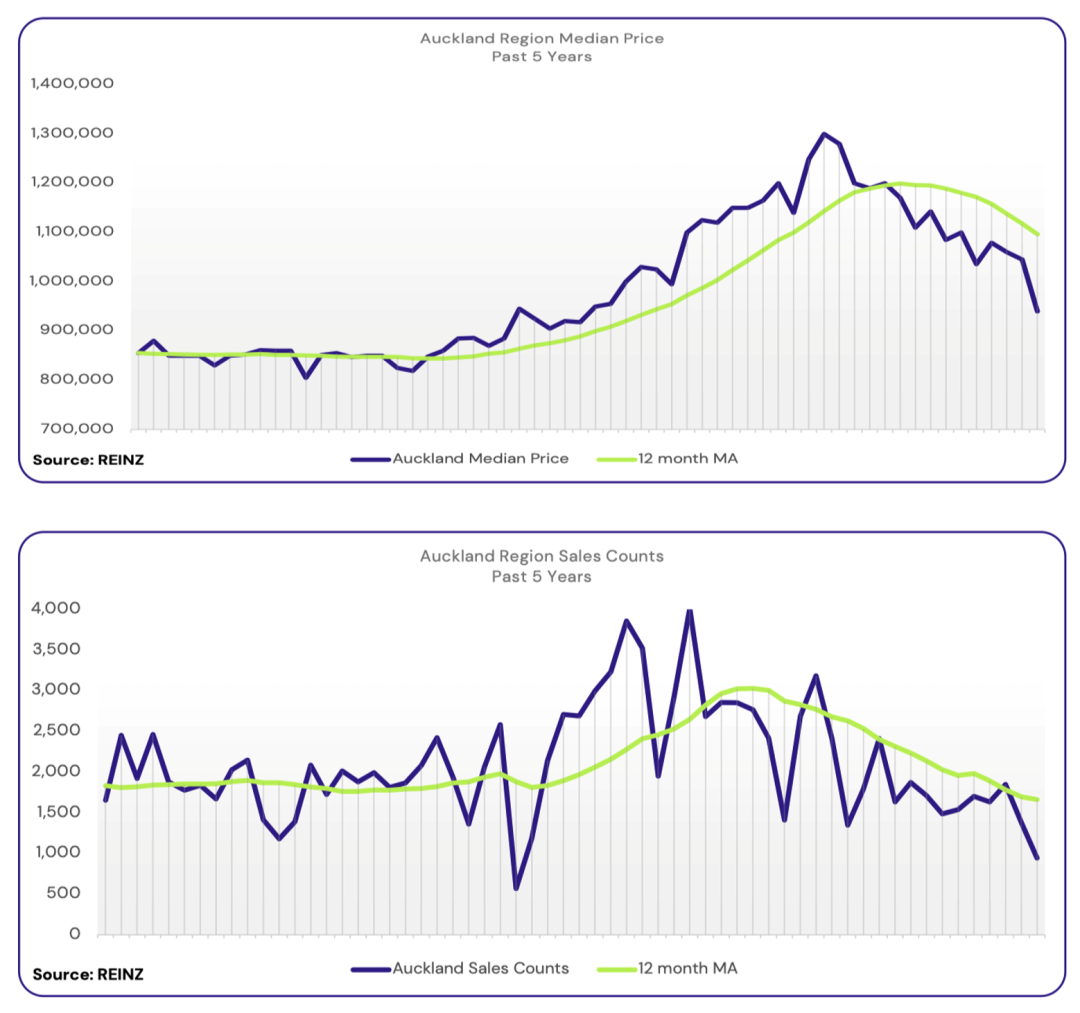
The current market downturn is undeniable, but times like these are often when market anxiety is greatest. Statistics tend to magnify market conditions, pushing buyers’ and sellers’ expectations to extremes. At such times, many buyers can actually find‘property bargains’—homes priced below their true market price.
The property market’s iceberg effect
Why do property bargains exist? This brings us to the property market’s iceberg effect. People generally assess the market through sale prices, but this often reveals only the tip of the iceberg. This is especially true in a subdued market, where very low sales volumes distort prices.
For example, suppose there are 10 similar homes awaiting sale in an area. Usually, the one that appears to offer the best value will sell first. At a particular point, 9 are asking $1,050,000, while 1 sells for $1,000,000, establishing that price as the market benchmark. Without another sale, everything seems quiet. In fact, the other 9 properties are changing behind the scenes; those changes simply cannot be seen.
After a while, only 1 seller is still willing to accept $1,050,000, while 8 want $1,100,000. Later, all 9 are asking $1,100,000. But without a sale, the recorded sale price remains $1,000,000 until a new transaction occurs. When it does, the price may change sharply in a discontinuous jump, prompting the media or people unaware of the market’s underlying changes to exclaim that house prices have shifted dramatically.
This resembles an iceberg: recorded sales sit above the surface, while the real forces lie hidden beneath it. Hence the term ‘iceberg effect’. It exists in both rising and falling markets. The fewer the sales, the more pronounced the effect, allowing property bargains to emerge.
“Property bargains’: what are they?
The term ‘property bargain’ comes from Hong Kong and refers to a property priced below its true current market price. Buying one can mean saving a substantial sum. House price cycles have been particularly pronounced in recent years, but even the rise from the trough to the peak was only 40%. In a falling market, some bargains can be priced 20% or more below the market’s underlying transaction price trend. Buying such a home is known as ‘snapping up a bargain’.
Property bargains are more common when sales are subdued, especially around the market bottom and in the early stages of recovery. Because of the iceberg effect, everyone focuses on the lowest recorded sales. The constant barrage of news and statistics continues to influence sellers, putting their expectations out of step with market trends. This creates far more opportunities for bargains, with discounts much larger than the market’s potential underlying decline.
For example, the fall in Auckland’s median price shown in the latest REINZ figures may not feel nearly as pronounced in the market around us, because most Chinese buyers are looking at standalone houses with land. In REINZ’s statistics, the subdued market means homes that sell tend to meet essential housing needs. With very low sales volumes, lower-end transactions account for a large share, distorting the statistics and exaggerating the decline. But reports of these falls and lower sale prices have a strong effect on sellers’ expectations, giving buyers more opportunities to snap up bargains.
{ad}
How can you find a property bargain?
To find a bargain, consider the following:
1
Do your research and prepare:
Before making any investment, it is important to understand the market and your own circumstances. This includes researching market trends and current economic conditions, and understanding factors that may affect property prices, such as mortgage interest rates, rental conditions and your purchasing capacity. Alongside publicly available research data, it is best to obtain detailed figures for the specific areas you are interested in.
2
Identify potential markets:
Look for areas where house prices are falling or are expected to fall. Consider factors such as population growth, local employment trends and future transport infrastructure.
3
Consult professionals and property advisers:
Working with a real estate agent who knows the local property market is very important. They will understand price changes on individual streets, potential shifts in sellers’ expectations, and even have information about many properties that have not been listed. Generally, larger local agencies have access to more market resources.

4
Timing is crucial:
Timing is crucial when buying property in a subdued market. Buyers can certainly wait until prices bottom out before acting, but should not wait too long. Stay alert to market developments and be ready to commit, or you may miss a good opportunity.
5
Stay flexible:
If you are willing to consider a wider area and different property types, you may find better deals. In a strong market, even homes with shortcomings can sell. Similarly, in a subdued market, those shortcomings are magnified and may lead to larger discounts. Buyers should be open to negotiating with sellers and prepared to be flexible over the terms of sale.
6
Attend auctions and be willing to make offers:
You can only understand what is happening in the market by participating more. Making more offers also helps you understand sellers’ current expectations. Many sellers only discover their true bottom line when faced with an actual offer.
7
Consider mortgagee sales:
Mortgagee sales can be more complicated than ordinary transactions, but often provide excellent opportunities to observe the market and make a purchase. Many property bargains come directly from mortgagee sales.
8
Ask real estate agents about off-market properties:
Many homes are being offered for sale without being publicly listed, and only real estate agents know about them. The sale prices of many such properties are also never made public. Spend more time with agents, visit more open homes and talk to them to gain more information and opportunities.
9
Do not fear missing out, but always be ready to buy:
Nobody knows where the bottom is. A home’s value depends on your intended use and how you feel about it. The market has already fallen, and various policies have suppressed potential purchasing power, but a recovery could also happen quickly. So when an opportunity appears, act promptly.
These are some practical tips for finding a property bargain. Finally, we wish every buyer success in finding the home they want.