
Reserve Bank announces another 25-basis-point OCR rise today! Has a commercial bank already followed suit?!
The Reserve Bank of New Zealand (RBNZ) today raised its Official Cash Rate (OCR) by another 25 basis points to 5.5%

The Reserve Bank of New Zealand (RBNZ) today raised its Official Cash Rate (OCR) by another 25 basis points to 5.5%. The bank reiterated that it still considers 5.5% the peak of the current OCR cycle and expects the rate to begin falling in the third quarter of 2024.
A strong market reaction
Interest rate markets reacted strongly to the Reserve Bank's monetary policy statement. The two-year swap rate fell sharply from 5.55% to 5.19%, while the ten-year swap rate dropped from 4.53% to 4.37%. In the bond market, the two-year government bond yield fell from 5.13% to 4.79%, while the 10-year bond yield declined from 4.45% to 4.30%.
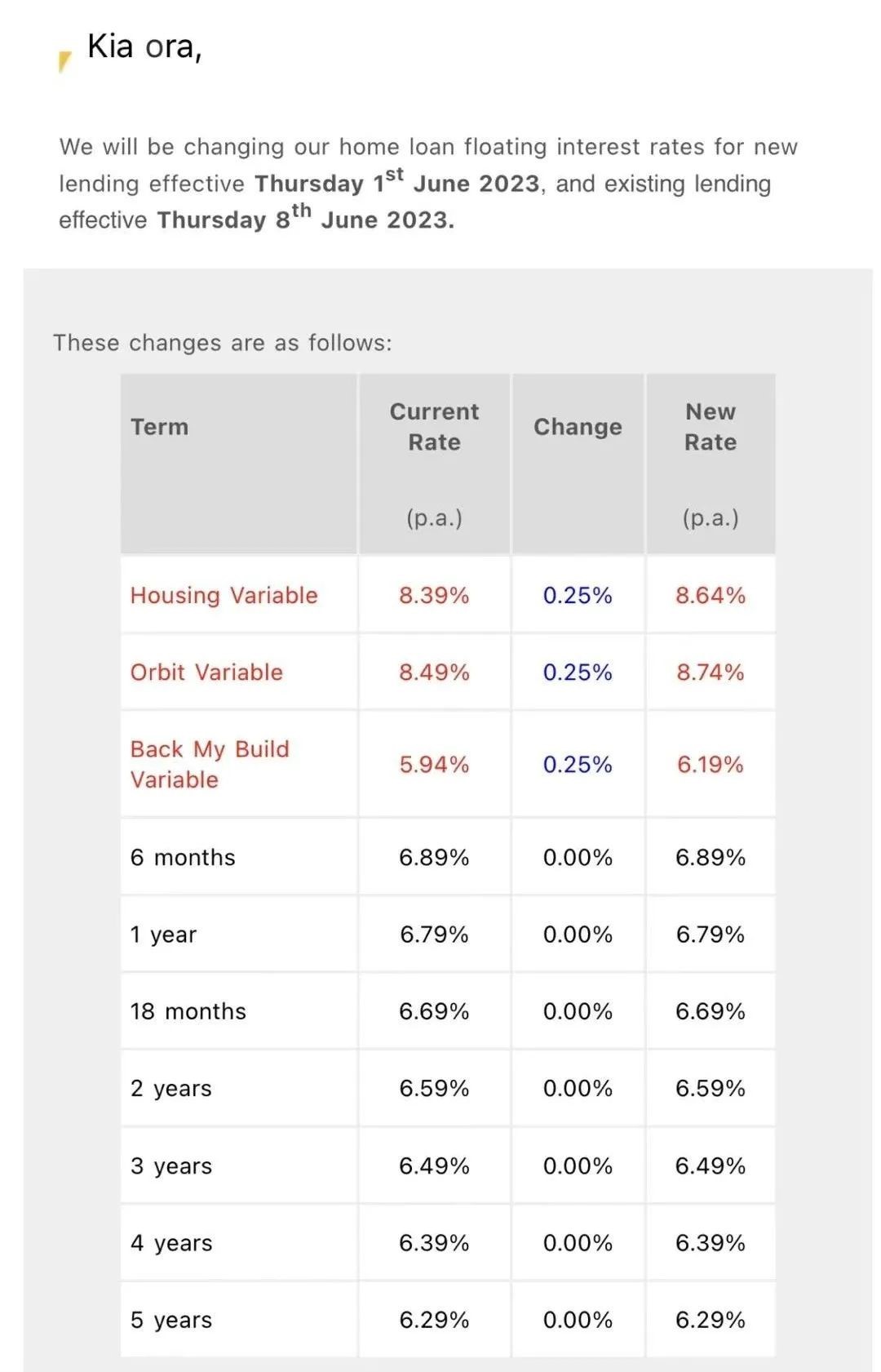
These market reactions all increased downward pressure on fixed interest rates, making this significant good news for mortgage holders. ASB was the first major commercial bank to respond, raising its floating mortgage rate from 8.39% to 8.64% and its ORBIT home loan rate from 8.49% to 8.74%.
Has the OCR reached the peak of this tightening cycle?
Even before the Reserve Bank of New Zealand released its latest monetary policy statement, many economists had stressed that, despite the bank signalling an OCR peak of 5.50% for this cycle, various signs pointed to further increases. Since the Reserve Bank raised the OCR from 4.75% to 5.25% in April, net migration has continued to rise, while the Government released its Budget last week. Both developments have added uncertainty to the OCR outlook. Previously, 5.5% was widely forecast to be the peak of this cycle; now, many economists predict the cash rate could rise to 6%.
With the Reserve Bank of New Zealand working hard to suppress inflation and the economy showing no signs of slowing, ASB had forecast another 50-basis-point increase this week.
ASB chief economist Nick Tuffley said today's monetary policy statement was something of a double-edged sword. He estimated the Budget would provide a 1.7% boost to the economy, but that the Reserve Bank still needed to “keep fighting” inflation. Rising net migration helps ease labour shortages but also puts downward pressure on wages, while stimulating demand for goods and services. Inflationary pressure persists, and monetary policy works with a lag, meaning the Reserve Bank could still raise rates further.
Similarly, before last week's Budget announcement, Westpac chief economist Kelly Eckhold had already raised his forecast OCR peak to 6%. This followed the Treasury's assessment last week based on net migration rising to 66,000 people. Eckhold said New Zealand's strong labour market continued to attract more people to the country. The bank expects annual net migration to New Zealand to reach 100,000 by the end of this year. This sharp increase would lift New Zealand's population growth rate from 0.5% at the end of 2022 to 2.4% by the end of this year, ushering in one of the fastest periods of population growth in decades and signalling a substantial increase in labour demand from more businesses.
Unlike those two banks, economists at BNZ and ANZ have both put their forecast OCR peak at 5.75%, and consider another rate rise in June more likely.
BNZ head of research Stephen Toplis believes the new Budget will be “the straw that breaks the camel's back”, because it will add to future inflationary pressure. He expects the Reserve Bank to raise rates by 25 basis points both today and in July, bringing the peak to 5.75%. Although he opposes further rate increases, the Reserve Bank's recent fear of high inflation makes it difficult to see it ending its rate rises in the short term.
Surprisingly, even Kiwibank, consistently the most dovish on controlling inflation, also considered a rate rise today a certainty. Kiwibank chief economist Jarrod Kerr had previously said the Reserve Bank of New Zealand did not necessarily need to raise the OCR above 5%, believing new migrants and the Budget would both help bring inflation under control. Whether today's OCR increase was 25 or 50 basis points was therefore not the most important aspect of this monetary policy decision.
Opposition to rate rises from the mortgage market
Recently, David Cunningham, the newly appointed chief executive of prominent New Zealand mortgage company Squirrel and former chief executive of The Co-operative Bank, wrote an open letter to Reserve Bank of New Zealand Governor Adrian Orr, stating that there is no longer any need for interest rate increases in the current financial market.
He believes more and more New Zealand households are feeling the pain of mortgage rate increases, and their repayment pressure will not ease even without an OCR rise. He explained that even if the OCR stays at its current level, the average mortgage rate paid by New Zealand borrowers will rise to 5.9% next year as large numbers move from lower fixed mortgage rates to higher ones.
{ad}
The Reserve Bank has said it hopes to push unemployment up to 5% to help control high inflation. Rising net migration will bring tens of thousands of workers to fill urgently needed vacancies and help relieve pressure from high wage costs. Meanwhile, the additional economic demand generated by new migrants' consumer spending may be negligible.
Cunningham believes the Reserve Bank of New Zealand should not strangle the economy or place greater pressure on already overburdened New Zealand borrowers to bring inflation down faster, as this would undoubtedly inflict more financial pain on countless households。