
Breaking: skilled migration dramatically simplified! Immigration Minister suddenly resigns? Former immigration officer explains who will find it easier to gain residence
On 21 June 2023, Immigration New Zealand announced its latest skilled migration changes, including a new 6-point Skilled Migrant Category (SMC) system

On 21 June 2023, Immigration New Zealand announced its latest skilled migration changes, covering the new 6-point Skilled Migrant Category (SMC) system, Accredited Employer Work Visas (AEWV), the Green List and the Highly Paid Residence Category. Overall, the skilled migration points system is simpler, giving highly skilled people a clearer pathway to a resident visa.
The changes also reinforce the importance of employer accreditation. Whether applying under the 6-point SMC system, for an AEWV or through the Green List, employees must work for an accredited employer or hold a job offer from one. If you want to retain your employees, securing employer accreditation is essential.

Michael Wood
Yet in an unexpected development just hours after the announcement, New Zealand Immigration Minister Michael Wood suddenly announced his resignation! He is under parliamentary investigation over a suspected potential conflict of interest involving undeclared Auckland Airport shares. Earlier this month, he resigned as Transport Minister. Today, following the immigration policy announcement, he also resigned as Immigration Minister. His successor is Andrew Little, a former Labour Party leader.

Andrew Little
Policy overview
Changes to the Skilled Migrant Category:
- Takes effect on 23 October 2023
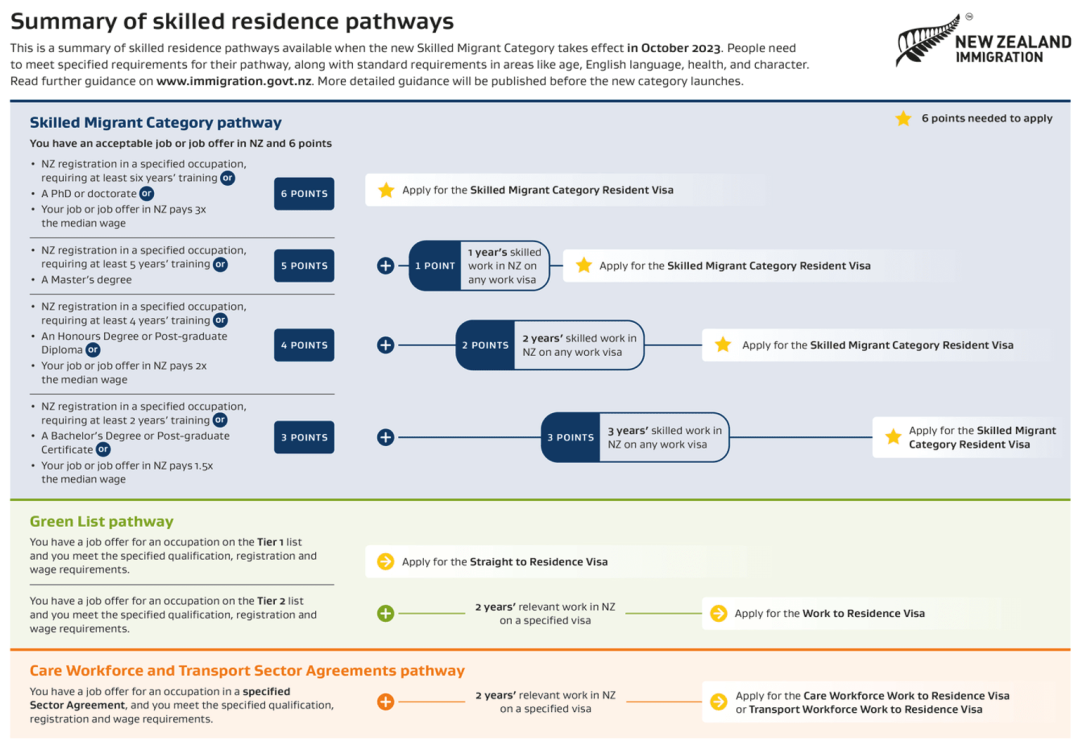
- Introduces a new 6-point system
- No cap on applicant numbers
- Target application processing time of 6–8 weeks
- Points earned through qualifications or income, and work experience
- Standard health and good character requirements
- English language requirement: IELTS 6.5 or equivalent
- Must have a current skilled job offer
- Applicants need 6 points from the following:
- Points from qualifications: a level 7 qualification (bachelor’s degree) earns 3 points; a level 8 qualification (bachelor honours or postgraduate qualification) earns 4 points; a level 9 qualification (master’s degree) earns 5 points; and a level 10 qualification (doctorate) earns 6 points.
Or
- Points from income: the median wage earns 0 points; 1.5 times the median wage earns 3 points; 2 times the median wage earns 4 points; and 3 times the median wage earns 6 points.
And
- Points based on a current skilled job offer and work experience: each year of skilled work in New Zealand earns 1 point.
It is also important to note that all SMC applicants must have a job or job offer from an accredited employer in New Zealand, paying at least the median wage. Applicants in ANZSCO skill level 4 or 5 roles must earn at least 1.5 times the median wage.
Changes to the AEWV work visa category:
- Work visas can be granted for a maximum of 5 years
- After 5 years, visa holders must leave New Zealand
- New AEWVs will be valid for 5 years
Changes to the Green List:
The Highly Paid Residence Category will be abolished and incorporated into the new SMC system.
To examine this major overhaul of the immigration system, YIJU New Zealand invited Sonny Lam, a former Immigration New Zealand officer and now an immigration lawyer, to provide an in-depth analysis.
About the expert
Sonny Lam
Senior immigration lawyer at Queen City Law
Former immigration officer at Immigration New Zealand
YIJU: What changes will the new system bring for applicants? Could you explain them in detail?
Sonny Lam: This change is very good for new migrants to New Zealand, provided they can find a good job. For example, people in the following situations can apply for New Zealand residence:
- Bob has a bachelor’s degree in commerce. He has found an analyst role in Auckland paying $94k a year (1.5 times the median wage). Under the 6-point system, he can earn 3 points for his bachelor’s degree or 3 points for his salary. He can apply after working in New Zealand for 3 years, earning 3 points for New Zealand work experience to reach 6 points, with 3 points from his bachelor’s degree or 3 points from earning 1.5 times the median wage.
- Amy has a programming background but no formal degree. She has received a job offer as a cybersecurity specialist paying $190k a year (3 times the median wage). She can apply immediately because she already has 6 points: 6 points for earning 3 times the median wage.
- Trevor is an executive chef earning $124k a year (2 times the median wage). He worked in New Zealand for two years, from 2021 to 2023. He can apply immediately because he already has 6 points: 4 from his salary and 2 from his New Zealand work experience.
- June has a master’s degree. She can earn 5 points for her qualification and apply for residence after a year of skilled work in New Zealand.
The new system is more welcoming to new migrants, and I am optimistic about the future. With no cap and simpler settings, it offers an excellent opportunity to migrate to New Zealand.
It may be more difficult for recent graduates. For example, if their pay is below 1.5 times the median wage, they will need to gain New Zealand work experience.
For example, someone with a bachelor’s degree earning less than NZ$44.49 an hour must demonstrate skilled work experience in New Zealand from 2020 to 2023 to qualify under the new SMC system: 3 points for their bachelor’s degree and 3 points for New Zealand work experience.
For high earners and highly educated migrants, however, this policy is a positive development.
YIJU: What will visa processing times be under the new policy?
Sonny Lam:Immigration New Zealand aims to complete processing within 6–8 weeks, which is a bold prediction. It previously planned to process most applications within 12 months under the 2021 Resident Visa scheme, but for many people it did not complete processing within that timeframe.
I think a more realistic timeframe under the new policy is 3 months. Chinese passport holders in particular should be aware that processing is very likely to be delayed further by national security checks (NSC).
YIJU: How will the new policy’s work duration requirements affect students and recent graduates?
Sonny Lam:The new SMC policy could have both positive and negative effects. As mentioned above, it is very favourable for high earners who can apply immediately.
However, it is actually somewhat disadvantageous for recent graduates and current students in New Zealand, because they must spend 3 years in skilled employment in New Zealand before they can apply for a resident visa, unless they earn NZ$44.49 an hour.
The problem is that not all jobs qualify as skilled work, and this is a particularly tricky area. For example, working as a waiter or retail assistant would not be considered skilled employment.
In my experience, the usual career path would be:
- Obtain a bachelor’s degree
- Obtain an open work visa and start looking for work
- Work in an entry-level role for 1–2 years
- After 1–2 years, gain promotion to a role that meets the definition of skilled employment
- Work for another 3 years
- Apply for residence
For most new graduates, the expected wait will therefore be around 5 years, unless they can secure a skilled role after graduating.
YIJU: What impact will the new AEWV work visa and its 5-year work limit have?
Sonny Lam:I think work visa holders with a suitable job are very likely to be able to apply for residence within 5 years. Under the new SMC system, working in New Zealand for 5 years already earns 5 points. If applicants can increase their pay to NZ$44.49 an hour, or have a bachelor’s degree, they can apply for residence within this 5-year limit.
YIJU: Overall, how does the new SMC policy differ from the previous one, and what impact will it have?
Sonny Lam:There is no mention of partner bonus points, which means there is no shortcut to the requirement to work in New Zealand for 3 years to reach 6 points.
The new policy also makes no mention of bonus points for working outside Auckland, so it does not encourage migrants to work elsewhere. I expect Auckland’s population and house prices to grow substantially from 202 onwards. By contrast, demand in other regions and small towns will decline. Hamilton, Wellington and Tauranga are likely to be the biggest losers, as many people currently choose to work there to gain bonus points under the existing SMC policy, but may in future be drawn to skilled job opportunities in Auckland.
{ad}
Overall, this new system is very encouraging, and I expect the economy to benefit. I believe Auckland in particular will develop rapidly as its population density increases substantially, which will benefit the construction and property markets.