
CPI inflation officially falls to 6%! Is the fight against high inflation over? Experts warn there is still a long way to go
On Wednesday morning, Stats NZ released the closely watched latest consumer price index (CPI) figures, showing inflation in the second quarter of this year had fallen from 6.7% in the previous quarter to 6.0%

On Wednesday morning, Stats NZ released the closely watched latest consumer price index (CPI) figures, showing inflation in the second quarter of this year had fallen from 6.7% in the previous quarter to 6.0%.
Rising food prices remained the biggest contributor to persistently high CPI inflation. In the year to June, vegetable prices rose 23.3%. Prices for ready-to-eat food and for milk, cheese and eggs rose 9.8% and 13.8% respectively.
The second-largest contributor was housing and household utilities, driven by rising construction costs and rents. New house construction prices rose 7.8% in the 12 months to June 2023, compared with 11.5% in the 12 months to March 2023. Over the three years since the June quarter of 2020, the cost of building a new house has risen by more than a third. Rents rose 4.2% in the 12 months to June 2023, compared with 4.3% in the 12 months to March 2023.
Stats NZ's Nicola Growden said prices were still rising at their fastest pace since the 90s of the 20th century, although the increase was smaller than in recent quarters. On interest rates, the two-year swap rate, which influences mortgage rates, was little changed at 5.345%.
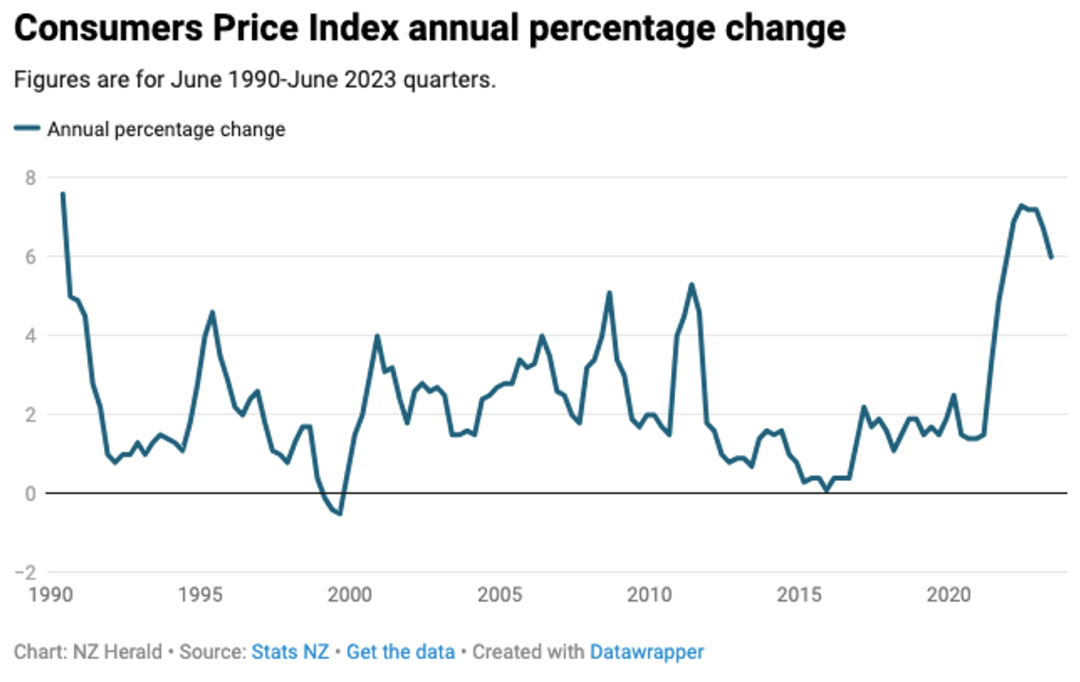
1990 to the present: changes in CPI (source: Stats NZ)
Westpac senior economist Satish Ranchhod said inflation had fallen, but only modestly, and some measures of core inflation had actually picked up in June, indicating that underlying price pressures remained. In other words, inflation was unlikely to return to the Reserve Bank of New Zealand's target range in the short term. ASB economist Kim Mundy shared this view, saying the Stats NZ figures did not show that the Reserve Bank of New Zealand had done enough to curb high inflation, and that, at this stage, an OCR cut remained a distant prospect, with hope of a cut only once CPI inflation falls below 3%. The Reserve Bank seems unlikely to consider this before 2024.
Even before the latest CPI figures were released, prominent independent New Zealand economist Cameron Bagrie had warned that, although inflation had eased slightly, there was still a long way to go and people would need to keep tightening their belts… He said that while high inflation had improved, inflation of 6% was still very high and a long way from 2% (the Reserve Bank of New Zealand's inflation target is 1–3%).
Economists' expectations for CPI
For economists, CPI is simply a macroeconomic indicator. For ordinary people, it represents everyday essentials and the practical question of whether a family can afford to eat. According to Stats NZ's food price index for June, food prices rose 12.5% from a year earlier, mainly driven by sharp increases in the prices of eggs, yoghurt and cheese. Bagrie warned that the Reserve Bank still faced a considerable challenge in bringing inflation under control in 2024. Reducing inflation from 6% to 2% meant demand would need to fall below supply, creating some excess supply before prices would fall.

Prominent independent New Zealand economist Cameron Bagrie
Bagrie further warned that people needed to prepare for weak economic conditions that could last for years. While this did not mean we were going through a period of financial hardship, it did mean we needed to rebalance demand and supply. He concluded that the period of rapid economic growth was over and we were now experiencing an economic slowdown.
ASB economists had previously forecast inflation of 5.9% for the year and a second-quarter increase of 0.9%. In the bank's Economic Weekly, they said they expected non-tradable inflation to remain relatively firm at 6.4%, above the Reserve Bank of New Zealand's forecast of 6.3%. How encouraging the latest CPI release would be for the Reserve Bank therefore depended on the details and whether underlying inflation pressures had eased. The key was how much confidence this would give the Reserve Bank when setting the OCR at its next monetary policy decision.
How does New Zealand compare in the global battle against CPI inflation?
As New Zealand released its latest inflation figures yesterday, many other countries were also grappling with rampant inflation. How has the Reserve Bank of New Zealand performed compared with its overseas counterparts?
Westpac chief economist Kelly Eckhold offered an interesting analogy: if the fight against inflation were a beauty pageant, the judges would say the New Zealand and US contestants had performed reasonably well, or at least had not fallen off the catwalk. The US recently reported annual inflation of 3%, lower overall than New Zealand's, although inflation across US states was higher, at close to 4.5% to 5%. The headline US consumer price index for urban consumers includes food and energy, but excluding energy prices, its core index rose 0.2% in June and 4.8% over the year.

The US core inflation index released last week showed annual growth of 4.8% (source: NZME)
New Zealand lags the US on some key inflation, trade and macroeconomic figures, and falls in the prices of certain key products and raw materials take time to flow through to the New Zealand market. The decline in US inflation, meanwhile, has benefited from plunging oil and gas prices. International headline inflation figures showed UK inflation at 8.7% in May this year, German inflation at 6.4% in June, and Australian inflation at 7% in the first quarter. Eckhold said the US and New Zealand had done somewhat better than other countries because they had recognised the challenge of high inflation early and adjusted interest rates quickly. New Zealand's official cash rate currently stands at 5.5%, compared with 5.25% in the US. In stark contrast, Australia's central bank had consistently lacked decisiveness, leaving it with a lower cash rate and higher headline inflation.