
Surge or slump? New Zealand’s 5 major banks release their latest house price forecasts for 2024
Although the Reserve Bank of New Zealand held the cash rate at 5.5% this Wednesday, the wording of its Monetary Policy Statement seems to have offered homeowners little comfort

Although the Reserve Bank of New Zealand held the cash rate at 5.5% this Wednesday, the wording of its Monetary Policy Statement seems to have offered homeowners little comfort. The Reserve Bank also said it could not rule out another cash rate increase in November. In other words, uncertainty will continue to hang over mortgage rates for some time. So should we take a more pessimistic view of the housing market in 2024?
In fact, the major commercial banks have recently revised their house price growth forecasts for 2024, suggesting that many economists are very optimistic about the housing market in 2024.

The major banks’ latest house price growth forecasts for 2024 vary, ranging from 2.3% to 8%. At the start of this year, however, their forecasts generally ranged from a fall of 2.6% to growth of 3.3%. In this article, we examine the latest forecasts for next year’s house prices from New Zealand’s five major commercial banks. Why are they more optimistic about the housing market’s future? And what has prompted them to revise their house price and interest rate forecasts?
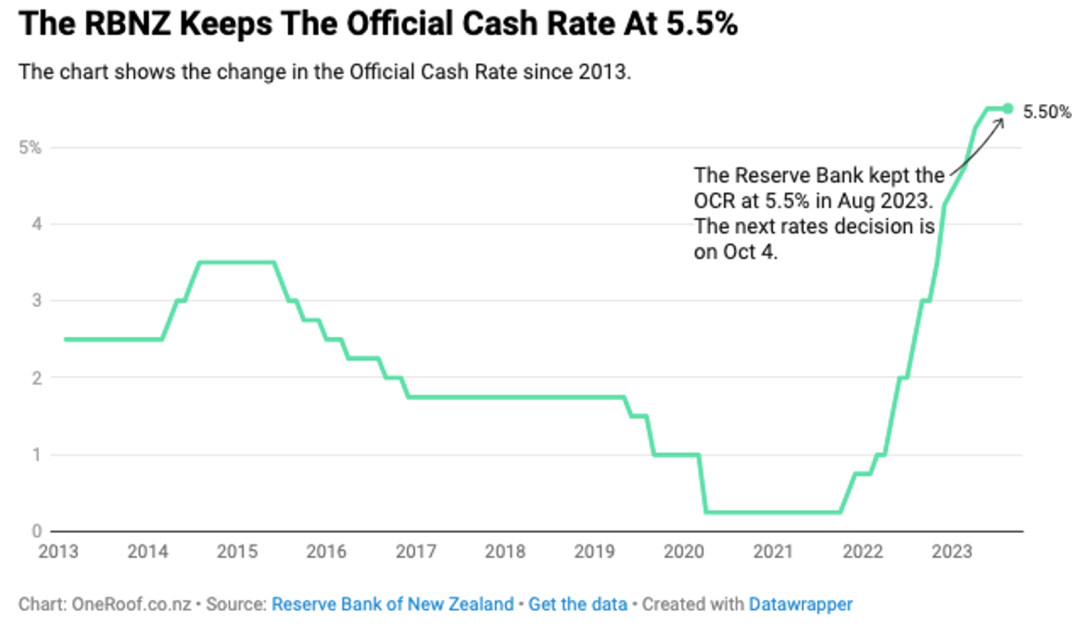
2013–2023: chart of changes in the Reserve Bank of New Zealand’s cash rate (Source: RBNZ)
ANZ Bank
At the start of this year, ANZ economists forecast that house prices would fall 1.3% in 2024. They have now revised that upwards to growth of 2.3%. Senior economist Miles Workman said one of the biggest surprises over the past year had been the strong increase in net migration, which would ultimately boost housing demand and directly contribute to rising house prices.
He noted that the Reserve Bank of New Zealand had recently eased LVR restrictions, with mortgage demand picking up slightly, particularly among first-home buyers. Another factor was the Credit Contracts and Consumer Finance Act (CCCFA), introduced in December 2021. Although its implementation contributed to the housing downturn, the government’s subsequent fixes to flaws in the rules represented, in a sense, another easing of financial conditions. Household balance sheet data also provided clear evidence that incomes were still growing strongly, with many households having built considerable financial resilience since the pandemic.
ANZ has also substantially revised its OCR forecast, from the peak of 4% it expected last year to a peak of 5.75% by the end of this year. Workman said high inflation was the main reason for the revised forecast. The bank believes further tightening is needed to force inflation back into the target range of 1–3%.

BNZ Bank
BNZ, which also uses QV data, forecasts that house prices will rise 7% in 2024, up 4 percentage points from its forecast 8 months ago. BNZ senior economist Craig Ebert likewise sees the strong increase in net migration as the main reason for the bank’s revised forecast.
Ebert said the bank could have forecast stronger house price growth, but rising mortgage rates, a slowing economy and an easing labour market had tempered its expectations.
ASB Bank
ASB chief economist Nick Tuffley said its forecasts were based on QV’s house price index. Currently, ASB has revised its house price forecast for 2024 from a fall of 2.6% to growth of 7%.

ASB Bank’s chief economist Nick Tuffley
Tuffley acknowledged that ASB had revised its house price forecasts several times this year. Net migration rose rapidly, particularly in February and March, and monthly net migration has remained high at between 5000 and 7000. Net migration is expected to exceed 92,000 people by October this year, which will have a significant impact on the housing market.
In August last year, ASB, like other institutions, expected the cash rate to peak at 4%. Although other financial institutions now forecast 5.75%, ASB maintains that the cash rate will remain at 5.5% and begin falling in the second half of next year.
Kiwibank
{ad}
Kiwibank chief economist Jarrod Kerr said in January this year, Kiwibank forecast house price growth of 4% for 2024, but subsequently raised that to 5%. However, he also noted: “The Reserve Bank of New Zealand’s forceful monetary policy has dictated the market’s future, while overlooking the severe blow that rate increases since late last year have dealt to households with mortgages. Household spending patterns have quietly changed. High inflation is forcing New Zealanders to spend more on essentials, while they are also cutting spending on big-ticket items.
He said bluntly that official cash rates far above expectations a year ago were a global challenge. The current situation was difficult because inflation would persist. This was also a situation the Reserve Bank of New Zealand would prefer to face, rather than genuinely weak economic data and deflation caused by low inflation.
Westpac Bank
Westpac Bank’s January forecast was for house prices to rise 1% in 2024, but it has now revised that to growth of 7.7%. The bank’s senior economist Satish Ranchhod said there were three main reasons for the changed housing market outlook:
01
The housing market bottomed out and began recovering much earlier than the bank’s economists expected;
02
The cash rate has peaked, giving home buyers greater confidence;
03
Population growth is stronger than at any point in recent years, which will drive the housing market. Historically, the housing market has also picked up during periods of particularly strong growth in new migrant numbers.
A year ago, Westpac, like other banks, forecast that the cash rate would peak at 4%. Now, like ANZ, it expects the OCR to rise to 5.75% in November. High inflation is the main reason for the revision. It had expected inflation to peak at around 6% to 6.5%, but inflation actually rose well above 7%.
Do you think house prices will rise or fall next year? Share your views!