
Chinese buyers exempt from tax? The controversies surrounding lifting the foreign buyer ban! Could New Zealand house prices surge again?
This week, National Party leader Christopher Luxon and finance spokesperson Nicola Willis announced their NZ$14,600,000,000 tax relief policy

This week, National Party leader Christopher Luxon and finance spokesperson Nicola Willis announced their NZ$14,600,000,000 tax relief policy and pledged to reverse a series of tax measures affecting property investors. YIJU New Zealand has compiled some of the existing policies National says it will change:
- Restore full interest deductibility for rental properties.
- Lift the ban on foreign buyers purchasing properties worth more than NZ$2,000,000, and impose 15% stamp duty on these transactions. Overseas buyers would still be barred from purchasing properties below NZ$2,000,000.
- National previously pledged to reintroduce a 90-day notice period for tenants and remove the requirement for renewed tenancies to have fixed start and end dates once a fixed-term tenancy expires.
The proposal to lift the foreign buyer ban has delighted those working in the luxury property market, but has also sparked considerable controversy among the public and other political parties. Labour, for example, has asked: could a foreign buyer tax embroil New Zealand in international legal disputes? Would countries such as China oppose it? Could this revenue really be collected?
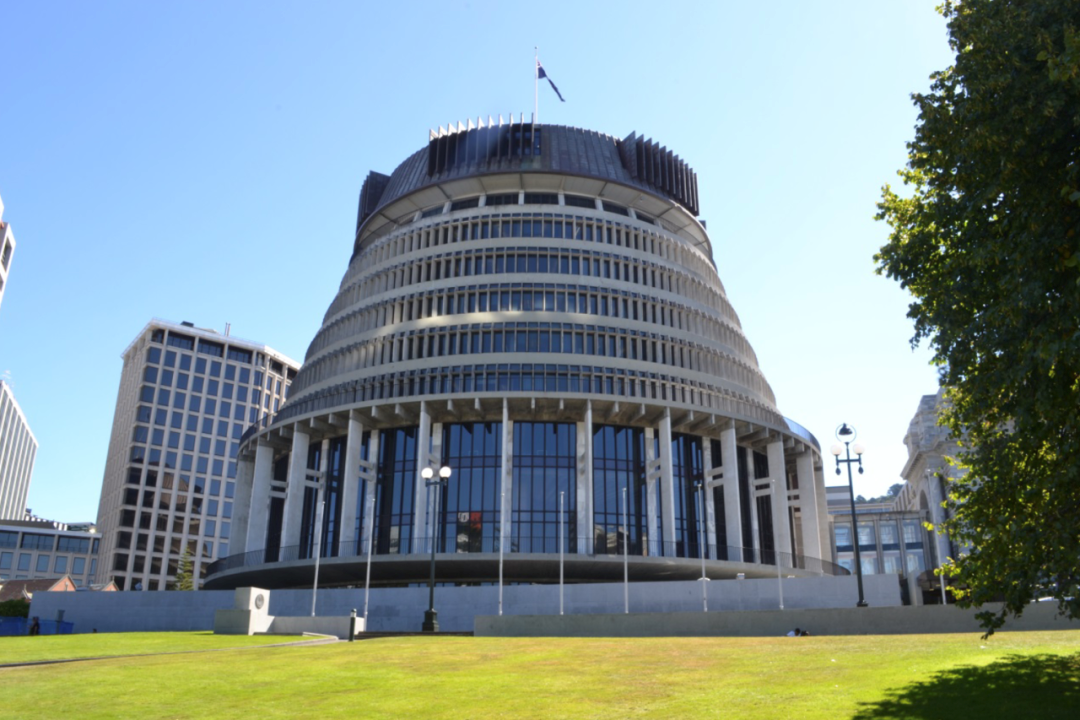
2,000,000 New Zealand dollars and above: can these properties generate enough tax revenue?
National spokesperson Niolca Willis said that, if elected, National would impose 15% stamp duty on overseas buyers purchasing properties worth NZ$2,000,000 or more, claiming this would generate an additional NZ$740,000,000 in annual tax revenue.
Does New Zealand really have that many properties worth more than NZ$2,000,000? Property data from OneRoof and Valocity shows that only 5% of residential properties nationwide are worth NZ$2,000,000 or more. Queenstown-Lakes has the highest proportion of properties that overseas buyers would be allowed to purchase under National's policy, with 29% of its residential properties falling within the permitted range. In absolute numbers, Auckland has the most properties worth more than NZ$2,000,000, while the West Coast has the fewest, with just one.
The research also found that, of the 133170 properties sold nationwide since August 2021, only 7177, or 5.3%, sold for NZ$2,000,000 or more. Auckland remained the main centre for high-value property transactions. This raises the question: if National lifts the foreign buyer ban, what would it mean for New Zealand house prices?
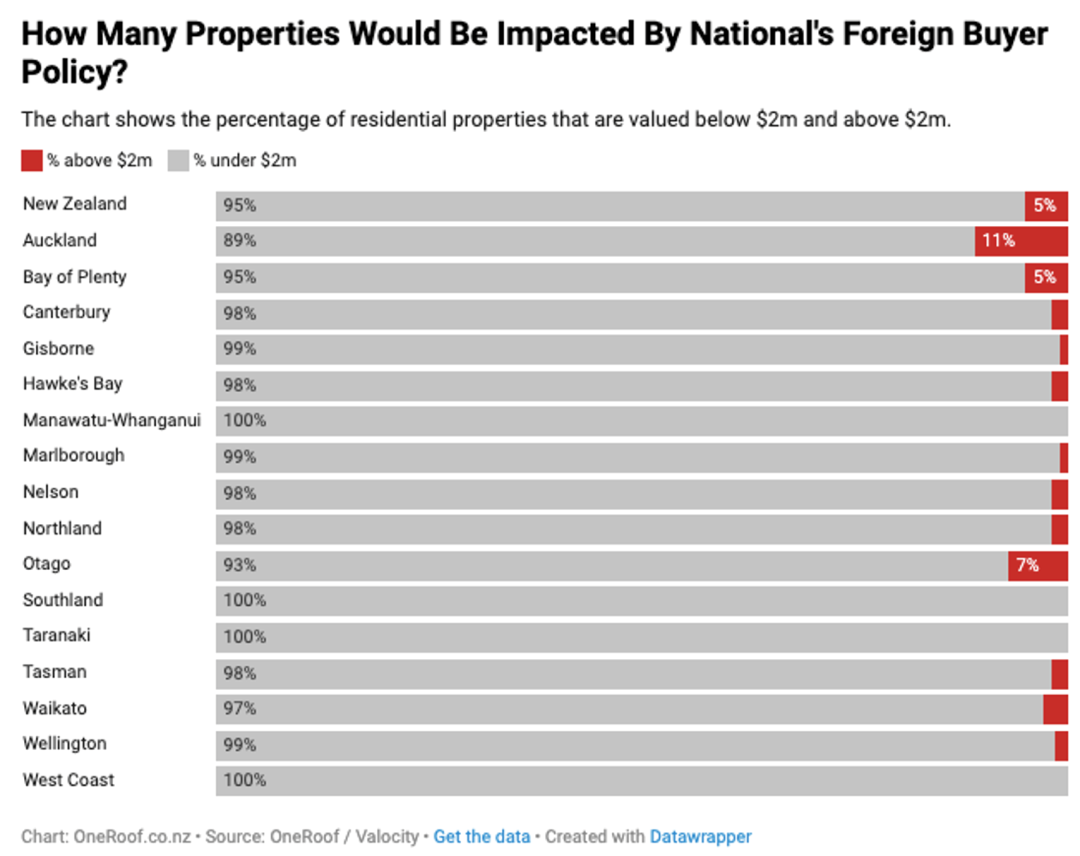
Percentage of the housing market affected by overseas buyers in New Zealand's main cities (Source: OneRoof/Valocity)
Tax experts: potential international disputes with China and other countries
A number of tax experts say that, from a legal perspective, changing the foreign buyer ban could face considerable difficulties even if National is elected and fulfils its pledge. They believe National's proposed foreign buyer tax could embroil New Zealand in international legal disputes and face opposition from major global powers such as China.
This is because New Zealand has dozens of international tax treaties, many containing non-discrimination clauses, including those with China, Japan, Mexico and Australia. Tax experts in the private sector and at Inland Revenue have identified four agreements that appear to prohibit New Zealand from implementing tax policies such as National's foreign buyer tax. Experts say these clauses are a major obstacle to introducing the tax.
In other words, if the foreign buyer tax conflicts with non-discrimination provisions, citizens of countries that have signed these treaties, including China, might not need to pay the tax—or could not be required to pay it.
Labour's overseas investment spokesperson David Parker said Chinese citizens could not be required to pay the foreign buyer tax. In a statement, he wrote that Chinese citizens would not have to pay the 15% tax on foreigners, rendering the revenue forecasts intended to fund the tax cuts meaningless.
David Parker said: “The central funding source National intended to use to pay for half its tax cuts has officially collapsed. Public tax advice provided to a parliamentary select committee clearly states that ‘the non-discrimination provisions in the new double taxation agreement apply to taxes of every kind and description’. Current National MPs Paul Goldsmith, Andrew Bayly, Judith Collins and Ian McKelvie were members of the Finance and Expenditure Committee when it considered the agreement in 2019.”
“This means Chinese citizens must also be exempt from National's proposed tax, alongside the already acknowledged exemptions for Australia and Singapore. In the year before overseas speculators were banned, Chinese buyers accounted for 36.7% of home transfers to non-New Zealanders. Adding Australia (19%) and Singapore (3.5%) means at least 60% of home transfers to non-New Zealanders would be exempt from National's tax.”
University of Auckland tax law expert Professor Craig Elliffe said the non-discrimination clauses would be difficult to enforce. He said changes to New Zealand's domestic law could override tax treaties, but doing so would itself breach international law.
Political parties respond
Labour finance spokesperson Grant Roberton said National's cuts to public services were more than twice those announced by the Government on Monday. He also stressed that National's misleading costings for the revenue from its proposed taxes appeared unlikely to materialise. He said collecting NZ$740,000,000 annually from overseas buyers depended on ever more overseas buyers entering New Zealand's property market each year and being willing to pay an additional 15% tax—an implausible proposition.
Labour's Public Service Minister Andrew Little said National's proposed cuts to public service spending would inevitably affect service quality to some extent, reducing access or leaving people waiting longer for services.
ACT leader David Seymour also promptly criticised the savings offered by the package as “a drop in the bucket” and said it was too similar to Labour's plan. He said plainly: this was not a comprehensive tax relief policy, but tinkering that made minor adjustments to unfair aspects of Labour's tax policy. That was not enough for New Zealand, which needed sweeping reform.
National also proposed restoring interest deductibility for landlords in the hope of lowering rents. Unfortunately, it promised a phased introduction over three years rather than immediate restoration upon taking office. Seymour said National should adopt ACT's plan and implement it immediately. Landlords and tenants were under immense pressure and needed relief now, rather than in the future.
Green Party co-leader James Shaw was adamant that National's plan would benefit landlords and property investors rather than groups such as students and beneficiaries. He criticised National's tax relief plan as a cynical ploy to cut taxes for the wealthiest few while disregarding the interests of most people. Under National's plan, those on the lowest incomes would gain nothing, while high-income property speculators could continue lining their pockets.
Optimism in the luxury market
After National announced the policy, Hamish Walker, chairman of Queenstown property sales company Walker and Co Realty, said its tax policy was “good news for Queenstown and a huge boost for those working in high-end construction”. He believed overseas buyers were unlikely to compete with New Zealanders for properties because they operated in an entirely different market. As an example, he said a property he sold last year could have fetched several times its sale price, well above NZ$30,000,000, had Americans been allowed to buy it. Local buyers simply did not have that purchasing power. Just last week, clients had told him they would happily pay some additional tax if the New Zealand Government allowed them to buy luxury homes.
Ross Hawkins, who handles luxury property transactions at Ray White, also welcomed National's announcement. He said the proposal addressed earlier concerns that lifting the foreign buyer ban would make buying a home harder for local first-home buyers. He did not believe the policy would cause house prices to surge if implemented. Despite the severe economic blow New Zealand had suffered, he believed it remained a safe haven in the South Pacific, with many buyers around the world still willing to settle here long term.
Queenstown-based independent economist Benje Patterson also said the policy would certainly put pressure on New Zealand's luxury property market, but would definitely not affect the ordinary residential market because overseas buyers would be outside that price range.
Infometrics chief economist Brad Olsen said the tax policy successfully removed a ban in a market that had little relevance to ordinary New Zealanders while also generating some tax revenue. It would not affect most families wanting to buy a home, or even those buying an investment property.
Bayleys head of insights Chris Farhi said the policy would stimulate demand in the luxury property market without “overstimulating” it. This was because overseas property markets were currently relatively quiet, and many countries had introduced restrictions on capital moving offshore. He also noted that sellers near the NZ$2,000,000 threshold might price a NZ$1,995,000 property just above NZ$2,000,000 to attract overseas buyers. Whether it would sell at that price, however, would be determined by the market.
How overseas buying has changed since the ban
{ad}
Bayleys property expert John Greenwood said the luxury property market had “disappeared” since the ban, with wealthy overseas buyers going to other countries. But those buyers would return if the ban were lifted, because New Zealand was a beautiful country. For these buyers, NZ$5,000,000 was a drop in the ocean; most were high-net-worth individuals.
Mark Harris, managing director of New Zealand Sotheby's International Realty in Queenstown, likewise believed the market above NZ$5,000,000 would be affected most. Demand for luxury property would come from wealthy buyers in international markets such as the United States, the United Kingdom and Asia. Prices in luxury markets elsewhere in the country could also be affected, including Waiheke Island, some high-value Auckland properties, the Bay of Islands, and parts of Tauranga and Nelson. He firmly believed overseas buyers remained interested in New Zealand as a place to own property.
Do you think the foreign buyer ban can be lifted smoothly? Share your views.