
Will we have to wait 18 months for a rate cut? Another major bank raises mortgage rates! The latest developments property investors should watch
On 21 August, ASB raised most of its fixed mortgage rates

01
ASB raises rates again
On 21 August, ASB raised most of its fixed mortgage rates. See the chart below for the specific increases:
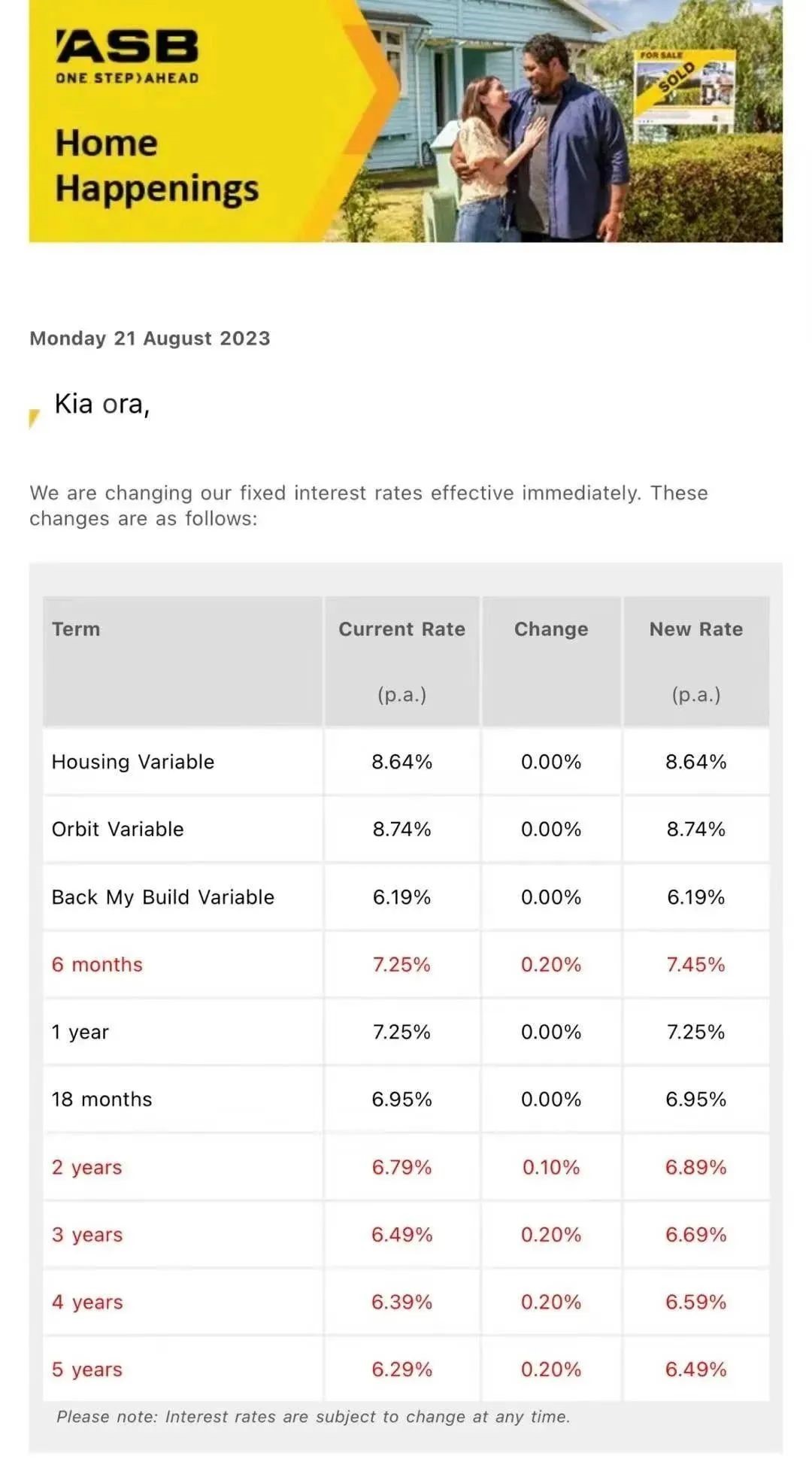
An ASB spokesperson said: “The key factors influencing home loan rates—the OCR, swap rates, customer term deposit rates and offshore funding costs—have all increased significantly over the past two and a half years. This changing economic landscape has pushed up banks’ borrowing costs in a relatively short period, and this is reflected in our lending rates.”
The major banks’ current rates are as follows:
02
The official cash rate remains unchanged at 5.5%,
but the likelihood of a rate rise has increased
In its latest Monetary Policy Statement, released at two o’clock last Wednesday afternoon, the Reserve Bank of New Zealand said it would hold the official cash rate (OCR) at 5.5%, but did not rule out further increases.
{ad}
The Reserve Bank also said interest rates would need to remain restrictive for the foreseeable future to ensure annual consumer price inflation returned to the target range of 1% to 3%. This means a further OCR increase has become more likely, or the first rate cut could be delayed from late 2024 until 2025.
Notably, falling dairy prices and the lagged effects of earlier monetary tightening, among other factors, have provided enough “signs” for the Reserve Bank to expect New Zealand’s economy to slip back into recession. This may also be the outcome it would prefer, as it would significantly curb inflation and remove the need for further OCR increases.
Overall, the OCR will not fall in the short term. The question for borrowers, then, is how long they will have to endure high mortgage rates: 9, 12 or 18 months?
03
First-home buyers remain the market’s mainstay
According to CoreLogic’s latest figures, first-home buyers accounted for 26% of property purchases in July, matching the record high set in June. For first-home buyers, the pressing desire to own a home appears more important than whether house prices rise or fall. Policies allowing KiwiSaver funds to be used towards a first home, along with looser loan-to-value restrictions and other concessions, have also encouraged first-home buyers to purchase.
The market for non-owner-occupier buyers, including investors, remains relatively quiet, accounting for 21% of all purchases last month. However, with less than two months until New Zealand’s general election, some prospective investors are undoubtedly ready to return if National wins and fulfils its promise to restore mortgage interest deductibility for existing properties.
04
Net migration has eased, but only slightly
The latest figures released by Stats NZ last week show monthly net migration inflows—arrivals minus departures—of around 5000 people, the lowest in eight months. However, net migration over the past twelve months has risen to nearly 87,000, the second-highest figure on record. There is reason to believe this sharp increase in net migration will substantially boost housing demand, with rising rents gradually giving way to rising house prices.
05
The Reserve Bank will not introduce debt-to-income restrictions immediately
Figures released by the Reserve Bank of New Zealand last week show that high debt-to-income lending still accounts for a very small share of the market. If the threshold were set at 7, only 9% of investor lending in June exceeded it, compared with just 1% of first-home buyer lending. This is because borrowers’ incomes have increased little over recent years, while house prices have continued to fall and mortgage rates have continued to rise.
Given the declining share of high-DTI lending, the new rules due in 3/April next year will not focus on regulating the market during the current cycle. Instead, they will seek to control the number of properties investors own and encourage them to hold properties over the long term for returns, preventing a repeat of the abnormal surge in house prices seen two years ago.
06
Is there room for mortgage lending to grow?
Looking ahead, the Reserve Bank of New Zealand will release its latest mortgage lending figures, for July, this Thursday afternoon at 3h. CoreLogic chief economist Kelvin Davidson expects overall new mortgage lending to remain subdued. Figures released in June showed that lending to first-home buyers with deposits below 20% accounted for just 6%, well below the permitted market share of 15%. With mortgage rates currently so high at 7%, lending growth will naturally be constrained.