
Focus on New Zealand’s 2023 election: which party policies will directly affect the Chinese community?
New Zealand’s 2023 election has entered the final stretch before voting, but the outcome remains far from clear

New Zealand’s 2023 election has entered the final stretch before voting, but the outcome remains far from clear. Many Chinese New Zealanders share a question: I want to vote, but which party’s policies best represent my interests and meet my expectations?
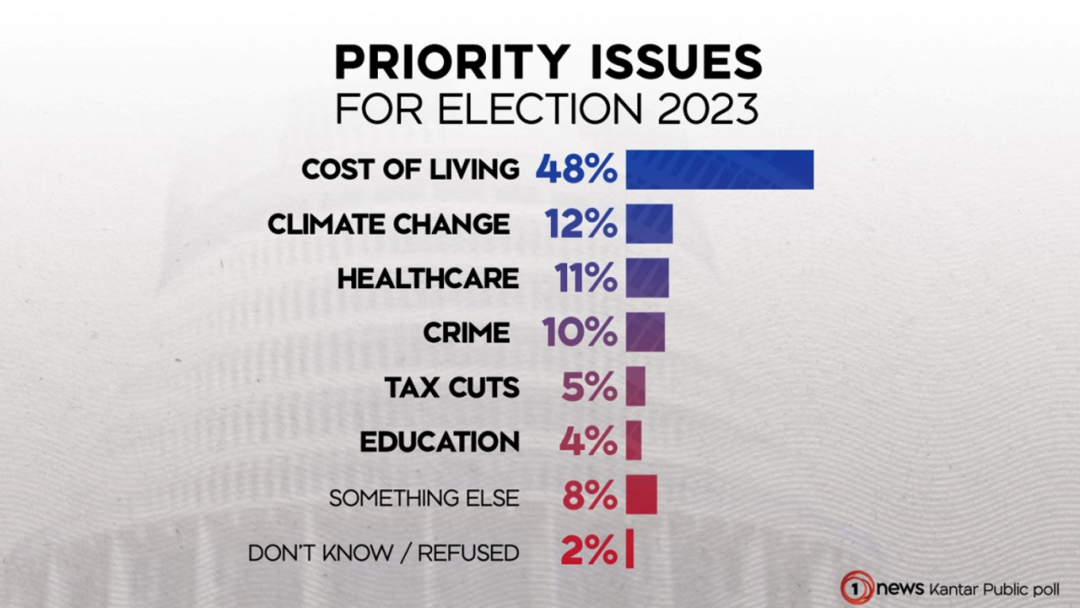
1 News A poll ranking the everyday issues New Zealanders care about most
In this article, YIJU will provide an overview of the parties’ policies on everyday issues that directly affect the Chinese community. Today, we will introduce policies on tax, living standards and housing, followed by education and public safety and other topics of particular concern to the Chinese community. Follow YIJU New Zealand’s WeChat official account for more timely, high-quality information about New Zealand.
Tax and living standards
Labour’s policies at a glance:
- Remove goods and services tax (GST) from fresh fruit and vegetables from 1 April 2024;
- Increase the Working for Families (WFF) in-work tax credit by NZ$25 a week to NZ$97.5. This would be the largest increase in the credit’s history, benefiting about 160,000 families;
- Further tax relief in 2026 would increase the incomes of 175,000 families by an average of NZ$47 a week;
- Labour’s leader has ruled out a wealth tax or capital gains tax.
Labour’s policies:
https://www.labour.org.nz/news-release_cost_living_gst
National’s policies at a glance:
- Increase Working for Families (WFF) tax credits for families with dependent children by NZ$25, and expand eligibility for the Independent Earner Tax Credit (IETC) for low- and middle-income earners and the FamilyBoost childcare tax rebate;
- Introduce new taxes on overseas property buyers and offshore online gambling; increase visa application fees and draw on Emissions Trading Scheme funds;
- Reverse Labour’s public transport subsidies and its plan to provide two-year-olds with 20 hours of free early childhood education (ECE);
- Abolish Auckland’s regional fuel tax;
- Reduce the bright-line test period from 10 years back to 2 years;
- The Clean Car Discount, also known as the “ute tax”; GST on online services such as ride-hailing and Airbnb, also known as the “app tax”;
- Reassess the Reserve Bank of New Zealand’s employment survey, the income insurance scheme currently paused by Labour, and Fair Pay Agreements. Phase in interest deductibility for rental properties. The previous plan to abolish the top tax bracket on income above NZ$180,000 has been abandoned; restore 90-day trial periods.
National’s “Back Pocket Boost” policy:
https://assets.nationbuilder.com/nationalparty/
pages/17859/attachments/original/1693346887/Back_Pocket_Boost.pdf?1693346887
{ad}
ACT’s policies at a glance:
- Provide tax relief for low- and middle-income earners, and reduce company, trust and top income tax rates to 28%;
- Reduce public service staffing and the number of agencies, abolish the bright-line test entirely, restore interest deductibility for rental properties, and reverse Labour’s public transport subsidies;
- Raise the pension eligibility age to 67 and end the government’s contribution to retirement savings;
- Sell up to 49% of the shares in state-owned enterprises and 100% of state-owned farming company Landcorp;
- Abolish the following programmes or agencies: income insurance, the healthy school lunches programme, Winter Energy Payments for people without Community Services Cards, fees-free tertiary education, Climate Emergency Response Fund spending, the Energy Efficiency and Conservation Authority (EECA), the Climate Change Commission, the Climate Change Chief Executives Board, industrial energy efficiency and fuel-switching programmes, forestry programmes, the Clean Car Discount, KiwiSaver subsidies, free prescriptions, the Provincial Growth Fund, the Progressive Home Ownership Scheme and First Home Grants, research and development (R&D) grants, Callaghan Innovation grants, R&D tax credits, growth and development spending, operating expenditure on developing new markets, film subsidies, industry transformation plans, Workforce Development Councils, the various demographic agencies for women, Pacific peoples, Māori development and ethnic communities, the Office for Māori Crown Relations, and the Human Rights Commission
- Remove all remaining import tariffs.
ACT’s policies to streamline government and improve efficiency:
https://assets.nationbuilder.com/actnz/mailings/6681/attachments/original/ACT_Alternative_Budget_-_End_the_waste__fix_the_economy.pdf?1695252857
The Green Party’s policies at a glance:
Provide everyone out of work with a weekly “income guarantee” of NZ$385, plus a sole-parent supplement of NZ$135, replacing Jobseeker Support, student allowances and Sole Parent Support; introduce a tax-free income band of NZ$10,000; impose a 2.5% wealth tax on net wealth above NZ$2,000,000; and change Working for Families payments to NZ$215 a week for the first child and NZ$135 a week for each subsequent child. Set a minimum wage that keeps pace with inflation; establish redundancy rights, automatic union membership, and rights to form unions and take political strike action; support a capital gains tax; increase funding for WorkSafe, the Employment Relations Authority (ERA) and the Labour Inspectorate; provide five weeks’ annual leave; and introduce new bereavement leave standards appropriate to Māori culture.
The Green Party’s policies:
https://assets.nationbuilder.com/beachheroes/pages/9614/attachments/original/1684816106/Policy-Greens_Workforce-Policy-2020-2023.pdf?1684816106
The Māori Party’s policies at a glance:
- Introduce a series of tax reforms, including a tax-free threshold of NZ$30,000, and adjust tax thresholds to support people on low incomes;
- Remove GST from all food, introduce a wealth tax, an overseas company tax, a land-banking tax and a vacant homes tax, and restore the company tax rate to its previous level of 33%.
The Māori Party’s tax policies:
https://www.maoriparty.org.nz/2023_tax_policy
New Zealand First policies at a glance:
Remove GST from “basic foods”, including fresh food, vegetables, meat, dairy products and fish; adjust tax brackets for inflation; and introduce tax incentives to promote economic development.
Housing policies
Labour’s policies at a glance:
- Provide grants covering up to 30% of comprehensive home retrofit costs, capped at NZ$18,000;
- Provide up to NZ$7000 for partial retrofits and up to NZ$3000 to switch from gas to electricity (Labour’s home energy upgrade policy: https://www.labour.org.nz/news-household_rebates_energy_efficient_homes);
- Build 6000 more public homes by 2027, in addition to those already planned (Labour’s public housing policy: https://www.labour.org.nz/news-release_supercharging_public_housing);
- Build 1000 social homes in Auckland each year.
National’s policies at a glance:
- Allow local councils to retain discretion over whether to implement the Medium Density Residential Standards (MDRS), which allow up to 3 homes of fewer than 3 storeys on a site without approval;
- Make housing growth a priority for transport funding;
- Establish a new NZ$1,000,000,000 fund to incentivise councils to approve residential sections (National’s housing supply policy: https://assets.nationbuilder.com/nationalparty/pages/17928/attachments/original/1685403005/Going_for_Housing_Growth.pdf?1685403005);
- End emergency housing in Rotorua within two years by increasing the supply of social housing, in line with Labour’s policy;
- Give priority to long-term residents;
- Tighten eligibility criteria for benefit applicants staying in motels and increase scrutiny of social housing allocation agency Kāinga Ora (National’s social housing policy: https://assets.nationbuilder.com/nationalparty/pages/18376/attachments/original/1694219300/Delivering_better_social_housing.pdf?1694219300);
- Allow people aged under 30 to use their KiwiSaver accounts to pay rental bonds; amend the Overseas Investment Act and Income Tax Act to encourage build-to-rent housing developments (National’s build-to-rent housing policy: https://www.national.org.nz/national_announces_boost_for_build_to_rent_housing);
- Restore landlords’ right to end tenancies without giving a reason.
ACT’s policies at a glance:
- Allow developers to opt to use insurance and codes of practice (COPs) for construction work in place of council building consents (ACT’s housing construction policy: https://assets.nationbuilder.com/actnz/mailings/6561/attachments/original/230909_ACT_Policy_Document_%28Housing%29.pdf?1694250731);
- Share half of GST revenue with councils that provide new residential sections; introduce a register of equivalent building materials;
- Replace existing building regulations with compulsory 30-year building insurance (ACT’s policy to stimulate housing supply: https://www.act.org.nz/housing);
- Amend the Residential Tenancies Act so landlords can require tenants to leave after issuing 2 notices within 1 year, replacing the previous requirement for 3 notices within 90 days; reduce the notice tenants must give landlords from 28 days to 21 days; reduce the notice landlords must give when moving into or selling a property from 90 days to 42 days; allow landlords to charge an additional pet bond; allow Kāinga Ora to terminate certain tenancies directly rather than relocate tenants, with only a service manager’s signature required instead of approval from the chief executive or a deputy chief executive; give landlords the right to dispose of tenants’ abandoned belongings within two weeks of a tenancy ending; allow Kāinga Ora to place tenants with records of misconduct at the bottom of public and emergency housing waiting lists; allow neighbours’ testimony as evidence of antisocial behaviour at the Tenancy Tribunal; extend section 53 of the Residential Tenancies Act to all tenancy types rather than only fixed-term tenancies; reduce the notice period from 90 days to 21 days; repeal the “priority renewal” policy; introduce a policy requiring Kāinga Ora to cooperate with police when it learns of illegal activity; and require Kāinga Ora to address and consider all public complaints and inform complainants of the outcomes (ACT’s policy to protect landlords’ rights: https://assets.nationbuilder.com/actnz/mailings/6745/attachments/original/230927_ACT_Policy_Document_%28Ending_the_war_on_landlords%29_%281%29.pdf?1695802564
- and its policy on tenant behaviour: https://assets.nationbuilder.com/actnz/mailings/6745/attachments/original/230927_ACT_Policy_Document_%28Protecting_the_community_from_unruly_tenants%29_%281%29.pdf?1695802568)。
The Green Party’s policies at a glance:
- Cap annual rent increases at 3%, link new tenancies to previous rental agreements, and introduce a Rental Warrant of Fitness inspection system for rental properties;
- Expand public housing provision and Māori-led housing projects;
- Expand shared ownership, progressive home ownership and government low-interest loan schemes; provide government guarantees for community housing and government mortgage refinancing for new homeowners in financial difficulty;
- Provide development incentives for high-rise, energy-efficient and accessible buildings; tax increases in the value of land near public transport hubs; and protect urban trees and green belts (the Green Party’s housing and sustainable communities policy: https://assets.nationbuilder.com/beachheroes/pages/9589/attachments/original/1686018330/Policy-Greens_Housing-and-Sustainable-Communities-Policy-2022-2023.pdf?1686018330);
- Build 35,000 new, warm and affordable homes over the next 5 years.
The Māori Party’s policies at a glance:
- Build 2000 homes on Māori ancestral land within two years.
- Ensure half of all new public homes are allocated to Māori.
- End sales of freehold land to foreigners and apply the Overseas Investment Act to residential property purchases (the Māori Party’s housing policy: https://www.maoriparty.org.nz/whanau_build)。