
Prices are officially rising! New Zealand’s latest property report for November reveals where house prices are climbing fastest
After a year and a half of falling house prices and rising interest rates in New Zealand, the market trend has fundamentally changed…
After a year and a half of falling house prices and rising interest rates in New Zealand, the market trend has fundamentally changed, with the national average house price recording quarterly growth for the second consecutive month. In this article, we use the latest property data to analyse recent housing market trends across the regions.
The latest OneRoof-Valocity House Value Index shows that house price growth is gathering momentum across most of the country, with an increasing number of areas recording gains. Over the three months to the end of October, house prices in Auckland and Canterbury rose by more than 2%, while the national average increased by 1.7% to NZ$952,000.
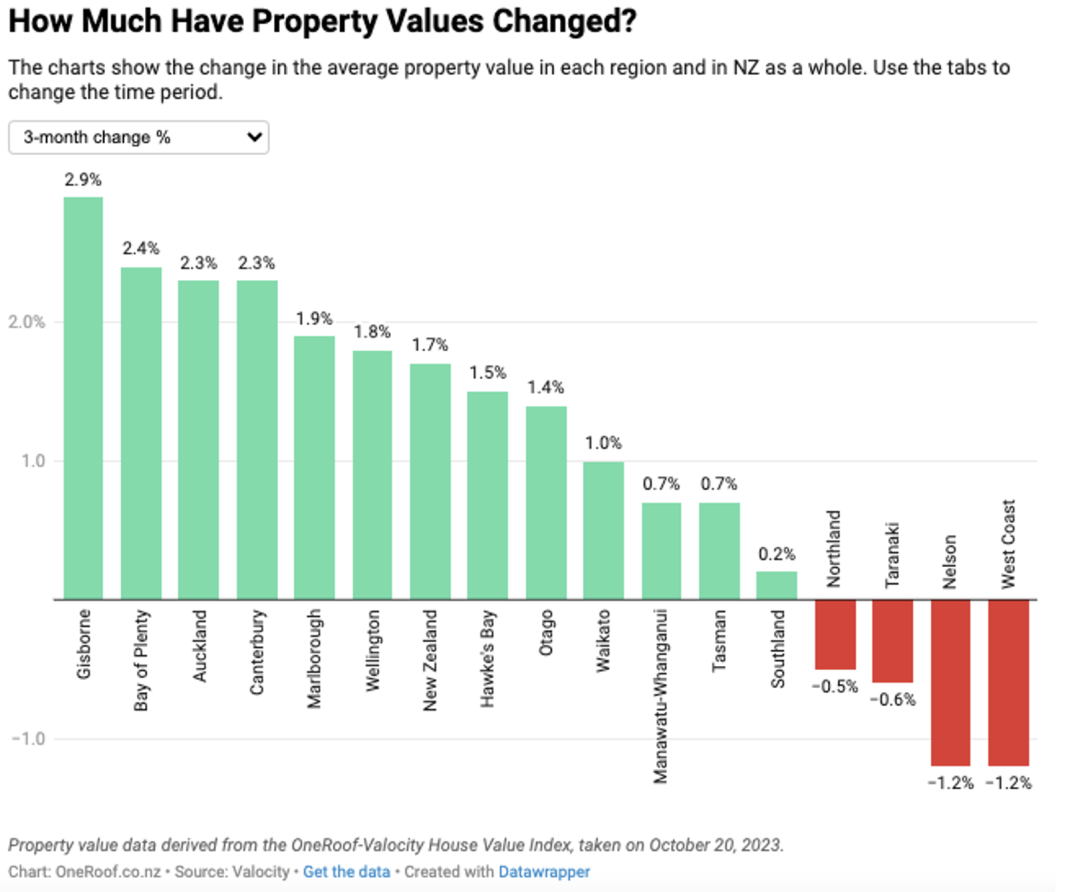
Only Nelson and the West Coast continued to record some decline in house prices, while the pace of decline slowed in Northland and Taranaki. OneRoof-Valocity’s data shows that average house prices across the country’s seven main cities recorded quarterly growth for the first time since March 2022, with Dunedin and Queenstown Lakes joining the recovery in October.

OneRoof property editor Owen Vaughan said the strongest market performance was in the major centres, with the trend beginning to spread to smaller regional cities. Whangārei, Napier and Invercargill all saw their housing markets improve in October. Christchurch remained the biggest surprise: strong first-home buyer activity pushed its average house price up 2.5% over the quarter to NZ$768,000. However, the supply of homes for sale remained insufficient. New listings in Canterbury in October fell 3.4% year on year, while total listings were only 7.5% higher than in October last year. By contrast, Auckland’s new listings in October rose by almost 2% year on year, but a surge in sales reduced its overall stock of homes for sale by 8.3%.
Vaughan said New Zealand’s general election had affected listing numbers to some extent, with many sellers hesitating ahead of the 14 October vote. After the election, the number of properties for sale on OneRoof increased slightly. Although new listings over the past two weeks were insufficient to draw firm conclusions about the market’s direction, growing confidence and expectations of house price rises appeared to be gathering unstoppable momentum. The data shows that the median property price searched by prospective buyers nationwide rose 2% month on month, while Auckland’s median search price increased 5%. Search prices do not necessarily translate into final sale prices, but they offer a useful reflection of market sentiment.
OneRoof-Valocity’s data also tracks house price trends across 927 suburbs nationwide. In the three months to the end of month 10, 566 suburbs recorded price growth, almost 100 more than at the end of September. Christchurch continued to lead the gains, with Merivale and Fendalton topping the rankings with quarterly growth of 8.1% and 7.9% respectively. House prices in six of the city’s suburbs have now returned to their peaks, while another nine are within NZ$10,000 of their peak values. Notably, most suburbs recording growth—363 in total—had average house prices below NZ$1,000,000, reflecting the continued dominance of first-home buyers in the market.
Material for this article was sourced online.