How to seize the best investment opportunities in global trade from New Zealand
As ordinary New Zealand entrepreneurs and small and medium-sized investors, how can we seize opportunities amid the changing times?
|
Tucked away in a corner of the South Pacific, New Zealand is far from most countries and has long had a relatively low profile in global politics and economics. In recent years, however, the world's economic powers have paid increasing attention to New Zealand, which has achieved significant results in international trade cooperation. As ordinary New Zealand entrepreneurs and small and medium-sized investors, how can we find opportunities amid the changing times?
|
 As is widely recognised, New Zealand and China have achieved substantial results in practical cooperation in recent years, including economic and trade exchanges, people-to-people links, connectivity and infrastructure development. Their economies are highly interdependent, with complementary strengths. China has remained New Zealand's largest trading partner, export market and source of imports for many consecutive years. In 2022, the Regional Comprehensive Economic Partnership and the protocol upgrading the New Zealand–China Free Trade Agreement officially came into force, giving stronger impetus to bilateral economic and trade cooperation. In the first quarter of this year, trade in goods and services between New Zealand and China totalled NZ$9,380,000,000, comprising NZ$5,290,000,000 in New Zealand exports to China and NZ$4,090,000,000 in imports from China.
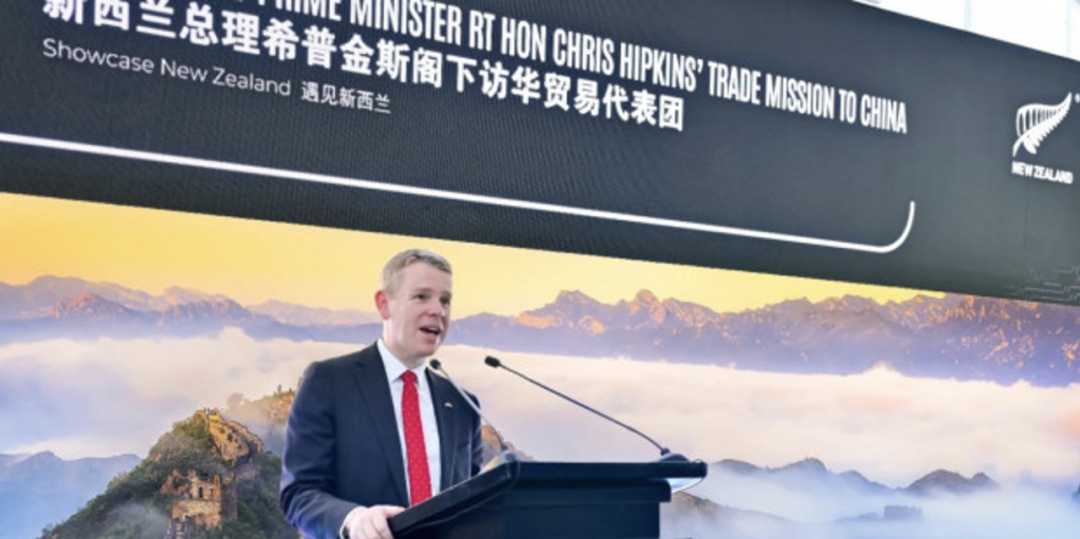
From 25–30/6/2023, New Zealand Prime Minister Hipkins made his first official visit to China since taking office. During the visit, he described current New Zealand–China relations as “very positive and constructive”. The scope for Chinese businesses to develop in the New Zealand market is striking, with extensive future investment opportunities in agriculture, food, tourism, education, advanced environmental technologies and infrastructure.
 Beyond China, New Zealand has also performed strongly in global trade. On 16 July, members of the Comprehensive and Progressive Agreement for Trans-Pacific Partnership (CPTPP) formally approved the United Kingdom's accession at a ministerial meeting in Auckland. Following nearly two years of negotiations, the UK Government also formally signed the accession protocol. The UK thus became the first European country to join the agreement since it was signed in 2018. It is also the largest trade agreement the UK has joined since Brexit.
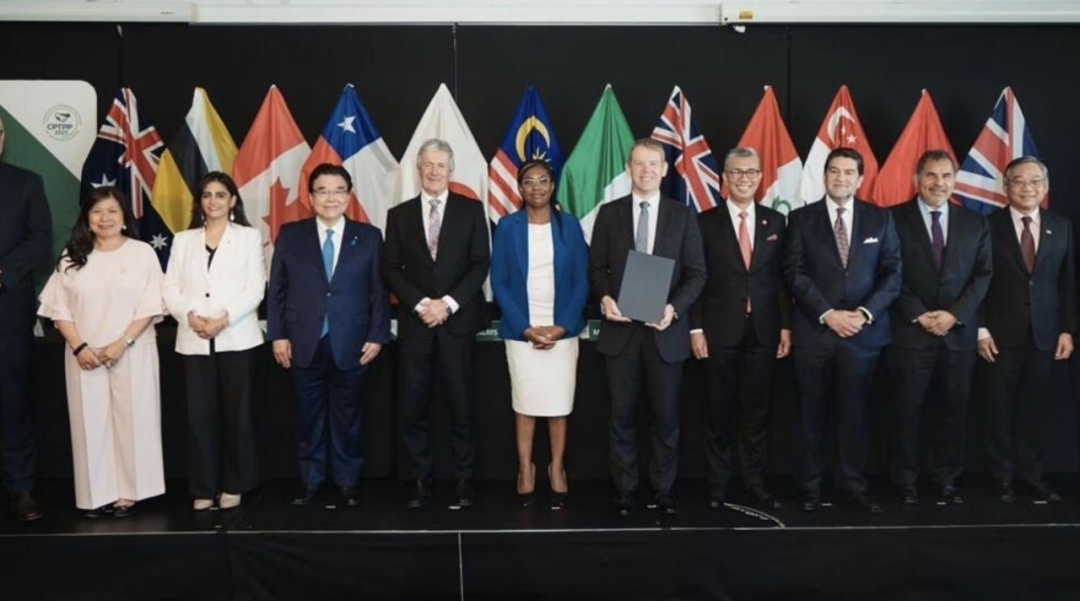 The UK Business and Trade Secretary recently formally signed the agreement to join the CPTPP in New Zealand
New Zealand holds the rotating chair this year. Prime Minister Chris Hipkins said that major economies joining the CPTPP would help strengthen connectivity between the Atlantic and the Indo-Pacific, reinforcing the trading system within the region's regulatory framework. The CPTPP currently has 11 members: Australia, Brunei, Canada, Chile, Japan, Malaysia, Mexico, New Zealand, Peru, Singapore and Vietnam. With the UK joining, the combined gross domestic product (GDP) of CPTPP members reaches US$157,000, increasing their share of global GDP from 12% to 15%.
 New Zealand is a highly developed capitalist country with a strongly outward-looking economy. It is also one of the few developed countries in the Organisation for Economic Co-operation and Development (OECD) whose economy is founded on agriculture, and one of the world's major agricultural exporters. In recent years, New Zealand has been among the OECD countries with sustained economic growth, low unemployment, moderate inflation and a relatively strong exchange rate. In the World Bank's recent global Doing Business reports, New Zealand has consistently ranked among the leaders across 190 economies. It also ranks first globally for investor protection, freedom from corruption and opposition to protectionism, making it one of the world's most competitive “small but beautiful” economies.
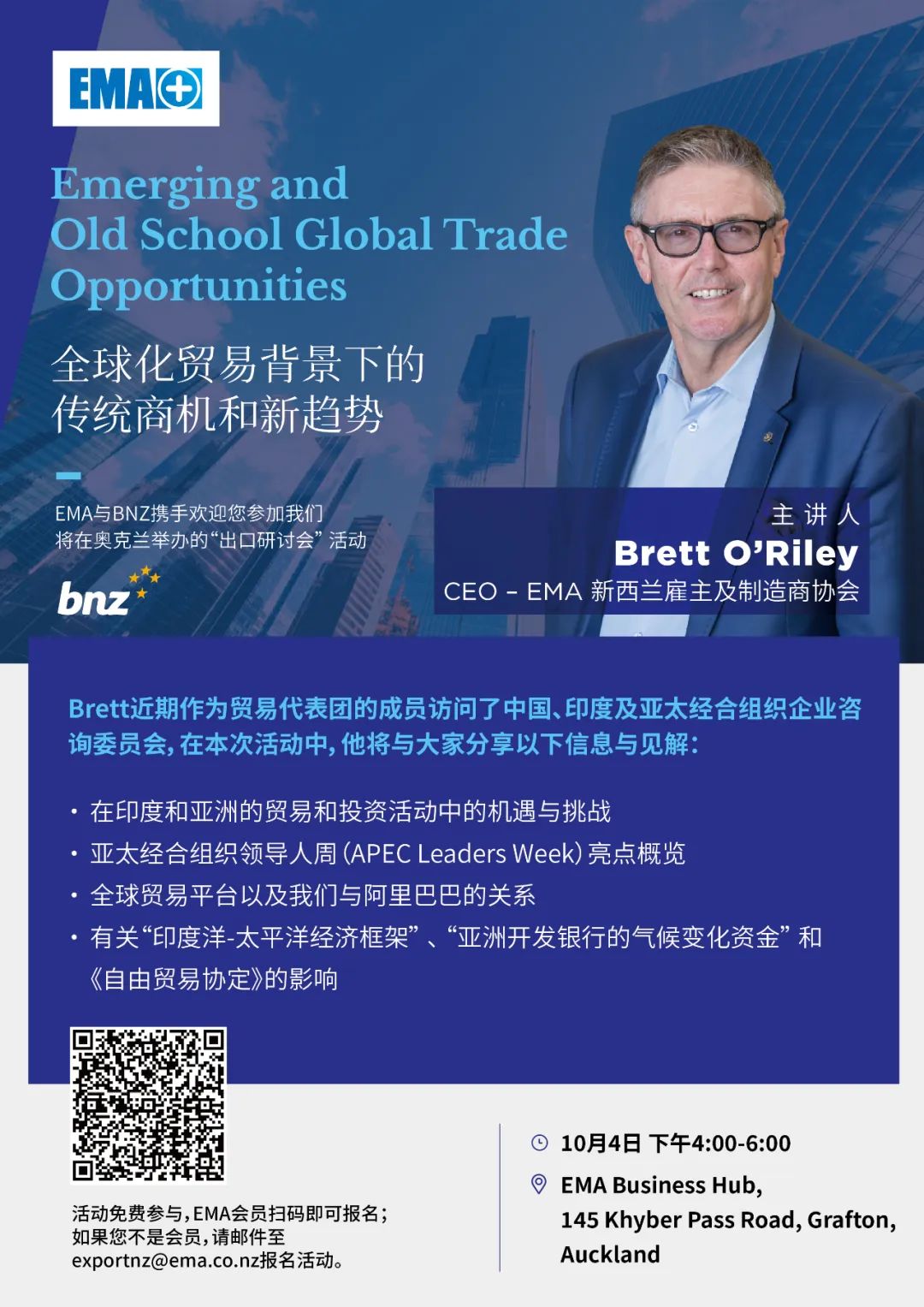
 Brett will draw on his recent experience travelling to India, China and the APEC Business Advisory Council as a member of New Zealand trade delegations, and discuss the following topical issues:
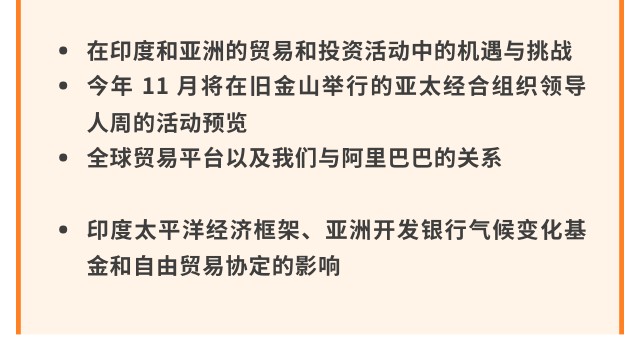
The seminar will offer analysis of the latest international trade trends and explore many issues critical to import and export businesses, providing useful insights for New Zealand exporters. Details of the Auckland seminar are as follows:
Time: 4 October, 4:00–6:00pm
Venue: EMA Business Hub, 145 Khyber Pass Road, Grafton, Auckland
Attendance is free. EMA members can register by scanning the QR code below; if you are not an EMA member,
please email exportnz@ema.co.nz to register.