
Rents are rising rapidly and first-home buyers are still active! 5 things property investors should know this week
Is surging migration once again driving a sharp rise in rents?

|
Will New Zealand’s rental market follow in Australia’s footsteps? In May this year, YIJU reported that a large influx of migrants into Australia’s major cities over a short period had intensified the shortage of rental properties. Rental vacancy rates in many cities, such as Adelaide, were as low as 0.3%, meaning there were virtually no homes available to rent. At the time, annual rental growth in Australia had reached 19%, and Sydney’s average rent was A$756 a week and still rising.

Sydney’s rental market is crowded with prospective tenants struggling to find a home
This raises a question: with New Zealand also experiencing a large influx of migrants over the past year, are its tenants facing a ‘nightmare’ similar to Australia’s?
This Tuesday, Stats NZ is due to release rental housing data for October, followed by migration data for September on Wednesday. In recent months, tight rental supply and migration-driven demand have pushed rents up rapidly. This is undoubtedly good news for landlords, but a ‘nightmare’ for tenants. The next few data releases may show this situation intensifying. Although migration may begin to ease soon, it will take considerable time to return to normal levels, meaning pressure on tenants’ rents could persist for some time.
Perhaps trends in Australia’s rental market can offer a guide to New Zealand’s future direction. CoreLogic data shows Australia’s rental vacancy rate fell to a record low of 1% in October, well below the average annual vacancy rate of 3% over the past 10 years. With homes hard to find, rental growth has remained near its peak of around 10%. Although it has eased slightly recently to 8%, growth remains strong. Australia’s current national median rent is A$590 a week.
|
This Tuesday, the Reserve Bank of New Zealand will also release mortgage lending data for month 7 through September. Recently, the number of ‘high-risk’ loans with high debt-to-income ratios (DTIs) has fallen sharply, mainly because mortgage interest rates remain elevated. This trend will almost certainly appear again in the next release. However, given that the Reserve Bank of New Zealand may formally introduce specific DTI caps, the direction of these figures over the coming year will remain a focus for investors. Current market speculation suggests DTI restrictions are likely to take effect in the middle of next year, with a significantly greater impact on investors than on owner-occupiers.
|
CoreLogic’s latest First Home Buyer Report, released last week, shows that first-home buyers’ market share is strengthening further. Their share of purchases has reached new highs in recent months, hitting 27% in the third quarter. Notably, first-home buyers hold a high market share not only in the main centres but also in other property hotspots and regions, including Whangarei, Rotorua, South Waikato, Clutha and Invercargill.
CoreLogic chief property economist Kelvin Davidson believes first-home buyers have several advantages, including access to KiwiSaver for at least part of their deposit, favourable bank provisions for low-deposit lending, and relatively limited competition in the current market. However, with a change of government and the associated easing of property tax rules for investors, first-home buyers may gradually find themselves less competitive in the property market.

|
Westpac’s financial results released last week included important figures on borrowers refixing their loans. 88% of borrowers have now moved off ultra-low mortgage rates below 5% and into the 5–7% range. Meanwhile, 67% of borrowers have chosen to hold savings equivalent to at least three months of repayments as a buffer, with median cash holdings close to NZ$13,000. A range of other figures also suggests most households with mortgages are adapting well to the new environment of high mortgage rates. These figures still warrant close attention, as the transition from ultra-low to high rates is not yet complete and the labour market has begun to soften.
|
Reserve Bank of New Zealand data released last week showed that 72% of loans in September, including new lending, refinancing with another bank and top-ups, had fixed-rate terms of two years or less. This was up from 62% in June and the highest share since April. This is hardly surprising: longer-term fixed rates have risen sharply in recent months, making shorter-term fixed rates more competitive again. They also offer certainty for a period ahead while reducing the risk of ‘overpaying’ if mortgage rates fall in future.
Below is a table of mortgage rates from New Zealand’s major commercial banks:
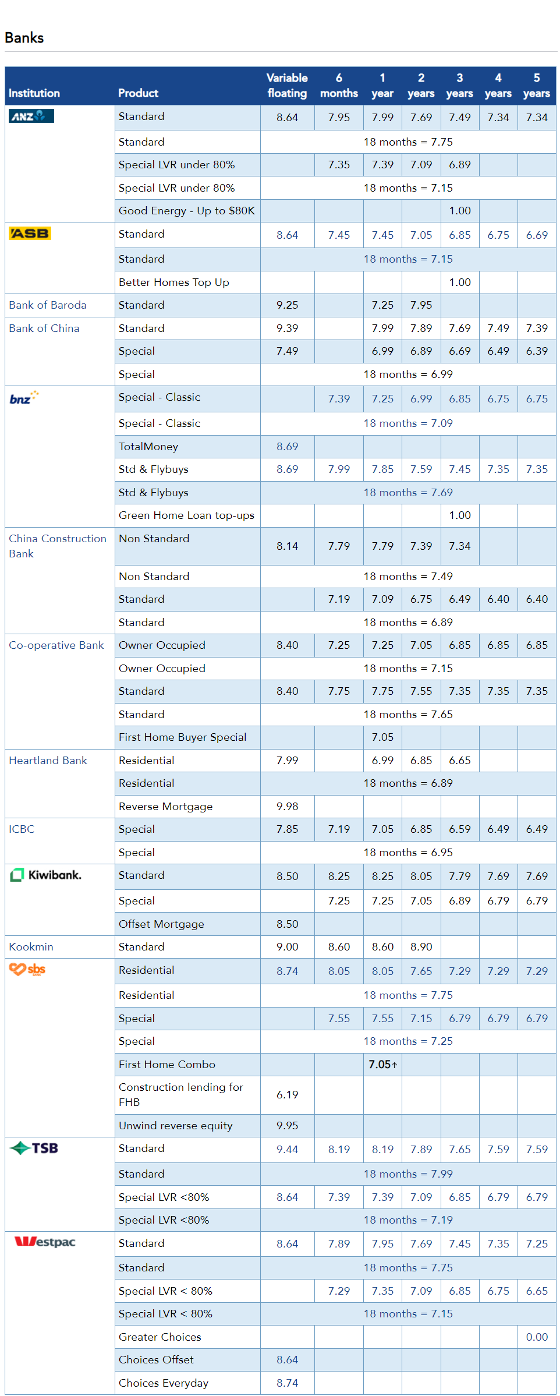 Source: https://www.interest.co.nz/borrowing
The information above was sourced online.