
Major DTI lending changes are coming: property investors, check how much they could affect you
The Reserve Bank of New Zealand previously announced a major change for property investors, proposing new debt-to-income ratio (DTI) restrictions on mortgage lending.

The Reserve Bank of New Zealand previously announced a major change for property investors, proposing new debt-to-income ratio (DTI) restrictions on mortgage lending to regulate property investment activity in the financial market. The bank is currently consulting on its proposed DTI restrictions and says the rules will be implemented alongside other measures, such as loan-to-value ratio (LVR) restrictions。


The Reserve Bank of New Zealand proposes introducing new DTI restrictions on banks’ mortgage lending from the middle of this year. It hopes to limit banks’ provision of high-value loans to borrowers seeking high levels of debt relative to their incomes, protecting the stability of the financial system. The rules would link the amount property investors can borrow to their income.
The bank proposes allowing banks to:
| 1 | Lend 20% of residential lending to owner-occupiers with debt-to-income ratios above 6; |
| 2 | Lend 20% of new lending to investors with debt-to-income ratios above 7. |
Income will be measured at the household level, and the specific limits can be adjusted as the housing market changes. For example, a couple with a combined annual income of NZ$100,000 could borrow a maximum of NZ$600,000 as owner-occupiers or NZ$700,000 as investors.
The new rules apply only to purchases of existing properties. Buyers of new builds do not need to take them into account, and their mortgage applications will not be affected.

Depending on whether you are buying to live in or invest, you can simply multiply your household income by 6 or 7 to calculate your maximum borrowing amount. For example, an owner-occupier earning NZ$150,000 a year could borrow up to NZ$900,000. Alternatively, an income of NZ$60,000 would allow borrowing of up to NZ$360,000.
All rental income can be included in your income。For example, a property-investing couple earning salaries of NZ$100,000 and NZ$50,000, with annual rental income of NZ$30,000, would have a total income of NZ$180,000. Their maximum borrowing would be 180,000 × 7 = NZ$1,260,000.
Debt includes all mortgages, credit cards, personal loans, student loans and other debts。Suppose they already have a mortgage of NZ$350,000 and credit card debt of NZ$10,000. After deducting these debts, their maximum additional borrowing under the new DTI rules would be 126 − 36 = NZ$900,000.


Once the new rules take effect, investors could borrow against an existing investment property, for example NZ$150,000, to provide a 30% deposit on a property worth NZ$500,000. This means they could afford a property worth 75% more. Under the new rules, some property investors could borrow more and find they can afford properties previously beyond their reach. New-build purchases would be unaffected, requiring only a 20% deposit.

The announcement is expected between June and July this year. The bank is currently consulting publicly on the proposed rules and will announce the final details in June this year.

CoreLogic chief economist Kelvin Davidson said the new DTI rules would have very little effect on the current market once implemented.
He believes high mortgage rates are currently restraining the market, so the bank is getting ahead of the situation by establishing new rules before mortgage rates fall again. When that happens, people will start applying for larger loans based on their incomes.
Currently, only about 10% of investors and owner-occupiers would be affected by the rules. He added that they would not necessarily make housing more affordable, but might bring a slight improvement. They limit a person’s ability to acquire multiple properties in a short period. If an investor is already heavily indebted, the only way to borrow more would be to increase their income, which takes time.
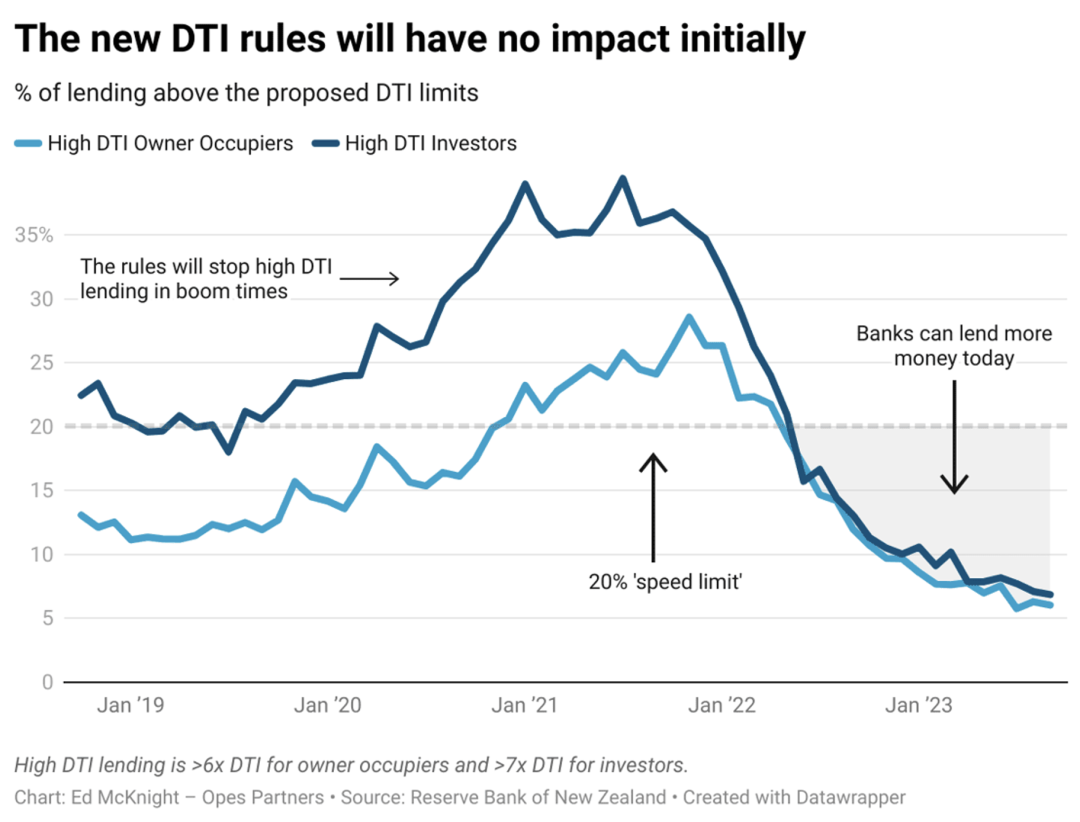 Impact of the new DTI rules on different property buyer groups from 2019 to the present (Source: Reserve Bank of New Zealand)
Currently, only 1 in every 10 borrowers obtains a loan with such a high debt-to-income ratio. This means banks could issue more high-DTI loans while complying with the bank’s new rules. Although the rules would have no immediate effect, they would encourage investors into the market and push up property prices. However, once interest rates fall, borrowers would be unable to borrow more.

In some parts of New Zealand, such as Invercargill and Taranaki, house prices and unemployment are low and incomes are stable, so DTI rules would have less effect on the market. In holiday hotspots such as Queenstown and the Coromandel, house prices are high relative to incomes, giving DTIs a greater influence on the market.
The national map below lets you check the estimated DTI for your area:
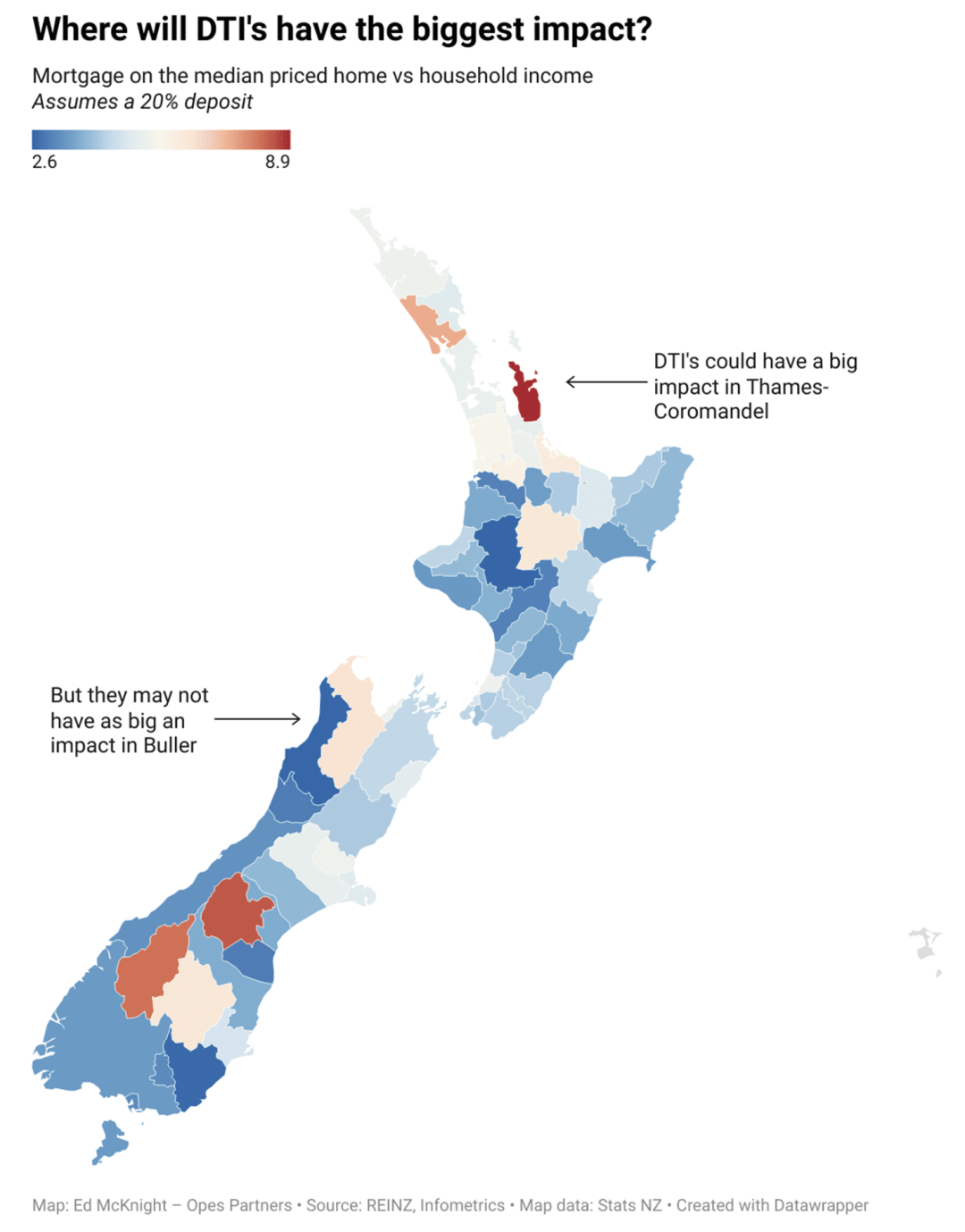 Map illustrating the impact of DTI rules on home buyers across New Zealand’s regions (Source: REINZ)