New Zealand’s house price rebound stalls: opportunity or trap? How Auckland’s property market could evolve in 2024
From the end of the 2023 general election through to the 2024 New Year holiday, optimism swept New Zealand’s property market. Expectations were that a cycle of successive interest rate cuts would begin in the first half of 2024, rents would keep rising, and another wave of rapid property price growth was about to begin.
From the end of the 2023 general election through to the 2024 New Year holiday, optimism swept New Zealand’s property market. Expectations were that a cycle of successive interest rate cuts would begin in the first half of 2024, rents would keep rising, and another wave of rapid property price growth was about to begin.
By Lunar New Year, however, New Zealand’s property market seemed to have been rattled by a succession of comments from the banking sector.

First, Reserve Bank of New Zealand chief economist Paul Conway unexpectedly gave a media interview, breaking the Reserve Bank’s usual tradition of silence from December to February and sending a somewhat ominous signal.
In the interview, Paul Conway said inflationary pressures in New Zealand remained substantial and rate cuts were not imminent. Commercial bank economists then came forward with updated interest rate forecasts, saying it was too early for cuts.
A prominent example was ANZ, which said in its monthly report that the Reserve Bank of New Zealand would not cut rates but would instead raise them 2 times, in February and April, lifting the OCR to 6%. This directly reversed market expectations.
On 16 February, Reserve Bank of New Zealand Governor Adrian Orr told the University of Waikato’s annual economics forum that core inflation was declining very slowly and the Reserve Bank would stick to its 2% inflation target. Orr’s remarks brought expectations of no rate cuts this year to a peak.

The banking sector achieved its aim: interest rates returned to elevated levels. Wholesale rates in the interbank market reversed their downward trend from before February and rose rapidly.
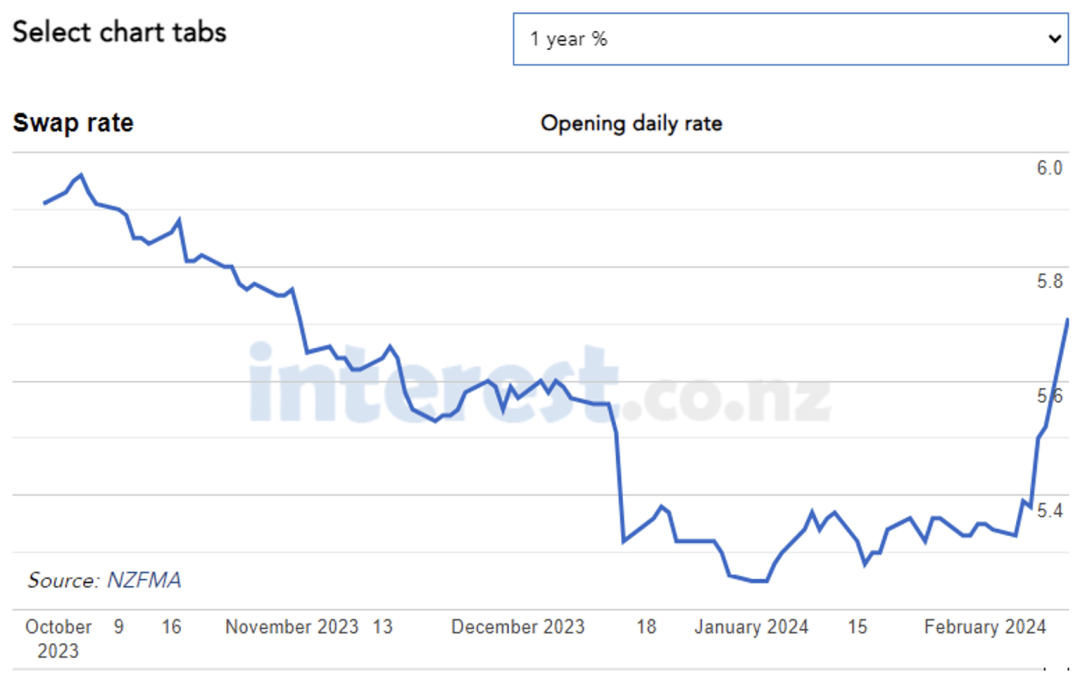
Although the Reserve Bank did not announce a rate rise on 28 February, instead holding the OCR unchanged at 5.5%, the market’s earlier optimism had already been dampened, and more people were becoming increasingly cautious.

In the height of summer, the property market appeared to have been caught off guard by this succession of comments. Some buyers looking for opportunities began slowing down and reassessing the market. Sales volumes fell as a result, while house prices, which had been rebounding, also eased slightly.
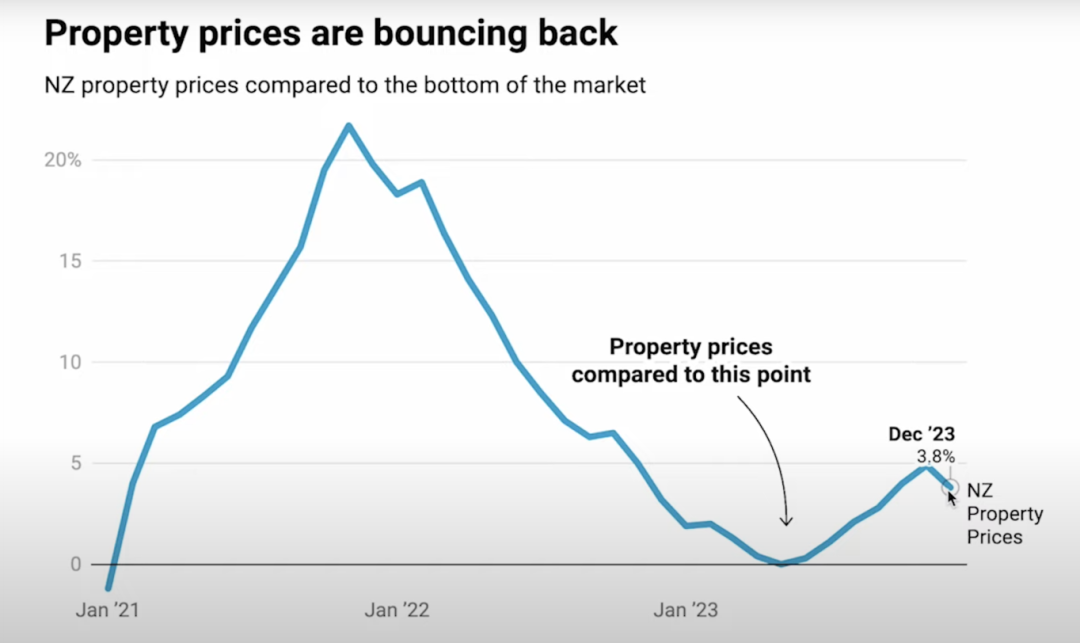
However, if we look beyond the current stream of sensational short-term financial headlines and carefully analyse market data trends, it becomes clear that the banking sector’s calls to keep interest rates high may be only one reason.
Another reason is simply a normal market response as optimism over the election result fades.
The chart below shows changes in New Zealand’s contracted house sale prices during 2023. The election’s influence is clear: prices rose more before the election and less afterwards.
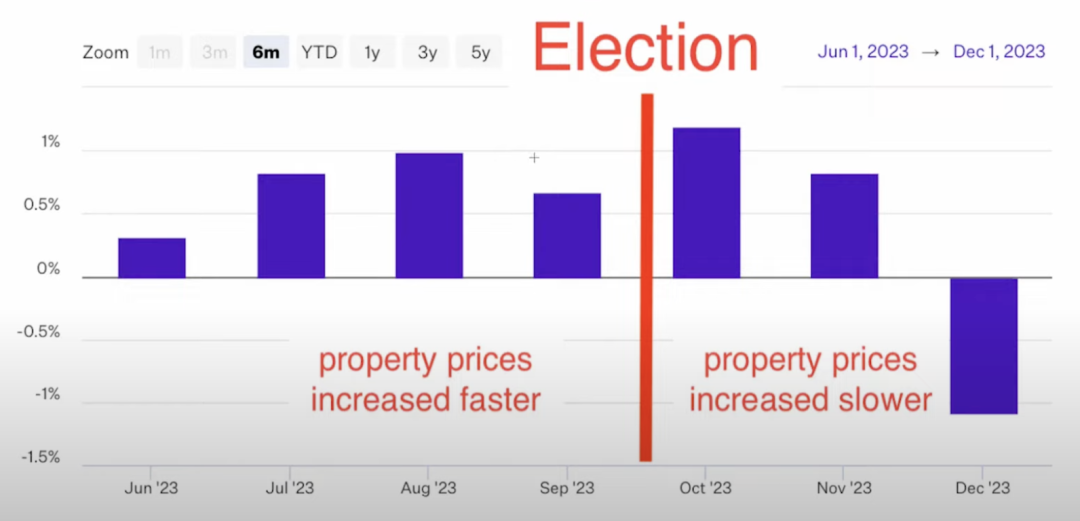
The property-friendly National Party’s campaign policies had already effectively stimulated the housing market before the election, prompting prices to begin rising in anticipation from July 2023. After a rise lasting half a year, the benefits began to materialise. A healthy pullback in a market that had risen ahead of events is normal.
In fact, house prices had already begun consolidating slightly in December last year, and 1–February simply continued the trend that began in December. The banks’ comments in February merely brought publicity around that trend to a peak.
The banking sector’s short-term messaging serves its own purposes. If we look closely at the banks adding fuel to the house price pullback, we find that at the end of 2023, they themselves were very optimistic about house prices in 2024.
The table below lists the banking sector’s forecasts for house price growth in 2024:
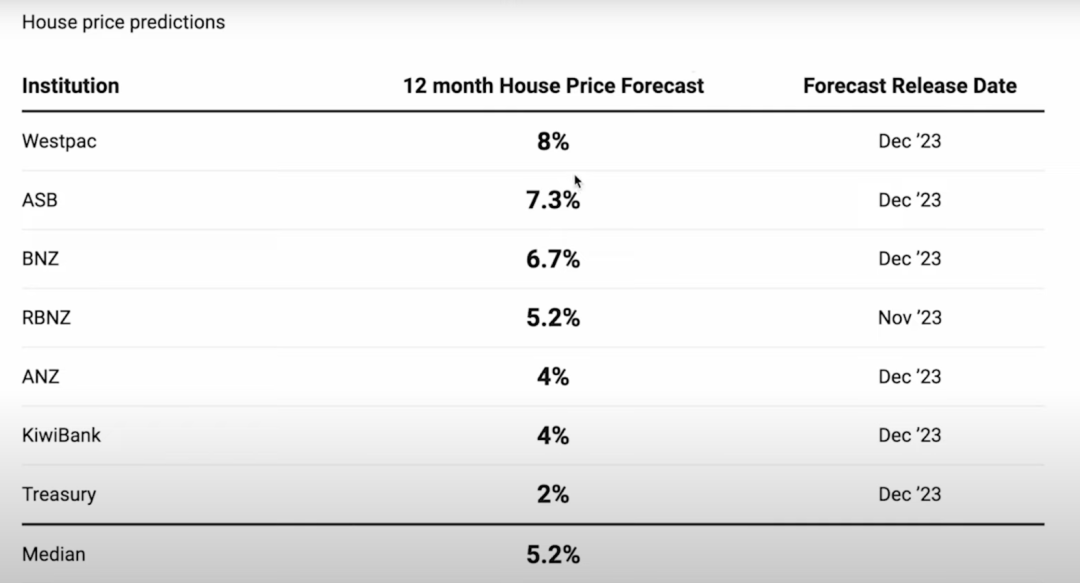
The highest forecast was 8%, while the median increase was 5.2%, exactly matching the Reserve Bank of New Zealand’s house price growth forecast.
Viewed this way, the pullback early in the year is more likely to be an opportunity. After all, interest rates will eventually fall. The banks’ message that cuts will not come so soon can, at most, slow house price growth, while the policies being implemented by the National-led coalition government have a long-term influence on prices.

Of the policies currently being implemented, restoring tax deductibility for interest expenses has the greatest impact on investors. Most people may have underestimated its practical effect.
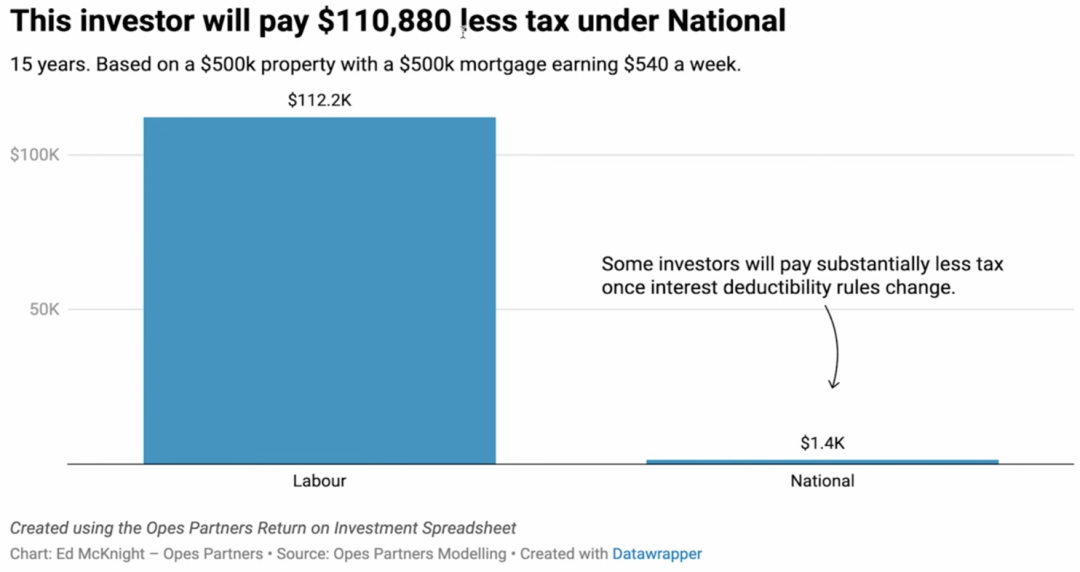
Take a house renting for $540 a week with a $500,000 mortgage to calculate the difference between National’s and Labour’s tax policies. The difference in mortgage interest deductibility alone amounts to nearly $110,000 over 15 years. If the house costs $750,000, this policy alone would create a house price difference approaching 15%, even before accounting for interest and other returns generated by that $110,000 tax difference over 15 years.
The long-term impact of property policies will far outweigh short-term noise about the timing of rate cuts. High interest rates cannot last indefinitely. The property market will eventually move beyond the sharp swings of the past 3 years and return to its underlying long-term trend.
This difference will be more pronounced in Auckland, where rents and expectations of rent growth are strongest. This is also one reason why many house price datasets indicate that Auckland property is undervalued.

The map below shows house price hotspots nationwide, based on long-term price trends. Blue indicates that local house prices are currently undervalued relative to their long-term trend, while red indicates overvaluation.
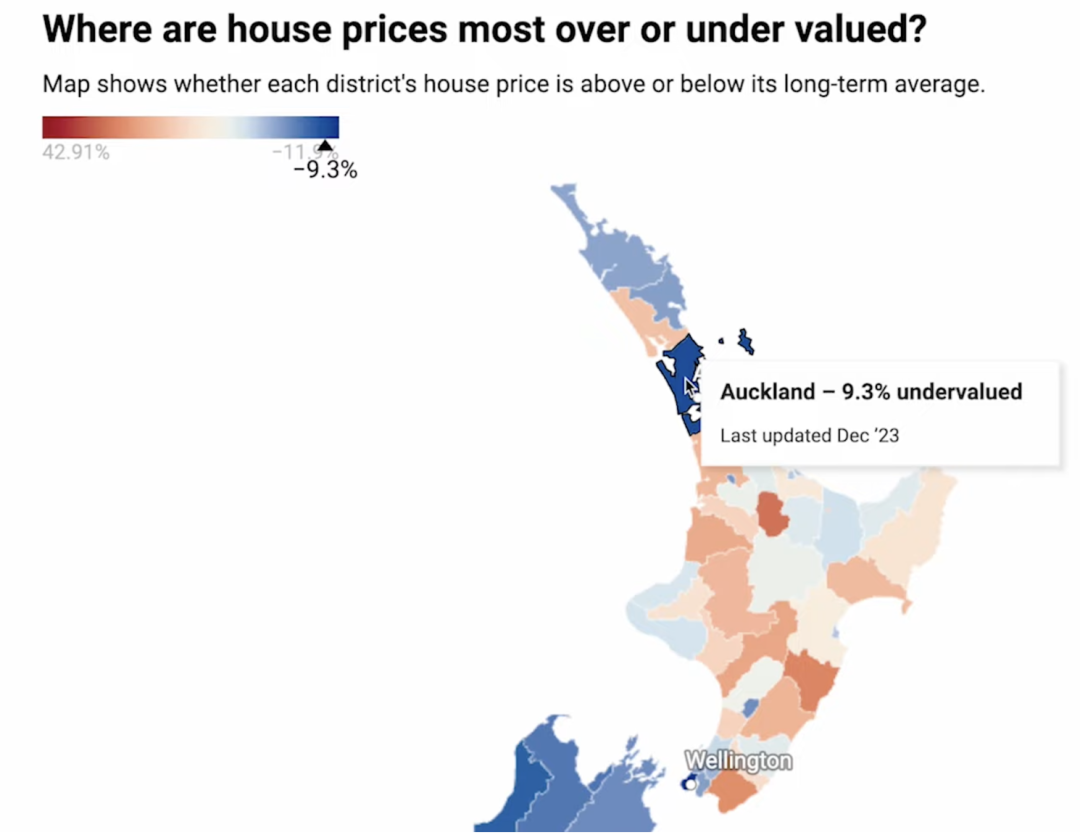
If the dramatic house price swings of the past 3 years and more were “abnormal”, this map clearly distinguishes just how “abnormal” different regions have become.
Using December 2023 as the reference point, Auckland appears in dark blue, indicating substantial undervaluation of as much as 9.3%. This suggests that the house price decline over the past 3 years has overshot in New Zealand’s largest city, leaving prices well below their long-term trajectory. The central North Island, meanwhile, appears potentially overheated.
For investment in 2024, therefore, the focus should be on Auckland, putting precious capital to its best use. After all, most people already find buying a single home a considerable stretch and simply cannot afford the cost of choosing the wrong property.

How do you choose the right property? In a market as individual and full of potential pitfalls as New Zealand’s, real estate agencies with deep local roots have an important role to play.
Today, we have invited experienced industry professionals from New Zealand’s largest real estate agency, Barfoot & Thompson’s Yan Lin, Lawrence Yuan and Robin Liu, to analyse local market conditions and offer investment advice for the North Shore, central Auckland and east Auckland respectively, areas of particular interest to Chinese buyers. We explore the opportunities in these popular areas and how to avoid choosing the wrong property.

Yan Lin
Residential Sales
Glenfield Branch
Yan Lin:I think investors can be divided into two groups. The first consists of those with limited funds and no subdivision experience. For them, small townhouses or new small standalone homes on subdivided sites can offer good investment returns. Rents are currently stable, and interest will gradually become deductible again, making the overall returns very attractive. Prices for these property types are currently relatively low, so it is a good time to buy.
For investors with more funds or subdivision experience, now is also a very good time to acquire land suitable for subdivision. Many sites with subdivision potential are appearing on the market at attractive prices. However, subdivision requires investigation beyond price, including whether the land is in a zone that permits subdivision and whether stormwater and wastewater pipes meet subdivision requirements. Other factors also need consideration, such as last year’s flooding: is the land in a flood zone, and is there an overland flow path?
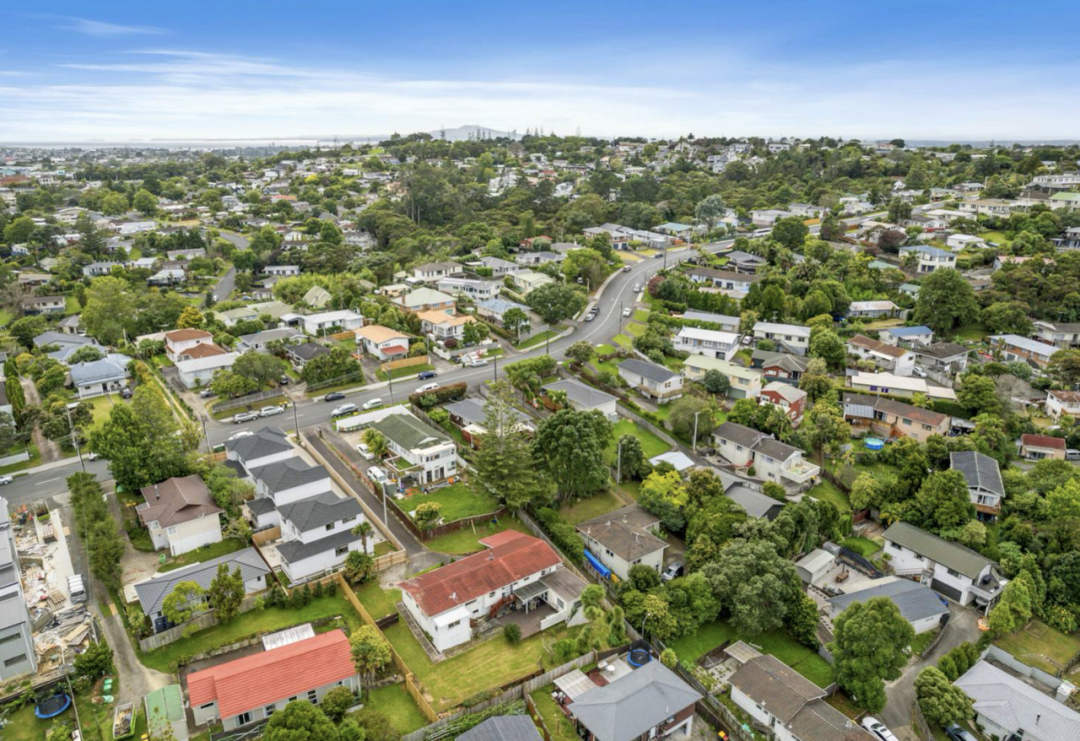 Image source: Barfoot & Thompson
Overall, the North Shore offers diverse investment opportunities, from entry-level areas to premium neighbourhoods, giving investors plenty of choice. Owners interested in buying land to subdivide should have a more detailed discussion with an agent. We understand local areas and market conditions better and can take a clearer, more considered approach to subdivision.

Lawrence Yuan
Residential/Rural Sales
Mt Eden Branch

Lawrence Yuan:Central Auckland’s property market is renowned for its traditional, high-quality large homes. These offer residents a comfortable living environment as well as strong potential to retain and increase their value. There is a saying in real estate: “Good properties only get better; poor ones do not.” This means that a quality property investment in central Auckland will only grow in value and appeal over time.
 Image source: Wikipedia
So, should you buy any property in a good neighbourhood as long as you can afford it? My answer is yes. When choosing a property, its neighbours and community environment matter just as much as its own value. As the saying goes, “A home is precious, but good neighbours are worth far more.”
I believe central Auckland’s property market will improve steadily in the second half of this year. Despite considerable uncertainty in the current economic environment, its location, educational resources and amenities mean the market here is expected to grow steadily.

Robin Liu
Residential Sales
Howick Branch

Robin Liu:The two things we Chinese care most about are homes and children. East Auckland has Macleans College and Saint Kentigern College, schools that will certainly attract many Chinese buyers looking for a home or an investment. East Auckland also offers a wide range of property types. The older parts of east Auckland, in particular, are ripe for renewal, making them suitable for developers to acquire land. Selling these new homes should not be much of a problem either, because east Auckland is an established, safe community where property retains its value, and it has Auckland’s lowest flood risk.
Older homes on large sections are becoming increasingly scarce in east Auckland. Buying within a desirable school zone is ideal, of course, but a 600-square-metre section in the Macleans school zone starts at almost two million dollars. In these circumstances, buyers could consider a property on a full section within a primary school zone.
Looking at the bigger picture, new homes are now generally quite small; we often call them “shoeboxes”. These homes are usually bought by new migrants, whose main concerns beyond buying a home are their children’s schooling and safety. If they cannot meet all these requirements at once, they will choose a cheaper property, preferably within a primary school zone. Investors can work backwards from these priorities to identify properties offering higher returns more precisely.
If you have any questions about investing or buying a home, or would like to learn more about property trends in different parts of Auckland, you are welcome to attend the industry event on 8 March, jointly hosted by Barfoot & Thompson, BNZ and YIJU New Zealand. At the event, we will invite professionals from a range of fields to discuss the outlook and investment opportunities for 2024.
Attendance is free. Simply scan the QR code on the poster or register by email! We look forward to seeing you there!