
Revealed: Is buying in a school zone still worthwhile? A top secondary school rejects an in-zone Chinese student’s enrolment application — was it left with no choice, or is there more to the story?
In this article, we examine how the whole situation unfolded.

Photo credit: NZME
A recent New Zealand Herald report about Auckland Grammar School (Auckland Grammar School) refusing to enrol an in-zone student of Chinese heritage has caused a considerable stir in the Chinese community. In this article, we examine how the whole situation unfolded.
Chinese mother Hillary Au-Yeung said Auckland Grammar School had refused to enrol her Year 9 son, even though he lives within its zone and his older brother already attends the school. After the student had been unable to attend school normally for a month, his mother, Hillary Au-Yeung, asked the Ministry of Education to intervene. Jason Swann, the ministry’s Director of Education for Central Auckland, subsequently approved her request for assistance and directed Auckland Grammar School’s board to enrol her son as soon as possible.
However, the school challenged the ministry’s direction and has still not enrolled the boy.
The Secondary Principals’ Association said the reason was that Auckland Grammar School had experienced ‘massive’ and ‘significant’ roll growth, placing additional pressure on its capacity.
Association president Vaughan Couillault expressed his frustration to the media: the additional pressure involved far more than 10 or 20 children — it meant hundreds more than the ministry had forecast. The school said it was unable to comply with the ministry’s requirement to accept students living within its zone. They said nobody wanted children sitting at home without an education, but the reality was that the school lacked the teaching space and staff to accommodate so many new students.

Au-Yeung is a New Zealand citizen who lives and works in Hong Kong. Her two sons live with their grandfather in a property she owns within the school zone.
Au-Yeung told reporters that, as the boy’s mother, she considered the school’s refusal to enrol him unfair. She had now travelled from overseas to deal with the school in person.
This week, she waited for hours in the school office, hoping for a resolution. She claimed Auckland Grammar School said it would not enrol her younger son because he was not living with a legal guardian. She questioned why every other school and the Ministry of Education recognised his grandfather as a suitable legal guardian. Her older son, now in Year 13 at the school, also lives with the same grandfather. The school accepted his application three years ago, so why would it not enrol her younger son now?

In a statement to the Herald, the Ministry of Education’s acting northern regional leader, Leisa Maddix, said the ministry understood that Auckland Grammar School had declined the application because insufficient evidence had been provided that the student lived within its zone. Following consideration and review, however, the ministry approved the request to direct the school’s board to enrol him. It said it would continue working to resolve the matter.
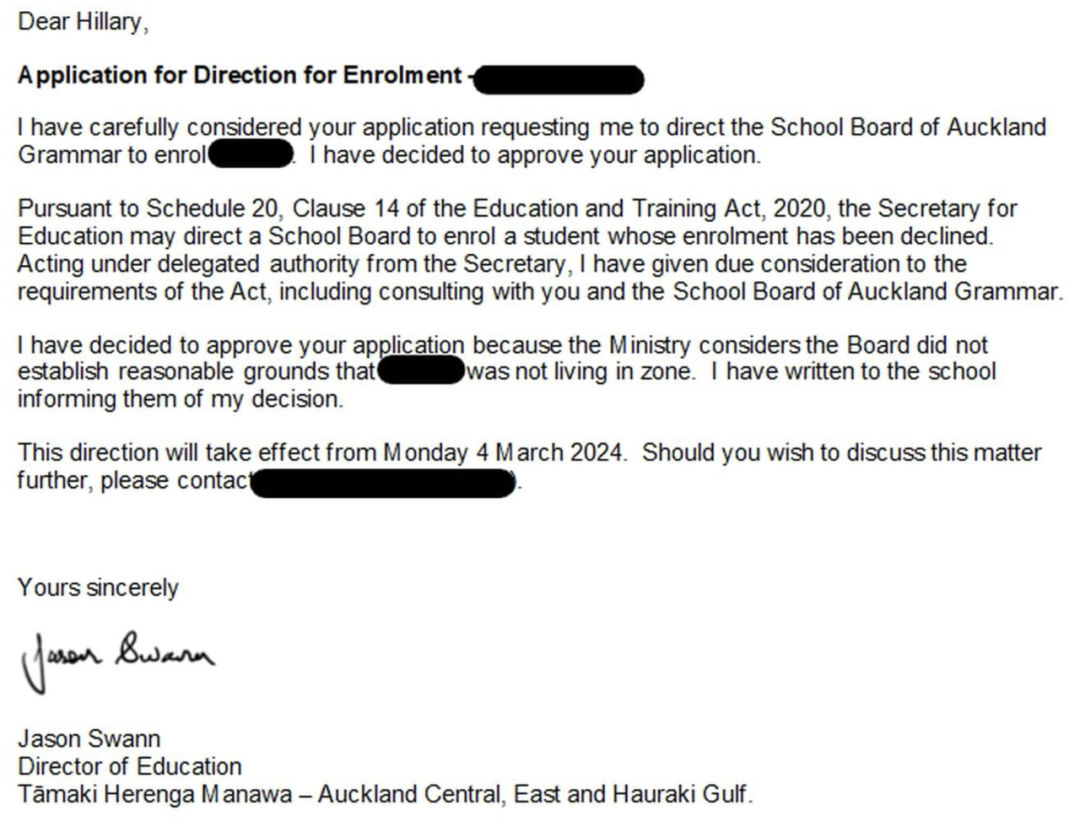
The Ministry of Education wrote to Au-Yueng, saying it did not believe Auckland Grammar School’s board had any reasonable grounds to conclude that her son did not live within the school zone
Despite the ministry issuing a direction, finding that the school board had provided no reasonable grounds to conclude that the student lived outside the zone, and writing to the school approving Au-Yeung’s son’s enrolment application, he has still not been enrolled.


Au-Yeung said she paid about NZ$500,000 for her property in the zone three years ago so her older son could attend such a well-regarded school. She openly acknowledged that she bought the in-zone property to secure her children’s education.
Meanwhile, the school outlined its own difficulties in a statement. Auckland Grammar School said its enrolment procedures complied with the Education Act. It treated all prospective in-zone students equally to ensure fair and transparent access. However, the school has its own enrolment scheme, which its website explains is intended to prevent potential overcrowding.
Secondary Principals’ Association president Couillault said Auckland’s Central City, Flat Bush, Papatoetoe, Manurewa and Ormiston areas had experienced substantial population growth, adding to enrolment pressures. The influx of 150,000 additional people had not been evenly distributed across the country’s schools. A considerable proportion of these students were also new to the country. He said swift, effective solutions were needed, along with a review of the local supply of quality teachers, but none of these issues would be easy to resolve in the short term.

 Auckland Grammar School headmaster Tim O’Connor
Appearing on TVNZ 1’s breakfast programme this morning, Auckland Grammar School headmaster Tim O’Connor said the law was the law and needed to be applied to ensure fairness and transparency throughout the system. For example, some people believed a large family could rent a single bedroom in someone else’s home to gain access to education. He said some parents went to extreme lengths to deceive schools so their children could enter the coveted Double Grammar Zone, which had become a selling point for property in the area. These people were prepared to rent residential garages or have telephone lines connected in other people’s homes to prove they lived there.
O’Connor did not deny the school’s duty of care towards students. However, with so many enrolment applications each year, staff had to carry out thorough visits and checks in the area, including necessary measures such as using private investigators, to ensure ‘fair’ access to education for everyone. The school received 752 out-of-zone applications in 2024. Although classroom capacity continued to expand, it still could not meet the enormous demand.

This seemingly minor issue of enrolling an in-zone student reflects a much larger social problem. In recent years, surging net migration has placed unprecedented pressure on infrastructure and social resources, including education and healthcare, in many major cities, particularly Auckland. The fair allocation of educational resources is a particularly significant issue.
YIJU New Zealand invited former New Zealand immigration officer and current immigration lawyer Sonny Lam to provide an in-depth analysis.

In Auckland, school zones have long been an important influence on house prices and families’ educational decisions. This is particularly apparent in the case of Auckland Grammar School, which is known for its academic excellence and prestige. Its enrolment zone, commonly known as the ‘Grammar Zone’, has become synonymous with exclusivity and privilege, pushing up housing costs within its boundaries.
Traditionally, the appeal of living in the Auckland Grammar Zone has been driven by the belief that proximity to the school guarantees access to a quality education and enhances property values. Families wanting their children to attend are willing to pay a premium for homes within the zone. Property prices there have consequently soared, in stark contrast to neighbouring areas. Rising prices have become a barrier to entry for many families, further worsening existing inequalities in educational access. The belief that attending a prestigious school equates to success also perpetuates a cycle of privilege that disadvantages marginalised communities.
Recent events, however, have cast doubt on the inviolability of Auckland’s Grammar Zone ‘myth’. Hillary Au-Yeung and her son’s struggle to secure enrolment at Auckland Grammar School reveals the complexities and inequalities inherent in the education system. The point is that the Grammar Zone offers no unassailable guarantee. Do you think it is worth paying more for?
The family’s predicament illustrates the socioeconomic barriers many families face in seeking educational opportunities. Despite living within the designated zone and meeting academic standards, her son’s application was rejected on a technicality concerning guardianship arrangements. The refusal sparked public outrage and raised questions about the fairness and transparency of the enrolment process.
People are asking whether it is unfair to make an address or postcode a deciding factor in education. Are property prices within the zone inflated because of proximity to the school? This incident challenges the assumption that living in the Grammar Zone guarantees enrolment and exposes deeply entrenched privilege and exclusion within the education system.
Looking ahead, there is an urgent need to reassess enrolment criteria and address the underlying inequalities perpetuated by school zone policies. A shift towards a fairer approach to education is urgently needed, prioritising ability and need over ‘postcode privilege’. We need proactive measures to remove barriers and create inclusive learning environments where every child has the chance to thrive. Let us work towards a more inclusive and equitable education system that enables every child to fulfil their potential, regardless of their background or postcode.