Interest deductibility is about to return: can ordinary people really make money investing in property?
Since the coalition government officially announced last weekend that it would begin restoring interest deductibility for property investors next month, many investors have been eager to act. That raises the question: how much can an ordinary person actually earn from an investment property?


Many New Zealanders firmly believe that local property values double every ten years. Put simply, they assume that if they buy a property for NZ$800,000, they can sell it ten years later for NZ$1,600,000, making at least NZ$800,000 on the sale.
However, this view is somewhat wishful. Falling house prices in recent years appear to have shattered the myth that New Zealand property prices only rise and 'double every ten years'. Many people have finally realised that property investment does not always make money, and that house prices can fall as well as rise. Property investment is not a one-way bet. Rational investors need to consider rental yields carefully, alongside elusive capital gains.
 Ed McKnight, resident economist at property investment company Opes Partners
Recently, Ed McKnight, resident economist at property investment company Opes Partners, used a randomly selected three-bedroom property in New Plymouth as a case study to analyse overall investment returns.
Based on New Plymouth's rental data and house price growth over the past ten years, the property sold for NZ$360,000 in 2013, with weekly rental income of around NZ$390.
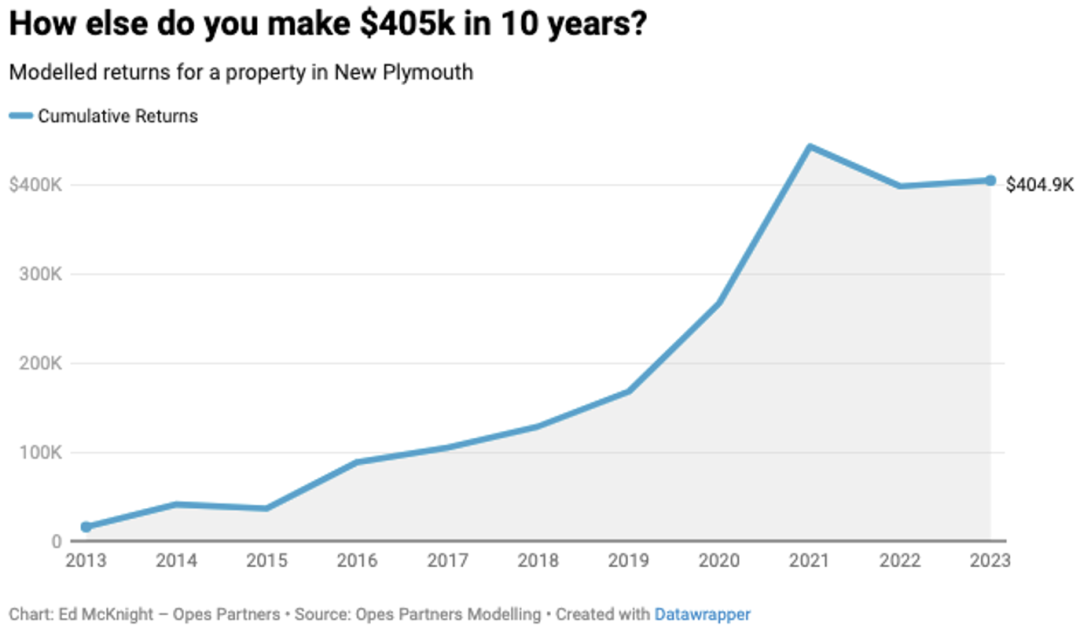
Changes in capital gains on a New Plymouth property over the past ten years (source: Opes Partner Modelling)
The model shown above accounts for interest rates, inflation and three separate changes to property taxation over the past ten years. According to the model, by the end of 2023, the property's value would have more than doubled, giving the owner over NZ$400,000 in capital gains. When returns are calculated annually, however, the amounts investors earn or lose fluctuate more widely between years.
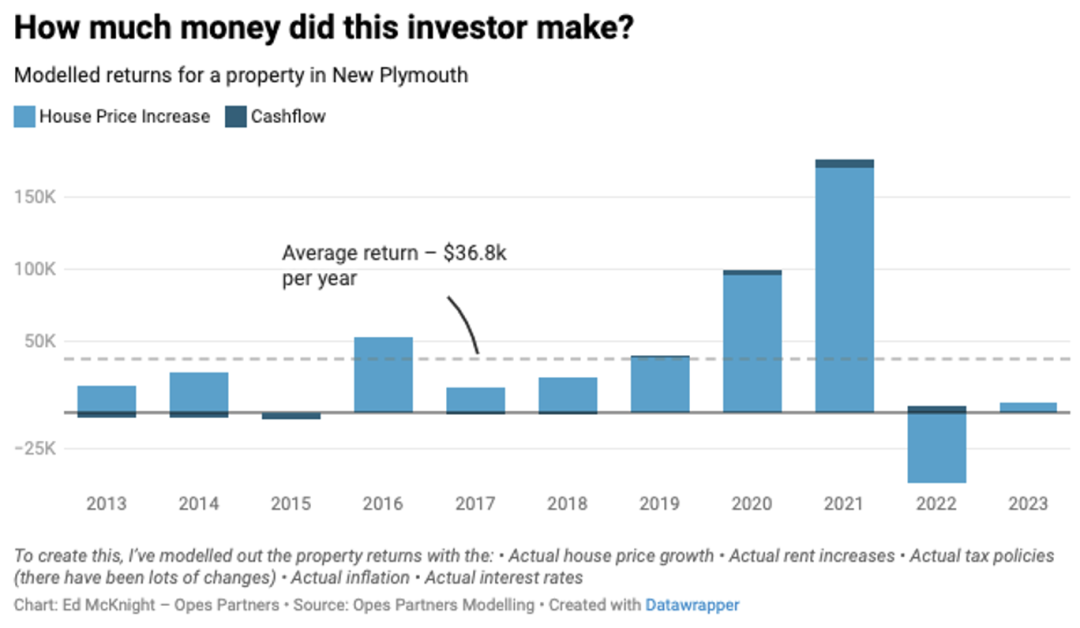
In 2016, property investors would have made a substantial sum, with average returns of nearly NZ$52,400 per property. This was because New Plymouth house prices rose rapidly that year, while rental income covered most interest costs. However, years like this do not last, and investors can suffer significant losses in other years. For example, house prices plunged in 2022, with investors losing an average of nearly NZ$45,000 per property. Looking back over the past ten years, overall property gains exceeded losses, but the path to those gains was far from smooth.
The case above offers three lessons:

|
The property increased in value by NZ$19,000 in the first year, but rent did not cover all the interest costs, so the investor needed to contribute another NZ$3000 towards mortgage payments. As a result, their wealth increased by only NZ$16,000. In the second year, house price growth accelerated, giving the investor NZ$28,000 in gains from rising property values. However, they still needed to contribute NZ$3000 towards mortgage payments, leaving their wealth up NZ$25,000 for the year. The following year, however, the market was less favourable. The property fell in value by NZ$1000, and interest payments brought the total loss for the year to NZ$4460. Across the past ten years, 2021 delivered the investor's best return: as house prices surged, the property's value rose by NZ$176,000. The following year, however, falling house prices cost the investor NZ$44,800. House prices cannot keep rising forever, nor can they keep falling forever. If you decide to invest in property, you need to be mentally prepared for its ups and downs.
|

|
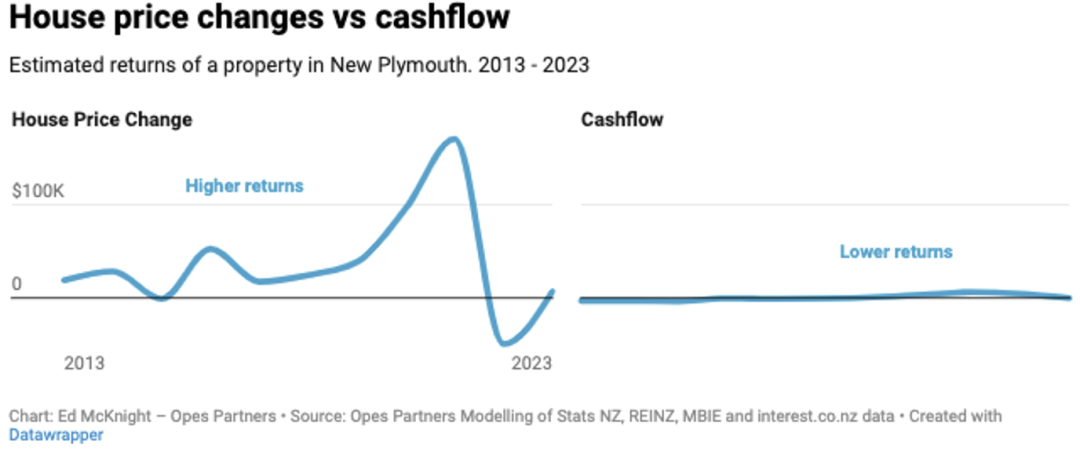
We can clearly see that 99% of the property's returns came from its increase in value. Only 1% of net returns came from rental income, meaning most of the financial return came from house price growth.
Changes in house prices and cash flow (Opes Partner Modelling)
|

|
Over the long term, the investor can gain NZ$404,900 in wealth from this property. If we present these figures using a different chart, it may look as though they make money every year.
However, investors must go through the growth cycle from trough to peak to achieve these substantial returns. This means holding the property for the long term, at least 7–10 years. The longer it is held, the greater the likelihood of making money. According to a CoreLogic research report, owners who make money on property tend to hold it for around 7 years on average, while those who lose money tend to hold it for only two years. Bear in mind that today's high interest rates are hurting investors. House prices have also only just begun to recover, meaning those who hold for the long term are more likely to make 'big money' than those simply looking for a quick profit.
|