New Zealand enters recession! Warning: could more buyers in this group be shut out of home lending?
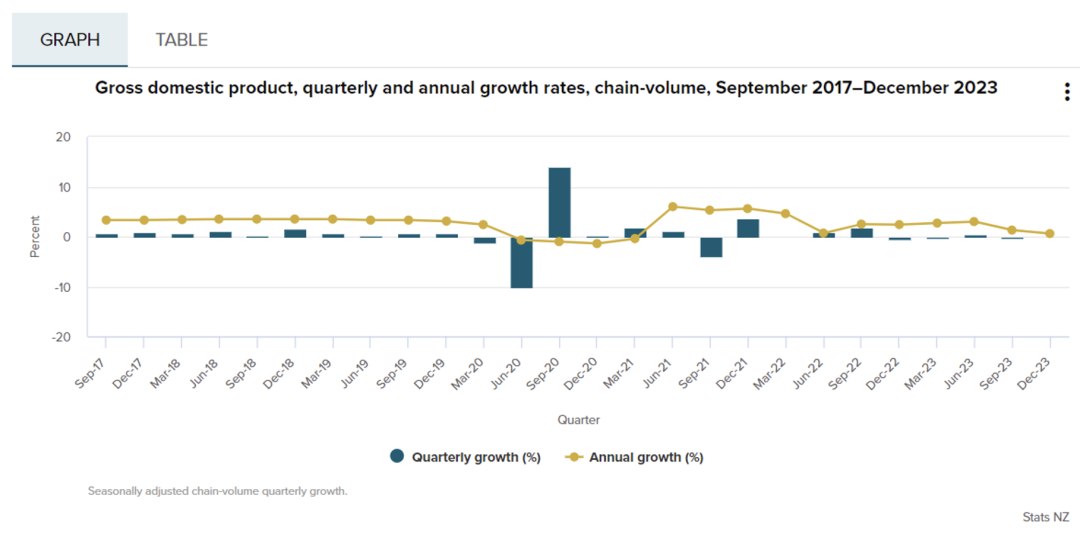
New Zealand's gross domestic product (GDP) fell 0.1% in the fourth quarter of 2023, following a 0.3% decline in the third quarter of 2023.


The latest gross domestic product (GDP) figures were released today. New Zealand's GDP fell 0.1% in the fourth quarter of 2023, following a 0.3% decline in the third quarter of 2023. This means New Zealand has slipped back into a technical recession, defined as two consecutive quarters of contraction.
Stats NZ said wholesale trade was the main driver of the downturn, largely due to declines in grocery and liquor wholesaling and machinery and equipment wholesaling. Retail activity also fell, mainly driven by declines in furniture, electrical and hardware retailing, and food and beverage services.
Stats NZ national accounts industry and production senior manager Ruvani Ratnayake said: ‘Increased activity associated with New Zealand's general election contributed to growth in public administration, safety and defence.’
Household spending rose 0.5%, mainly due to increased spending on services, particularly transport. Consumption of non-durable goods fell as spending on alcoholic beverages and petrol declined.

A mortgage broker recently warned that proposed new home lending rules could adversely affect mortgage applications from self-employed New Zealanders, potentially shutting some out of mortgage lending altogether.
 Reserve Bank of New Zealand Deputy Governor Christian Hawkesby
The Reserve Bank of New Zealand is understood to be requiring mainstream banks to implement new debt-to-income (DTI) rules to raise lending thresholds and reduce lending risks in the property market. Under the proposed rules, home buyers would be able to borrow only a specified multiple of their income: 6 times for owner-occupiers and 7 times for investors. Using the current national average annual income of NZ$82,576 from the latest Stats NZ figures as an example, an owner-occupier could borrow up to NZ$495,000.
Reserve Bank of New Zealand Deputy Governor Christian Hawkesby said these controls would ‘reduce financial risks’ and ‘support sustainable house prices’. However, a senior mortgage adviser expressed concern that the new rules could create major challenges for self-employed applicants, including business owners, tradespeople and contractors.
Jeff Royle of iLender said self-employed people face stringent conditions when seeking bank loans. To obtain a mortgage, borrowers must go through additional procedures to prove they have sufficient income, and the lending must align with the bank's interests.
Self-employed borrowers need to provide two years of satisfactory financial accounts, much as salaried borrowers present their payslips to a bank. However, not every self-employed person qualifies for a mortgage. Newer business owners or borrowers with irregular incomes must apply to non-bank lenders for alternative mortgages without standard income verification, also known as ‘alt-doc’ mortgages. To access lending outside the rules applied by commercial banks, they have to pay these lenders higher interest rates.
 Reserve Bank of New Zealand Governor Adrian Orr The introduction of DTI rules is intended to reduce risk in the mortgage market
Royle said that, to qualify for an alt-doc mortgage, a borrower's accountant must sign a declaration verifying the client's actual income. Borrowers may also need to provide a GST return showing that their business is operating normally and that they file returns on time with IRD, the tax authority.
Notably, many borrowers who choose second-tier lenders reapply for a mortgage with a mainstream bank after a year or two, having demonstrated their ability to meet repayments. Once DTI rules are introduced, however, this could become more difficult or even impossible. Royle warned that self-employed borrowers might never meet DTI requirements, preventing them from moving their loans to mainstream banks even when their income and expenses clearly show they can afford the repayments.
Currently, commercial banks have some flexibility when calculating how much borrowers can borrow. For example, they can add back business expenses such as vehicle and home office costs when calculating income. This increases the income recognised for self-employed borrowers, but it is unclear whether this flexibility will extend to DTI rules.
On the other hand, banks may discount a proportion of a self-employed person's income. This also happens to property investors declaring rental income. Royle said banks might no longer take their portfolios' full rental income into account when calculating whether they qualify for further lending under DTI rules. He suggested that another option for self-employed people was to buy a newly built home, which would very likely be exempt from DTI rules and could give borrowers access to more relaxed lending restrictions than other types of loans.