
New Zealand First softens its stance: could the foreign buyer ban be lifted? Latest property report reveals where house prices are rising fastest
OneRoof data shows that, nationwide, 481 suburbs with at least 20 property sales over the past year recorded annual price growth. This contrasts sharply with the corresponding figures released in April 2023, when only 114 suburbs nationwide recorded annual increases.
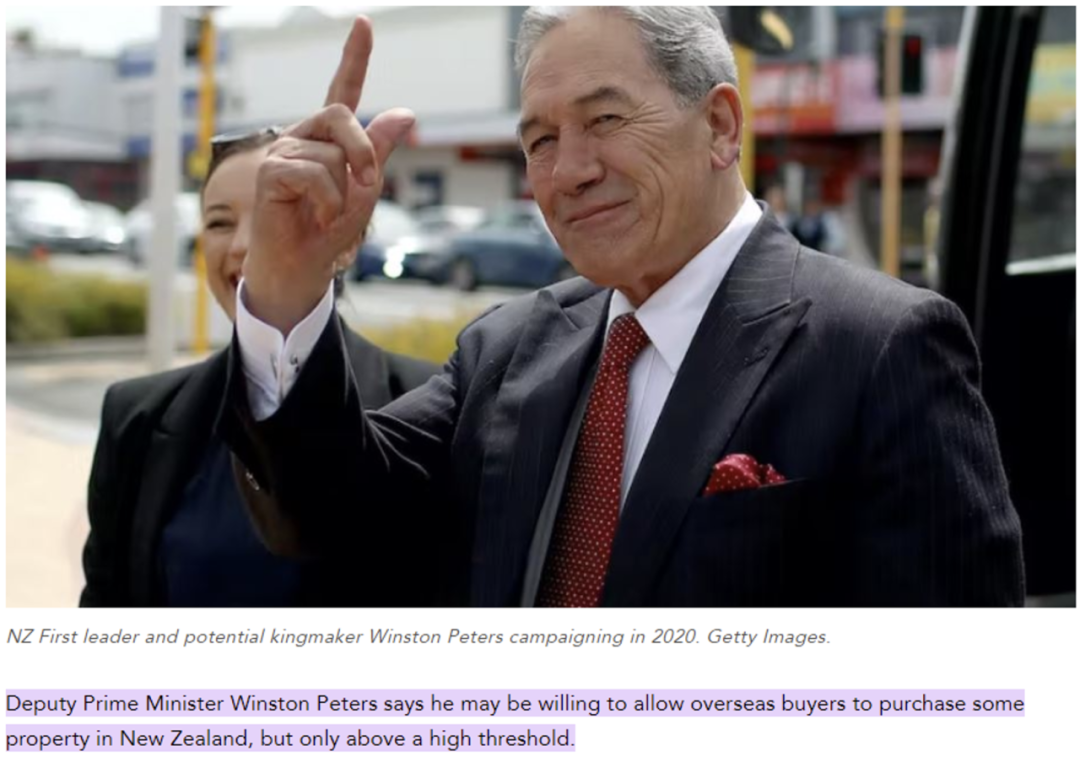

Deputy Prime Minister and New Zealand First leader Winston Peters says he may be willing to allow overseas buyers to purchase some New Zealand properties, but the threshold would be high.
Before the election, National proposed allowing overseas buyers to purchase properties priced above NZ$2,000,000, with a 15% tax on those transactions. The policy aimed to encourage foreign investment and raise government revenue to fund tax cuts in the Budget. However, it was ultimately excluded from National's coalition agreement with New Zealand First.
Nevertheless, Peters recently told Bloomberg he was willing to ease the rules for ultra-high-net-worth foreigners seeking to invest more broadly. He said lifting the ban on purchases of properties above NZ$2,000,000 'may be an inevitable conclusion'.

The latest OneRoof-Valocity house price index shows New Zealand's house price growth slowed to 0.5%, or approximately NZ$5000, in the first quarter of this year. Most regions showed signs of slowing growth, while prices in the Bay of Plenty and Gisborne even fell to some extent. With a surge in listings, property markets around New Zealand are returning to conditions favouring buyers.
Although Auckland recorded solid property sales in March, its price growth is losing momentum. The average house price rose just 0.1% (NZ$1000) to NZ$1,330,000. The latest figures also show a broader rebound in New Zealand's property market, with prices in nearly 60% of areas nationwide higher than a year earlier.
Over the year to the end of March, the strongest house price rises were found in Canterbury, including Merivale and Fendalton, and in lower-priced areas such as the West Coast. Mataura, in Gore, recorded the largest percentage increase, with its average house price rising 19.5% (NZ$50,000) to NZ$306,000. Merivale recorded the largest dollar change from a year earlier: strong sales in the second half of 2023 helped lift its average price by NZ$252,000 to NZ$1,594,000.
OneRoof data shows that, nationwide, 481 suburbs with at least 20 property sales over the past year recorded annual price growth. This contrasts sharply with the corresponding figures released in April 2023, when only 114 suburbs nationwide recorded annual increases.
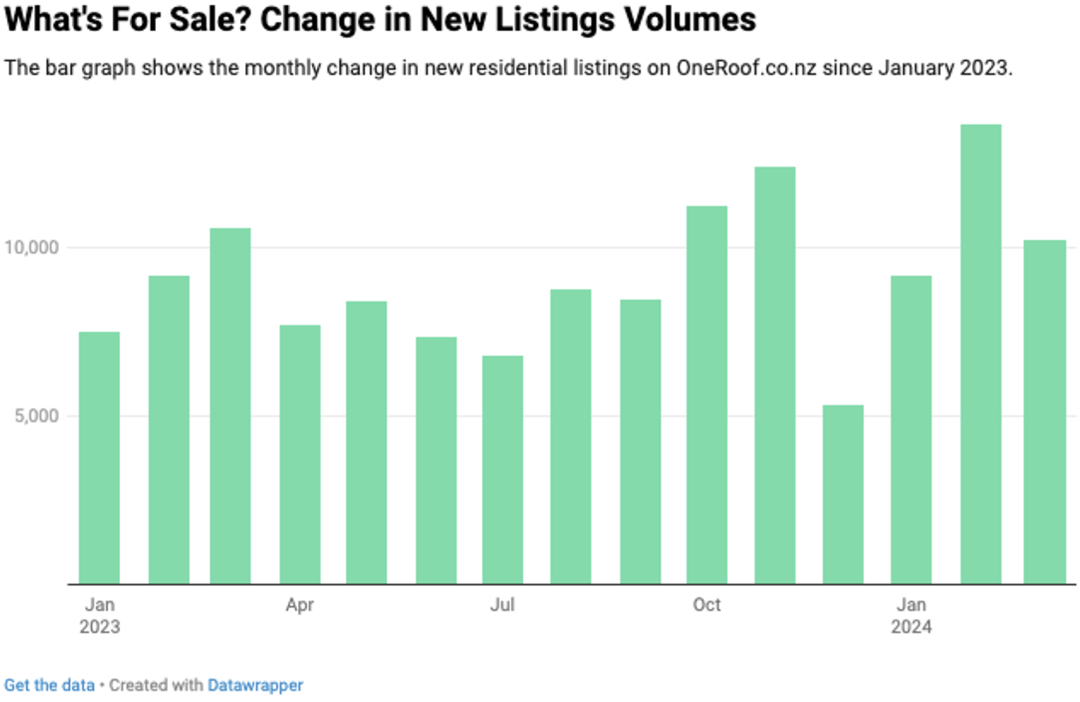 Changes in property listing numbers from January 2023 to January 2024 (Source: OneRoof)
Christchurch and Queenstown-Lakes were the strongest-performing urban property markets over the past year, with every suburb in these two regional centres recording annual house price growth. By comparison, Dunedin and Wellington performed somewhat less strongly, with clear annual price growth not evident in every suburb. Recovery also appears likely to take longer in Auckland, Hamilton and Tauranga, where only just over half of suburbs recorded clear price increases over the past year. The data also shows that every Auckland suburb except Totara Park in Manukau recorded price growth over five years. Prices in 11 suburbs more than doubled compared with April 2019.

OneRoof property editor Owen Vaughan said the total number of properties for sale on OneRoof was just over 40,000 at the end of March, up 13.5% annually. New listings in March rose 36% nationwide compared with a year earlier, and 48% in Auckland. The surge in listings has given buyers more options and greater bargaining power than six months ago. The market is undeniably shifting in buyers' favour. Joining Auckland in the slow lane for price growth were Canterbury, up just 0.8% in the first quarter, Hawke's Bay (+0.6%), Manawatū-Whanganui (+0.8%), Marlborough (+0.4%), Northland (+0.8%), Southland (+0.2%), Taranaki(+0.7%) and Waikato (no growth).
Vaughan stressed that Queenstown-Lakes continued to show strong growth. Busy property trading in the first quarter lifted its average house price by 2.5% (NZ$50,000) to NZ$2,030,000. However, this was slower than the 5% growth recorded in October last year. In stark contrast, the modest increases recorded in other major cities showed the market's current weakness, with Tauranga prices falling for the first time in six months. He concluded that, at a district level, the strongest first-quarter price increases were mostly on the West Coast, among the country's most affordable markets, while the largest falls were also in relatively inexpensive Gore and Kaipara.
 Helen O'Sullivan, global chief executive of property platform Valocity
, said uncertainty over when the Reserve Bank of New Zealand would cut interest rates, alongside persistently subdued economic activity, was holding back house price growth. Affordability remained borrowers' main concern. So far, the rebound had largely been concentrated in areas with entry-level house prices. She also said changes to the bright-line test and interest deductibility rules might offer existing investors some relief, but whether they would attract more investors into the market remained uncertain, particularly in the current high-interest-rate environment.