
Just announced: tenancy reforms introduce pet bonds! Have interest rates peaked? This week’s key developments for property investors
Image source: official website of the Economic and Commercial Office of the Consulate-General of the People’s Republic of China in Auckland, Ministry of Commerce of the People’s Republic of China


On 15 April, the New Zealand Government announced new tenancy policy reforms introducing pet bonds and requiring tenants to take responsibility for damage their pets cause to properties beyond fair wear and tear.
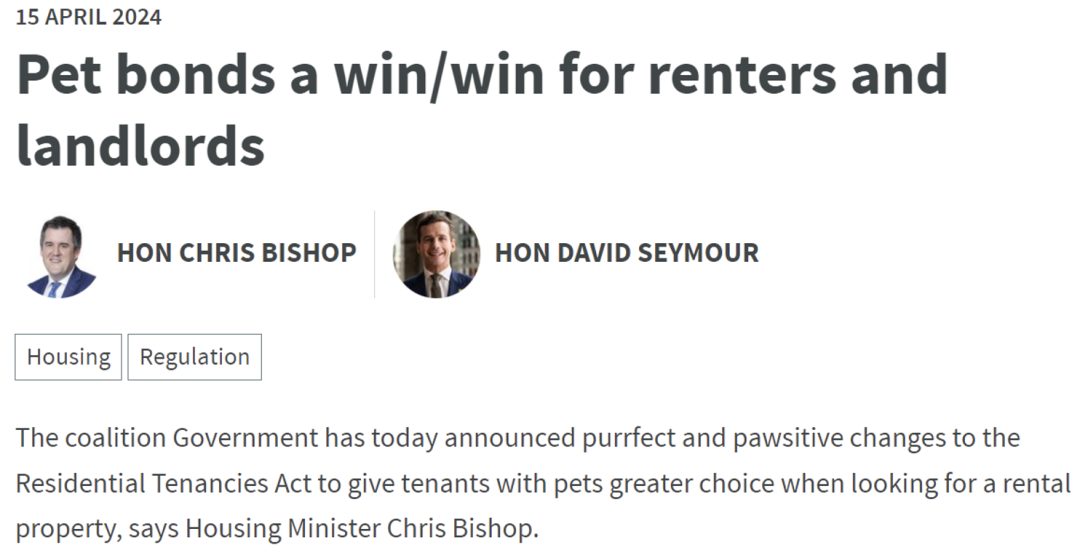
Changes to the Residential Tenancies Act announced by Housing Minister Chris Bishop and Regulation Minister David Seymour include a new pet bond of up to two weeks’ rent and a requirement for tenants to obtain their landlord’s consent to keep pets. The measures aim to give tenants with pets more options and address the difficulty of finding suitable rental homes when landlords are concerned about the risks posed by pets.
The legislative changes include: Landlords may charge an additional pet bond of up to two weeks’ rent on top of the existing bond; tenants must take responsibility for all pet-related damage beyond fair wear and tear; and tenants may keep pets only with their landlord’s consent, which landlords may refuse on reasonable grounds.

Bishop said prospective tenants with pets would welcome the changes. He said: “Pets are important members of many New Zealand households. An estimated 64% of New Zealand households have at least one pet, while 59% of people without pets would like to have one. Anyone who has tried to find a pet-friendly rental property knows how difficult it can be, so we will make it easier.” Seymour said the policy would address tenants being shut out of the market because landlords were unwilling to risk accepting tenants with pets. He said: “Some tenants are very willing to pay extra to live with their pets in their ideal home. If landlords can protect themselves against certain risks, they will be more willing to accept pets.

 Reserve Bank of New Zealand Governor Adrian Orr
Last week, the Reserve Bank of New Zealand released its shortest-ever monetary policy statement, explaining why it was keeping the Official Cash Rate (OCR) unchanged at 5.5%. In some respects, the decision would have surprised no one. It also followed the Bank’s consistent approach: although inflation is falling, it remains too high, so the OCR must remain elevated. Over the coming months, the housing market can be expected to remain constrained by rising mortgage interest rates.

Data released by the Reserve Bank of New Zealand last week showed that 56% of new lending issued in February this year, including home purchases, refinancing and top-up loans, was fixed for one year or less, a substantial increase compared with three months earlier. This suggests most borrowers are now very confident that mortgage rates have peaked and will fall next, so they do not want to lock in for too long. Of course, with current one-year rates still considerably higher than three-year rates, borrowers choosing shorter terms must pay somewhat more interest.

Meanwhile, the latest Cordell Construction Cost Index was also released last week. It primarily tracks material and labour costs for building standard new homes in New Zealand. The index rose just 0.5% between the fourth quarter of 2023 and the first quarter of 2024, with annual growth below 2.5%. By comparison, annual construction cost growth was in double digits at the end of 2022.
The recovery of building material supply chains and construction industry capacity is clearly a key factor in stabilising housebuilding costs. This is welcome news for the construction sector. It can reassure property buyers that any new-build projects they invest in will not face surging costs over time, while also making it easier for builders to price projects. Stable construction costs are particularly valuable against a backdrop of persistently subdued residential consent applications and actual construction activity.

Stats NZ data on new tenancies released last week showed rents rose 5.1% in the year to the end of March. This remained well above the long-term average of around 3%, but was the lowest reading since July last year, when it was 4.1%. With growth in net migration continuing to drive strong demand for rental homes, it may be too early to declare that rent growth has peaked. What is clear, however, is that rents have become very difficult for households on ordinary incomes to afford, so rent growth will inevitably level off at some stage.


At 10:45 am on Wednesday this week, Stats NZ will release this year’s first-quarter Consumers Price Index (CPI). In its latest forecasts, the Reserve Bank of New Zealand expects a quarterly CPI increase of around 0.4%, with annual inflation slowing from 4.7% in the fourth quarter of last year to 3.8%. This would be the first reading below 4% since mid-2021. If the actual result broadly matches these forecasts, market expectations and mortgage rates are unlikely to change much.
ANZ economist Henry Russell expects the CPI to rise 0.6% this quarter, bringing the annual rate down to 4%, though this would fall short of the reduction the Reserve Bank hopes to see. He also noted that although imported inflation could be -0.4%, the overall CPI points to easing inflation, albeit at a slower pace than the Bank expects.