One unlawful employee = an Immigration New Zealand fine of NZ$1000–3000? What do employers need to know about the new rules?
On 18 April, Immigration New Zealand urgently convened a public online meeting, mainly to discuss and explain policies introduced on 11 April to tackle businesses exploiting migrant workers. The new rules have increased employers’ operational and recruitment risks.

On 18 April, Immigration New Zealand urgently convened a public online meeting, mainly to discuss and explain policies introduced on 11 April to tackle businesses exploiting migrant workers. The new rules have increased employers’ operational and recruitment risks.
We have invited Sonny Lam, a former immigration officer with ten years’ experience as an immigration lawyer, to explain what these rules introduced by Immigration New Zealand to hold employers accountable and prevent worker exploitation actually mean, and what employers should do to avoid breaches and reduce operational risks.

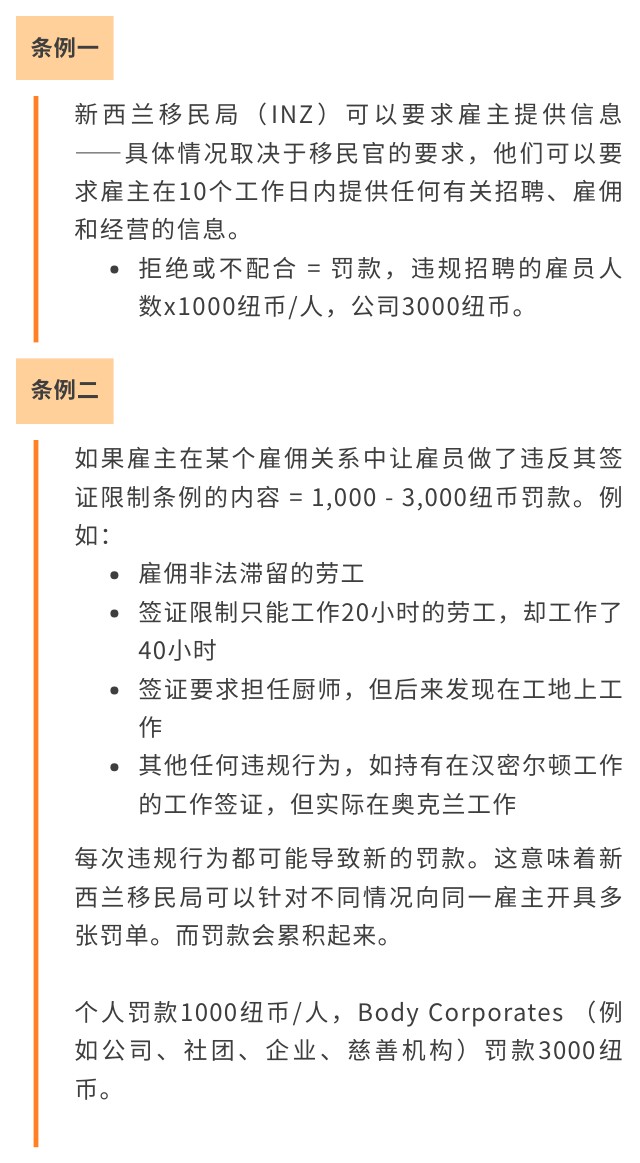
These breaches could lead not only to the loss of accredited employer status, but also to blacklisting. Businesses on the blacklist are prohibited from acting as immigration sponsors in any capacity again.


If you employ workers who are unlawfully in the country, you need to be particularly careful: Immigration New Zealand is determined to tackle breaches and worker exploitation. This means that, once investigated by Immigration New Zealand, you face a fine of $1,000 for each unlawful worker (note that the fine is imposed on the employer based on the number of unlawful workers, rather than on the workers), plus a $3,000 fine for the company itself. In other words, fines can accumulate without an upper limit.
For example, if Immigration New Zealand visits your company and finds 4 people working unlawfully, it can issue the company a fine of 4 × $3000 = $12,000. It can also fine you personally $1,000 × 4 = $4,000, bringing the total fines to $16,000.
If you employ someone whose visa restricts them to working in Wellington, but the job you provide is outside that region, this is also a breach.

If you employ someone, their hourly pay must be at least NZ$29.66 (only when sponsoring an AEWV). If the employee actually works 50 hours a week but you pay them for only 40 hours, you are in breach.
If you employ someone on an open work visa (Post Study Work Visa) and pay the minimum hourly wage of NZ$23.15, but they actually work 41 hours while you pay them for only 40 hours, their actual pay falls below the minimum wage. You could therefore be fined, and there is also a risk that your accreditation could be revoked.
Put simply, there are many ways to breach the rules. If you are not alert to policy updates or do not understand them well enough, you could breach them without even realising it. Previously, employment issues might only have required employers to deal with the Employment Relations Authority, followed by a hearing and mediation leading to compensation or fines. Now, INZ can also intervene to ensure that the process of employing migrant workers is lawful. INZ has the power both to impose fines and to revoke a company’s accredited employer status. Employers now face pressure from several directions and complex policies. If you have any questions about your current employment relationships, please contact me at any time for advice and a risk assessment.

Taken together with the topics we have discussed in our posts over the past two months, this points to one conclusion: tackling migrant exploitation will be a priority for Immigration New Zealand for at least the next 6 months, and it has already invested substantial resources and time in this work. The seniority of the Immigration New Zealand staff who attended the online meeting on 18 April also shows how seriously the Government is taking efforts to clean up the recruitment market. This means Immigration New Zealand will investigate and audit employers more rigorously in the coming months.
Scan the QR code to enquire for more information