
Revealed: Which types of New Zealand property hold their value best and attract the most buyers in the current market?
Choosing a property that will hold and increase its value is a concern for every buyer in New Zealand’s property market.
Choosing a property that will hold and increase its value is a concern for every buyer in New Zealand’s property market. From apartments in prime central locations to quality standalone houses, new homes on the urban fringe and land, each property type has its own advantages and appeal. As economic conditions and demographics change, some property types stand out for their stable prices and appealing features, attracting strong buyer interest. So, in the current buyer’s market, which properties hold their value best and are most sought after? Let’s take a closer look.
“More land is king”—is this an enduring truth?
You often hear claims in the property market such as ‘more land is king’, ‘land is scarce’, ‘it is land, rather than houses, that appreciates fastest’, ‘properties on larger sections tend to appreciate faster than those on smaller sections’, and ‘buying land offers better value than buying a house’. However, the latest research suggests this is not always the case.
Data from property consultancy CoreLogic shows that properties on larger sections sell for more. In Auckland, for example, properties with land areas exceeding 300 square metres have an average price of NZ$1,170,000. Properties on medium-sized sections of 300 to 599 square metres average NZ$1,540,000, while those on larger sections of more than 600 square metres average NZ$1,680,000.
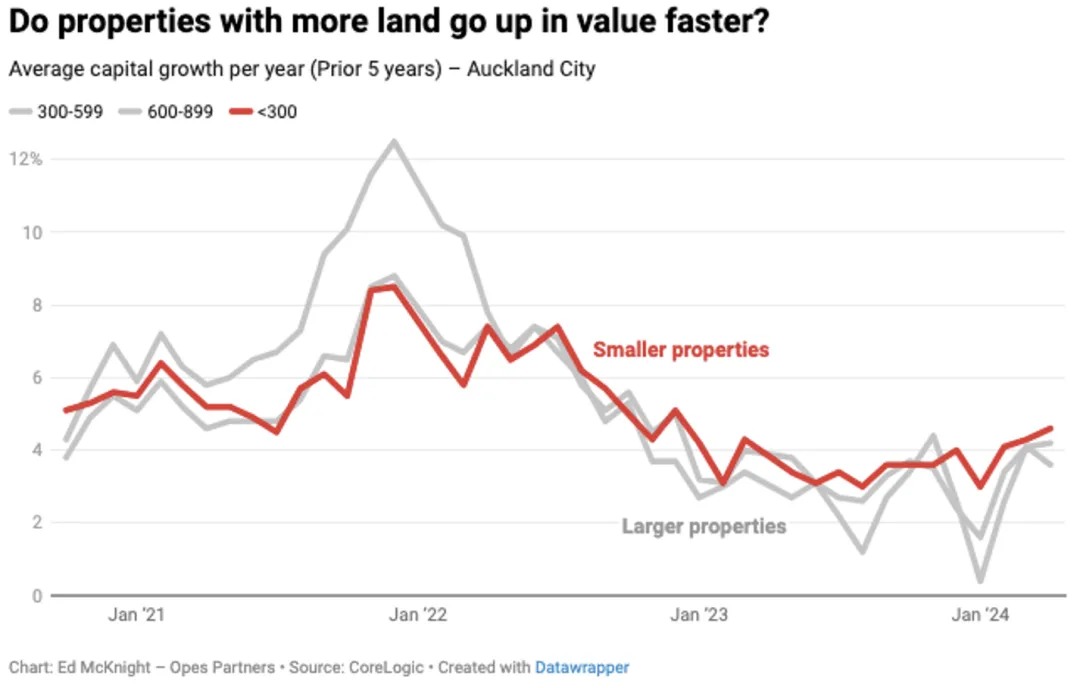
2016 to 2024: Capital return trends for Auckland properties by section size
During New Zealand’s property boom, prices for Auckland properties on medium-sized sections soared, but their growth has been subdued since the market peak. As the chart above shows, there has been a significant difference in capital returns between properties on sections smaller than 300 square metres and those larger than 600 square metres over nearly 10 years.
2021 to 2024: Capital return trends for Auckland properties by section size
Over the five years to April 2024, the former recorded average annual capital growth of 4.6%, compared with just 3.6% for the latter. So why are properties on smaller sections more likely to appreciate?
Opes Partners’ resident economist Ed McKnight explains that properties on smaller sections are often more affordable for buyers. As property prices rise, demand for smaller properties may increase. This also suggests that New Zealanders’ preferences are shifting from large, expensive properties towards smaller, more moderately priced ones. For buyers, finding a home that suits their needs matters most. Buyers should not simply regard it as a “good investment” and spend money on more land than they need. Do not blindly assume that buying a property on a larger section will deliver greater capital returns.
What do the most popular homes on the market look like?
For buyers with sound finances or mortgage pre-approval, layout, neighbourhood and school zones are all important considerations. Ray White real estate agent Elaine Ferguson emphasises the importance of layout. For example, families with three or four children favour family homes with more than one bathroom, a master bedroom with an ensuite, a flat section, a garage or good on-street parking, and landscaped gardens. The positioning of the kitchen and swimming pool also matters, so parents can keep an eye on their children.
When it comes to retaining value, Ferguson says townhouses and apartments generally do not perform as well as standalone houses. Newly built townhouses are too small, with yards that are too small to attract many buyers, limiting their potential for price growth. She adds that well-sized townhouses have better potential to retain value, but are relatively scarce because developers now want to maximise profits by building as many townhouses as possible on each site. Homes with features such as ‘more than three bedrooms, two bathrooms, a flat section, parking, and proximity to bus routes and cafés’ hold their value better, as do those with attractive views or on safe streets. By contrast, interiors without a distinctive style struggle to attract buyers’ attention.
What are the key selling points that attract buyers?
CoreLogic Head of Research Nick Goodall believes location is a key selling point and has a major influence on house prices. Buyers’ main questions include: How well is the property connected to surrounding transport networks and the community? Is public transport available? What school zone is it in? Is there space to work from home and enough parking?
QV Chief Operating Officer David Nagel stresses that, when it comes to retaining value, a property’s location appears to matter more than the property itself. Generally, central urban areas attract more buyers and prices tend to be more resilient. This is because most buyers want to live closer to the CBD. A market downturn can therefore be a good time to buy in a better-quality, more central location. In other words, the broader the pool of potential buyers, the better a home will retain its value in future.
So, which types of New Zealand property do you think hold their value best and are most sought after in the current market? Share your thoughts in the comments.