
Homebuyers shocked as DTI start date officially announced! With the First Home Grant scrapped, how can buying a home become easier?
For first-home buyers in expensive areas such as Auckland, the dream of home ownership remains out of reach even with a 20% deposit.

DTI restrictions to take effect on 1 July
Today, the Reserve Bank officially announced that it will introduce debt-to-income (DTI) restrictions from 1 July, while easing loan-to-value ratio (LVR) restrictions. The implementation date is in line with earlier market expectations.
The new rules require banks to allocate 20% of new mortgage lending to owner-occupier borrowers with DTIs above 6 and investor borrowers with DTIs above 7. Banks will also be allowed to issue 20% of owner-occupier lending and 5% of investor lending to borrowers with LVRs above 80% and 70%, respectively.

Well-known Chinese property expert Tony Tong said: “The latest quarterly data released by the Reserve Bank of New Zealand (RBNZ) for the March quarter shows that new high-DTI mortgage approvals are currently well below the proposed limits. But during the next property market upswing, new high-DTI lending will surge. That is when DTI restrictions will really take effect.”
“LVR restrictions address the consequences of defaults by reducing potential losses during a housing downturn, while DTI restrictions reduce the likelihood of defaults by focusing on borrowers’ ability to keep servicing their debt, particularly during a rising housing market. DTI and LVR restrictions therefore complement each other, and work better when both are included in the RBNZ’s ‘macroprudential toolkit’. Both act as guardrails, reducing the build-up of high-risk lending in the system.”
“Activating DTI restrictions also means we can simplify the LVR settings. High inflation is currently being brought under control effectively, and CPI is continuing to fall in the direction set by the Reserve Bank. Although high interest rates will persist for some time, the housing market may be in a window of opportunity as the OCR and commercial banks’ mortgage rates fall over the medium to long term, and property listings decline.”
What does scrapping the grant mean for first-home buyers?
This is not the only policy affecting the market recently. Housing Minister Chris Bishop announced last Wednesday that Kāinga Ora would no longer accept First Home Grant applications, with applications closing at 1 pm on 22 May (click to read)。

In his latest statement last Thursday evening, Housing Minister Chris Bishop said that (despite the grant being scrapped) first-home buyers could still access support through the First Home Loan scheme. Evidence suggests that the eligibility criteria for First Home Loans have a greater influence on whether someone can buy a home. They can also still withdraw their KiwiSaver savings to help fund a deposit. He explained that the biggest change for first-home buyers would be the Government’s plan to improve housing affordability by increasing supply. Its ‘Going for Housing Growth’ programme would increase housing supply by removing urban land constraints, improving infrastructure and funding, and creating incentives for councils and communities to support housing growth.
The announcement prompted a flurry of debate, with some supporting it and others opposing it. With policies continuing to emerge, the property market will inevitably remain volatile, and first-home buyers, who currently dominate the market, will face further impacts.

Many mortgage advisers said the Government’s decision to scrap the First Home Grant had left numerous first-home buyers confused and worried, and caught many advisers off guard. They spent that afternoon fielding a constant stream of calls from clients.
Mortgage adviser Claire Williamson said she received calls from several first-home buyers after the announcement. One client had already expressed interest in buying a property and needed the grant to meet the bank’s 10% deposit requirement. If the client could not complete the purchase this time, they would have to keep saving for a deposit…
For many of Williamson’s first-home buyer clients, the grant scheme lowered the barrier to home ownership, removing the need for a large 20% deposit. She believes the Government’s move could push interest rates a further 1% higher. On a mortgage of around NZ$500,000, that would add NZ$4000 to NZ$5000 to a first-home buyer’s annual borrowing costs.
Loan Market mortgage adviser Dave Williams said the Government should have given people more warning before stopping the grants. He estimated that around 80% of his first-home buyers had received the grant, and expected its removal to affect many buyers’ decisions. However, Williams also said that only around 20% of buyers truly needed the First Home Grant to buy a new home. The remaining 80% did not really need the money to complete their purchase, but anyone would happily accept this ‘free lunch’.
Meanwhile, EasyStreet Mortgage adviser Gareth Veale believes the Government has other ways to help first-home buyers purchase their first property. He believes looser lending criteria and the ‘First Home Loan scheme requiring only a 5% deposit’ could have a more positive impact on first-home buyers than the former First Home Grant.
He added that few buyers in Christchurch could find an existing home for less than NZ$575,000, so they did not even qualify for the First Home Grant. He does not believe the grant had as much impact on first-home buyers as others suggest. In his view, 99% of buyers would not rely on it to fund their deposit: it was simply free money towards a home purchase, with very limited influence.
So how can the prospects for first-home buyers improve in future?
Interest rates, house prices and incomes are key
Although the Reserve Bank of New Zealand has kept the Official Cash Rate (OCR) at a high 5.5%, fixed mortgage rates have actually been edging down as wholesale funding rates fall. The average two-year fixed rate offered by the major banks declined steadily from a peak of 7.04% in November last year to 6.73% in April this year. Although the decline has been modest, it has brought the average two-year fixed rate back to its level in July last year.
Meanwhile, entry-level house prices have remained relatively stable. According to the Real Estate Institute of New Zealand, the average price of the cheapest 25% of properties sold nationwide in April was NZ$590,000, taking the figure below NZ$600,000 for the first time since late 2022. That price remains well below the record NZ$670,000 reached in November 2021.
Another factor affecting affordability is income. It attracts much less attention than house prices or interest rates, but is just as important. In April this year, a representative first-home buyer couple had take-home income of NZ$2056 a week, up NZ$91 (4.6%) a week from April last year. Taking all these factors into account, what does this mean for first-home buyers?
Income and mortgage repayment data for April this year shows that mortgage repayments on the cheapest 25% of properties sold nationwide in April accounted for 43.4% of a typical buyer household’s income, with a 10% deposit. For buyers with a 20% deposit, mortgage repayments accounted for 34% of take-home income. Both affordability measures have declined almost continuously since peaking in November last year.
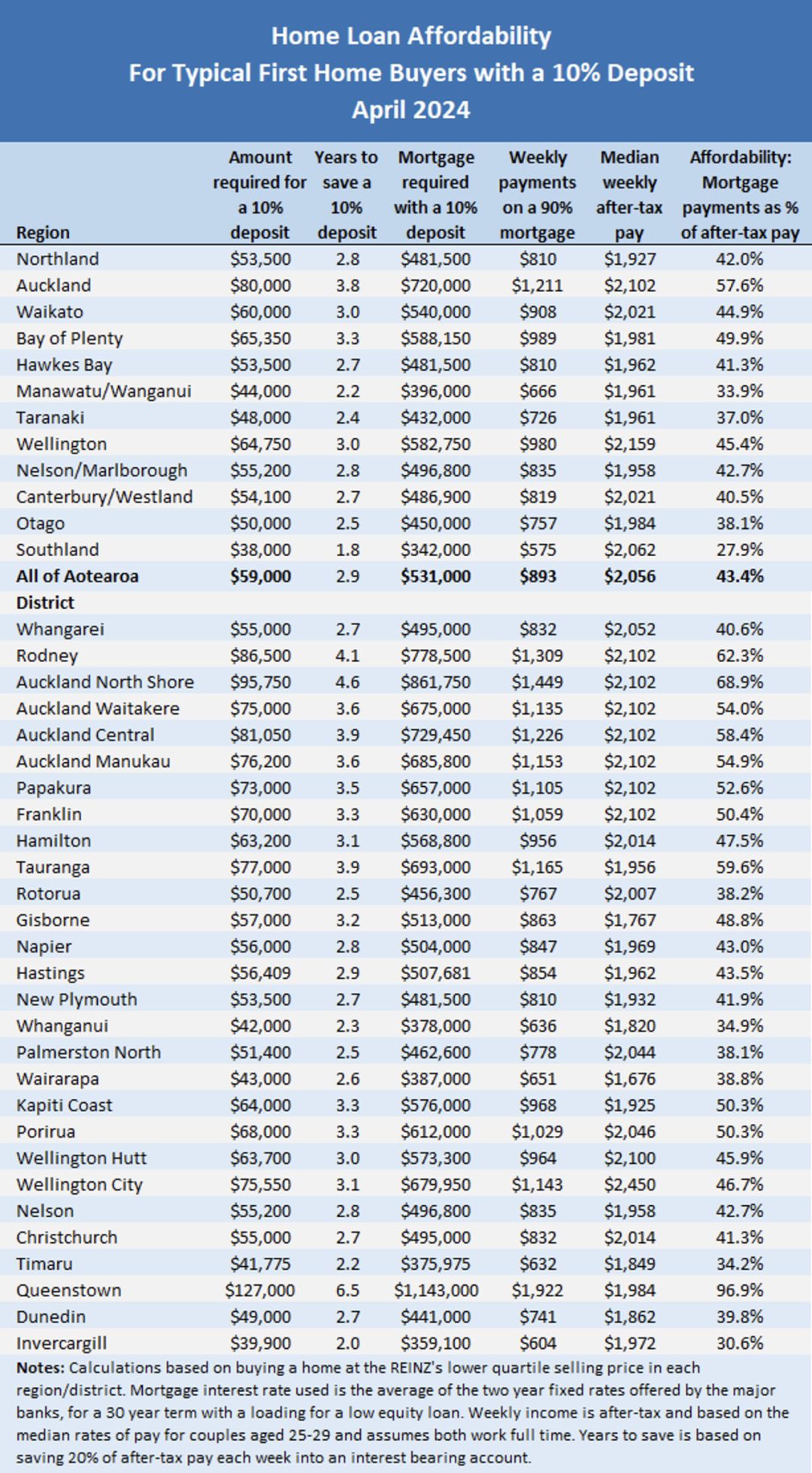
Housing affordability across New Zealand regions in 2024 for buyers with a 10% deposit (source: interest.co.nz)
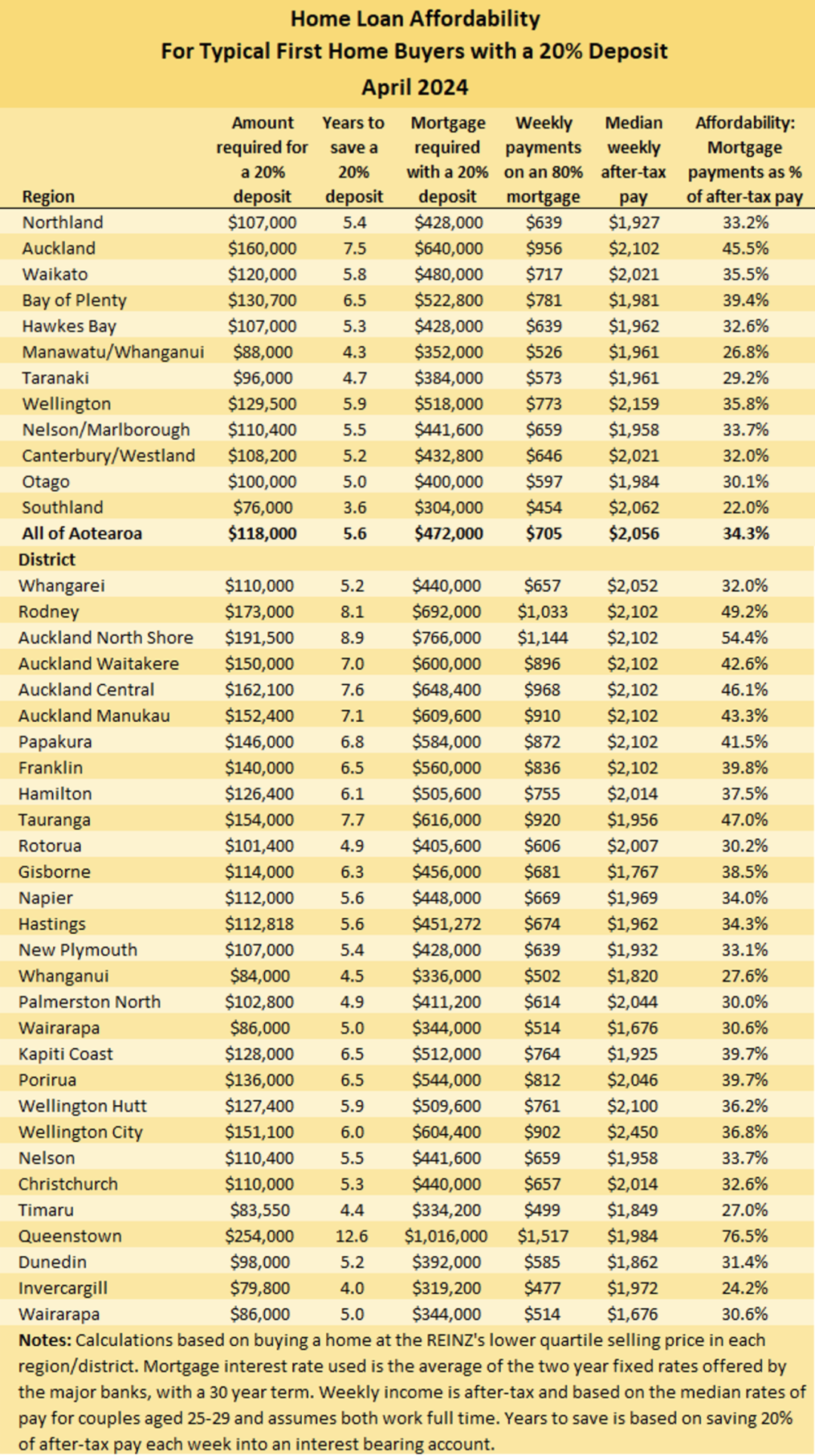
Housing affordability across New Zealand regions in 2024 for buyers with a 20% deposit (source: interest.co.nz)
Any improvement in housing affordability is welcome news for first-home buyers. However, these figures reflect national averages. For first-home buyers in expensive areas such as Auckland, the dream of home ownership remains out of reach even with a 20% deposit. To make buying a home easier for first-home buyers, house prices and mortgage rates need to fall substantially, while incomes need to rise substantially.