
Breaking: several banks cut interest rates, with some now below 6%! House prices have fallen for five consecutive months—can lower rates reverse the downturn? Expert analysis of the market outlook
Interest rates are expected to fall gradually over the coming months, potentially helping house prices stabilise and recover

The latest CoreLogic property data shows that New Zealand's housing market is experiencing its fifth consecutive month of falling prices, with Auckland prices down almost 3% over the past quarter. This has attracted widespread attention within and beyond the industry. Alongside persistently high interest rates, it is putting enormous pressure on sellers and prompting buyers to wait and see. However, some positive signals are beginning to emerge: interest rates are expected to decline gradually over the coming months, potentially helping house prices stabilise and recover.
Several banks cut mortgage rates
Several major banks, including ANZ, BNZ, ASB and Kiwibank, have recently cut fixed mortgage rates, with some now below 6%.
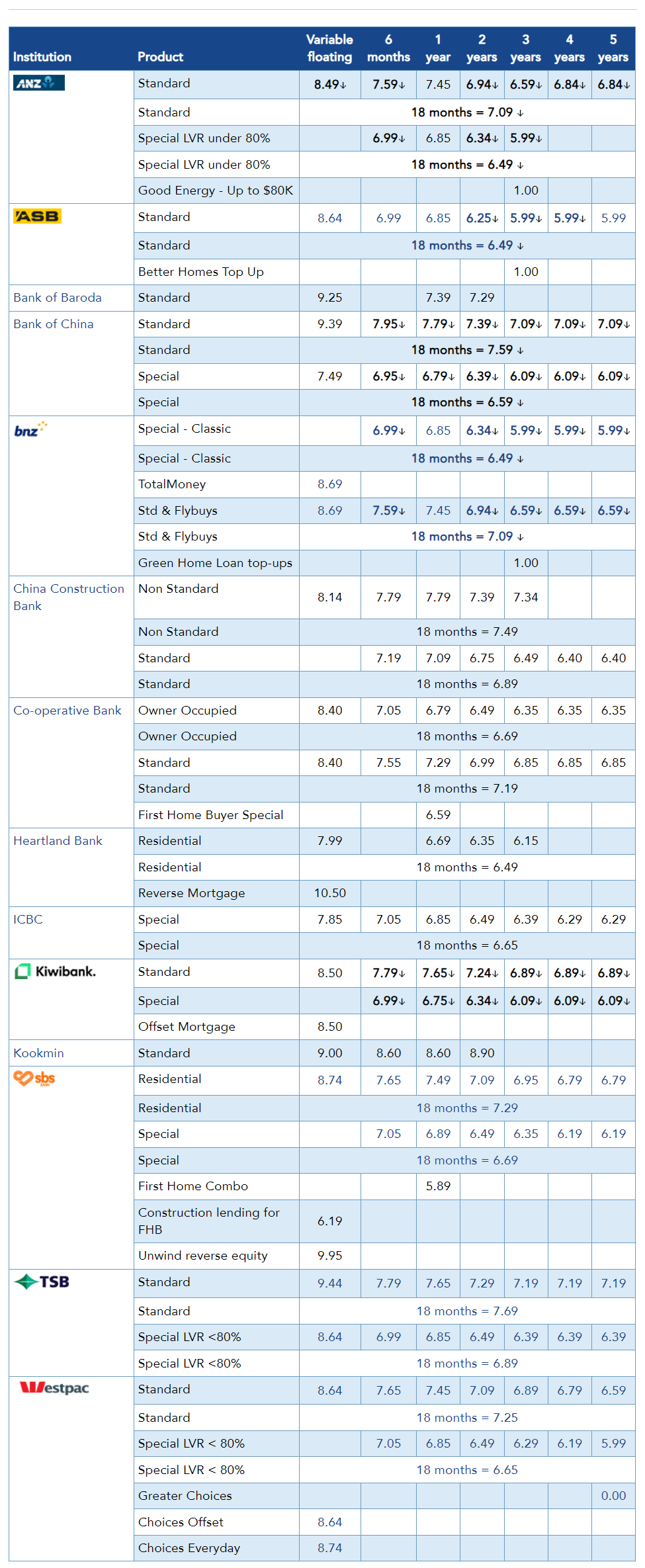
Source: https://www.interest.co.nz/borrowing
These cuts come ahead of an anticipated reduction in the official cash rate by the Reserve Bank of New Zealand. Several cuts are expected before the end of this year, with the next OCR update due on 14 August. The adjustments reflect rapidly falling wholesale interest rates and banks' expectations for future rate movements.
National house price trends and regional differences
New Zealand's median house price is currently NZ$827,515, down 0.5% from the previous month and 2.5% in total since February. Auckland's house price is NZ$1,095,000, down 0.8% from the previous month. Across the country, Wellington, Tauranga, Hamilton, Dunedin and Christchurch have also recorded price declines of varying sizes. Wellington has seen a particularly pronounced fall, with prices approximately 21% below their pandemic peak.
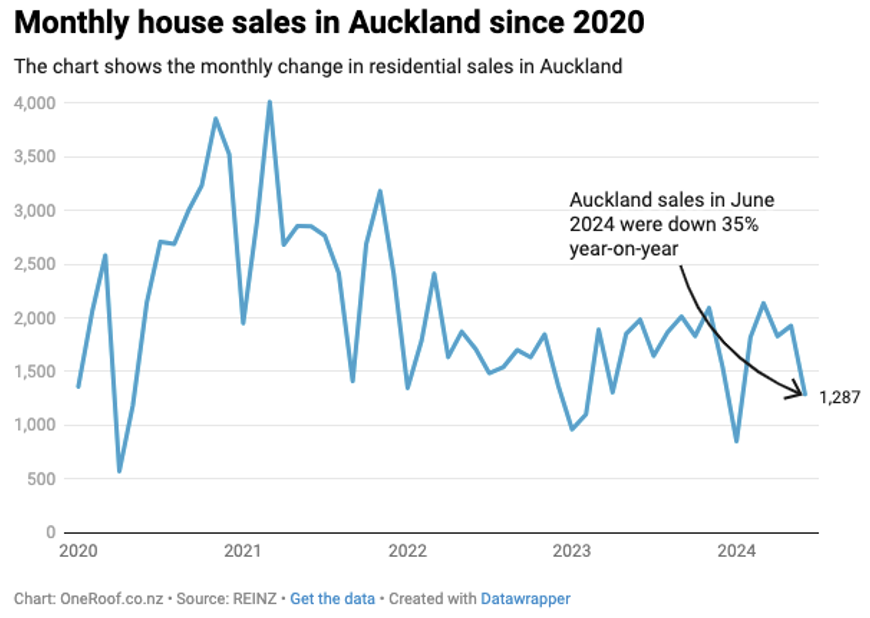
Chart of monthly Auckland home sales volumes from 2020 to the present (source: REINZ)
CoreLogic chief property economist Kelvin Davidson has identified two distinctive features of Auckland's housing market. First, Auckland house prices are already much higher than those in many other regions, making it difficult for buyers to purchase a home in the city. Second, Auckland has been at the centre of the recent townhouse construction boom. Some of these developments are still being completed and coming onto the market, further increasing the number of properties for sale and giving buyers more choice.
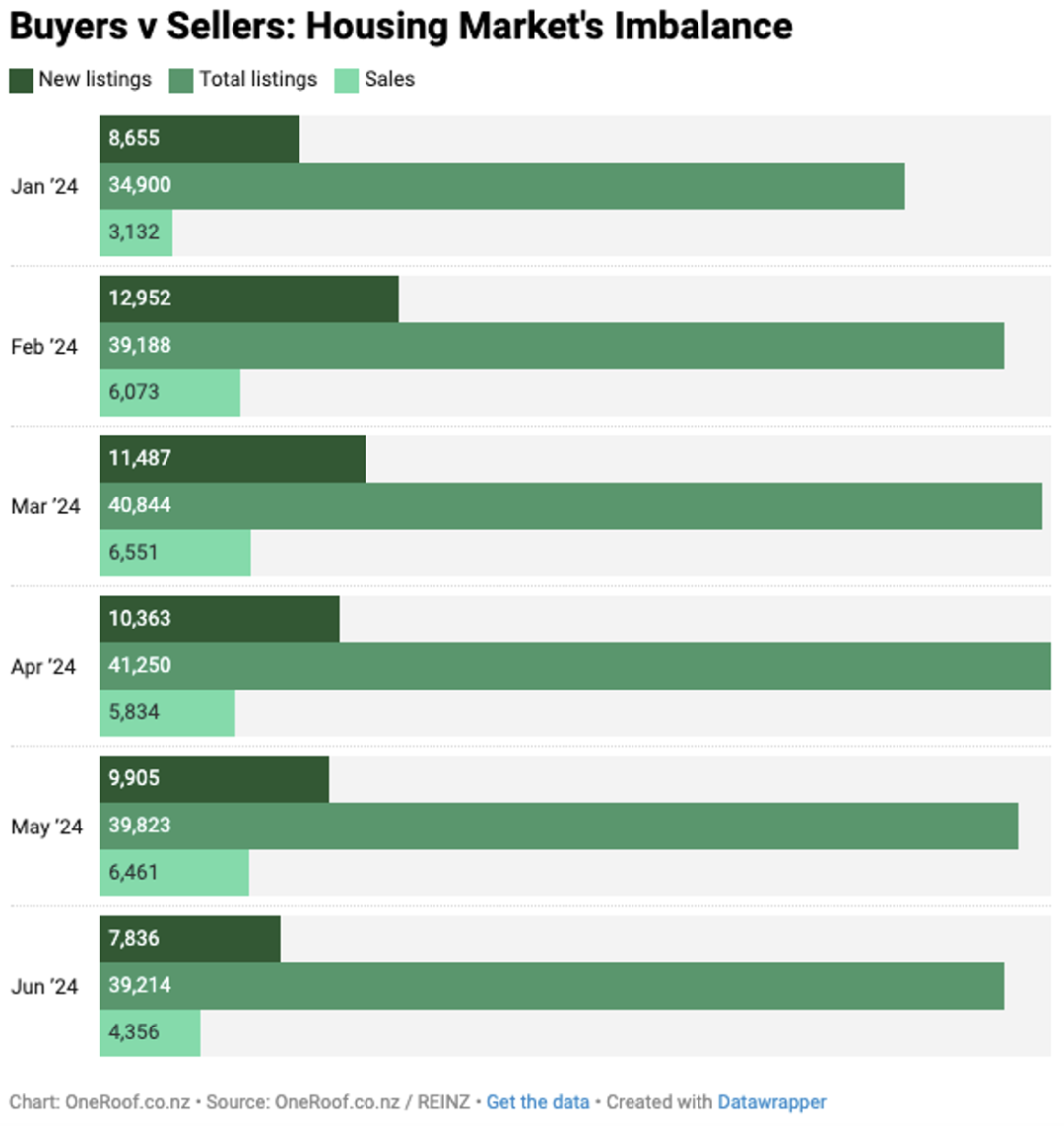
Chart comparing new listings and sales from month 1 to June in 2024 (source: OneRoof)
According to Davidson's analysis, New Zealand's weak economy and rising unemployment are the main reasons for falling house prices. High interest rates make repayments difficult for many buyers to afford, while the large number of properties for sale gives buyers more choice and negotiating power. Against this backdrop, longer selling periods and sellers making concessions to secure sales have become normal features of the property market.
Banks revise OCR forecasts
ANZ economists have recently revised three key forecasts, including their expectations for house prices and interest rates. ANZ previously expected national house prices to rise 1% by the end of this year, but weak recent economic indicators have led it to revise that forecast to a 1% fall. ANZ's research team is led by chief economist Sharon Zollner, who said the revision reflected factors including a weakening manufacturing index, subdued consumer confidence and a poor business outlook.
ANZ expects house prices to start recovering next year, rising 4.5%. It has also brought forward its forecast for the first official cash rate (OCR) cut to November this year, from February next year. This change is based on the latest economic data, particularly declining monthly net migration and a fall of more than 8% in job advertisements in June.
New Zealand is returning to a more normal inflation environment, in which affordability constraints will limit the potential for substantial house price growth. This has prompted other banks to lower their house price growth forecasts too. In May this year, BNZ economists forecast 2% house price growth in 2024, although even that may prove too high. They had previously expected growth of 5%.
Last month, Westpac lowered its house price inflation forecast for 2024 from 5.8% to 2.1%. The bank said prices had recovered slightly from May last year to just before the October election, followed by modest growth in the first quarter of 2024, broadly in line with expectations. However, housing market momentum has slowed since the 2023 election. This, alongside the Reserve Bank of New Zealand's firm stance on keeping interest rates high for longer, has been a major driver. Westpac expects house prices to rise 6% in 2025. Next year's prices are expected to benefit from a combination of lower interest rates and housing shortages resulting from continued construction weakness and population growth.
The hope offered by falling interest rates

Independent economist Tony Alexander
Against a relatively weak economic backdrop, falling interest rates undoubtedly offer hope for the housing market. In his latest analysis, independent economist Tony Alexander notes that as the Reserve Bank of New Zealand moves towards monetary easing, markets expect further interest rate cuts in the near future. Mortgage rates have already begun falling, which is undoubtedly good news for existing borrowers and prospective buyers. Alexander's latest survey suggests that although buyers remain concerned, market sentiment is changing, with more buyers beginning to fear missing out on an opportunity to buy a home (FOMO).
He notes that ANZ economists forecast house price growth of 4.5% in 2025 and 5% in 2026. This optimistic forecast signals confidence in the market's future. A housing market recovery depends on interest rate movements as well as overall economic performance, employment prospects and buyer confidence. Although the current market remains uncertain, a recovery is within reach as positive factors accumulate.
How the market is responding
Tony Alexander emphasises in his analysis that understanding changes in the property market requires listening directly to frontline real estate agents as well as examining official data. His monthly survey of real estate agents shows that although the market remains weak, buyer activity has increased as interest rates fall. Some agents report higher open home attendance and a growing proportion of first-home buyers. Although buyers remain concerned that house prices could fall further, lower interest rates are easing the financial pressure of buying a home, gradually improving market sentiment.
Although the property market remains a buyer's market, Tony Alexander's survey shows that positive signs are increasing. Improving market sentiment is bringing first-home buyers more choice and more competitive prices. While the market remains challenging, this undoubtedly represents a rare opportunity for first-home buyers.
YIJU's commentary
The second half of 2024 will remain challenging for New Zealand's housing market. However, with interest rates gradually falling and market sentiment improving, the property market is expected to recover gradually over the coming years. Buyers and sellers alike need to watch market developments closely and seize favourable opportunities.
So how can you accurately read the market and seize the right opportunities?
Taking place this Friday and Saturday at Auckland's Due Drop Events Centre (formerly Vodafone Events Centre) is the 2024 New Zealand International Building Expo and Summit (NZIBES), where you may find the best answer. The event will see the launch of a report commissioned by the New Zealand Chinese Building Industry Association (NZCBIA) from renowned New Zealand economist Shamubeel Eaqub, who wrote the NZCBIA Annual Construction Industry Report, an annual report providing new information on New Zealand's building, construction and property sectors. Thanks to the joint efforts of economist Shamubeel and the NZCBIA and MultiMarketing teams, the report offers in-depth analysis and forward-looking insights. It is expected to exceed many people's expectations and provide crucial guidance for the construction industry's positive development.