Major release: authoritative construction industry report published! After 30 years of stagnation, where do we go from here?
The report outlines the current state and importance of New Zealand’s construction industry and offers many practical recommendations to improve productivity and public perceptions

At the New Zealand Building Expo & Summit’s annual dinner on 9 August, the New Zealand Chinese Building Industry Association (NZCBIA) launched its NZCBIA Annual Construction Industry Report.
Commissioned by the New Zealand Chinese Building Industry Association and written by renowned New Zealand economist Shamubeel Eaqub, the report provides an annual update on New Zealand’s building, construction and property sectors. By examining productivity and potential solutions, it aims to improve understanding of the construction industry’s role and clarify opportunities for progress.
The NZCBIA Annual Construction Industry Report contains many figures worth noting, and some findings may surprise those in the industry—
-
The scale of New Zealand’s construction industry is striking: total annual sales reach NZ$99,000,000,000, directly employing 306,000 people and supporting a total of 576,000 jobs—approximately 20% of New Zealand’s total workforce!
-
In 2022, did nearly 40% of construction workers really have less than a year’s experience in the industry? In 2023, more than 90% of new employees came from other industries. High staff turnover and high-risk work continue to affect the entire industry.
-
New Zealand’s construction industry productivity has stagnated for 30 years! Is this due to changes in the industry’s structure or the prevalence of so many small businesses?
-
The construction industry’s first public perceptions survey found that the public viewed the industry poorly, with the strongest impression being “expensive”。
-
Both housing and infrastructure face supply shortfalls, with supply still failing to keep pace with market demand?
The report outlines the current state and importance of New Zealand’s construction industry and offers many practical recommendations to improve productivity and public perceptions. For example, to meet future demand, the industry must “mature” further, addressing future challenges by reducing uncertainty, simplifying processes and improving workers’ skills.
To read the report in detail, scan the QR code below or click “Read the original” at the end of this article to access the full report.

Building and Construction Minister comments on the report
On 9 August, the day the NZCBIA Annual Construction Industry Report was released, New Zealand Minister for Building and Construction Chris Penk issued a media statement on the report.
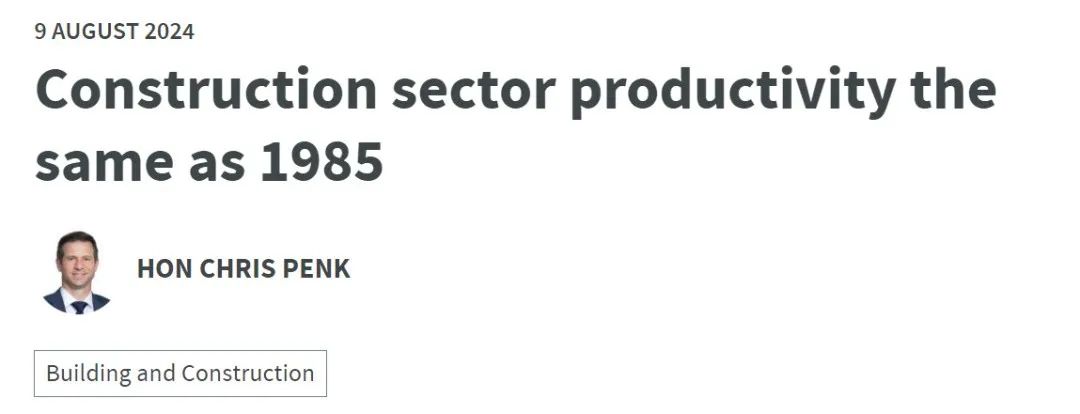
The statement reads as follows:
Chris Penk said the new report highlights the significant and widespread productivity challenges facing the construction industry, underscoring the importance of the Government’s plans to simplify building processes and lower costs.
The New Zealand Chinese Building Industry Association (NZCBIA) today released a report examining the building and construction sector and outlining the opportunities and challenges facing one of New Zealand’s most important industries.
Construction is a vital part of the economy, with sales in 2023 reaching 99,000,000,000 New Zealand dollars and indirectly supporting 20% of New Zealand’s jobs.
However, the report also paints a sobering picture, finding that construction industry productivity has remained unchanged since 1985——a shocking statistic given the enormous technological advances since then. Another key challenge is the increasingly slow building process. Since 2013, the time needed to build a house has increased by 50%, from 13 months to 19 months.
Together, these factors have made housing unaffordable, forcing New Zealand families to spend an increasing share of their income on housing. Of particular concern, renters now spend nearly 40% of their income on housing. This is also reflected in the report: when New Zealanders were asked to describe the construction industry in one word, the most common response was ‘expensive’.
The report’s findings are precisely why the Government is focused on simplifying the building consent system and removing unnecessary red tape that holds up construction. Improving industry productivity will take time, but building more homes is essential so that more New Zealand families can enjoy all the social and health benefits of living in stable housing.

As part of our ambitious reform agenda for the building and construction sector, the Government has already advanced a range of changes this year to simplify the building process, including:
-
Removing barriers to the use of overseas building products in New Zealand.
-
Making remote inspections the default, delivering significant productivity gains compared with traditional inspection methods.
-
Simplifying minor changes to building consents, removing the need to submit separate applications for small changes.
-
Addressing building consent delays by requiring councils to publish processing times quarterly.
-
Reviewing the earthquake-prone building system to better balance safety, costs and risks.
Thank you to the New Zealand Chinese Building Industry Association for this insightful report. It highlights the importance of simplifying construction and reducing its costs so New Zealanders can have the high-quality, affordable homes they deserve.
Industry feedback
New Zealand Chinese Building Industry Association President Frank Xu said stagnant construction productivity was evident across OECD countries. “We have experienced 30 years of stagnation, but this is not unique to New Zealand. Many comparable countries face similar productivity challenges. We sit in the middle of the OECD, but the report identifies how we can do better.”
Frank Xu said that while the industry’s economic outlook was positive, the report’s findings showed there was still much work to do. “Construction is a NZ$99,000,000,000 industry supporting 576,000 jobs across New Zealand. We need better planning of new building projects to ensure industry stability. The new Government also needs to continue removing regulatory barriers to getting projects started.”
The report shows that New Zealand’s building and construction sector will drive the country’s economic recovery if shortages of skilled workers and high staff turnover can be addressed.
To address productivity and skilled worker shortages, the report calls on New Zealand companies to strengthen frontline training and micro-training to improve workforce skills and retain industry talent and knowledge. Frank Xu said: “The report shows that we have workforce issues in construction that must be addressed for the industry to develop. The biggest challenge is staff turnover. We need to train more skilled people.”
TK Yong of Auckland-based LIVEFIRM Construction also recognised the importance of improving workers’ skills. He said the company’s dedicated staff training programmes had significantly improved retention and productivity: “For years, we have been developing carpentry skills, with enormous benefits for both the company and our employees. From a cost-benefit perspective, upskilling is highly advantageous for the company. Investment in skills development has delivered substantial returns. Our employees have gained valuable knowledge, enjoyed greater income growth and become more likely to stay with the company long term.”
“Across the industry, more dedicated training systems and resources for upskilling would greatly reduce staff turnover and improve the speed, quality and productivity of the national workforce.”
Issue 26 of YIJU | New Buildings, New Ways to Build magazine
will present a Chinese-language overview of the report’s key findings. Stay tuned.
If you are interested in the NZCBIA Annual Construction Industry Report,
scan the QR code below to access the full report.