
Warning! Banks’ non-performing loans surge past NZ$1,900,000,000, with the bad debt rate up 72% over the past year
The non-performing loan ratio will continue to rise

The latest commercial bank credit asset quality data released by the Reserve Bank of New Zealand shows that non-performing housing loans surged again in April 2024, rising by 7.7% and taking the total past a staggering NZ$1,900,000,000.
Key facts
Loans more than 90 days overdue are generally considered non-performing. When payments are more than 90 days overdue, borrowers have failed to meet their obligations on time, exposing commercial banks to higher credit risk and asset quality risk。
Although growth in non-performing loans appears to have slowed in recent months, the NZ$136,000,000 increase in bad debts this April was the second-largest monthly rise since June 2020, at the height of the COVID pandemic. It was exceeded only by the NZ$161,000,000 increase between December 2023 and January 2024. Notably, total non-performing housing loans have increased by NZ$384,000,000, or 25.3%, since the start of this year. Over the past year, the total has risen by NZ$796,000,000, an increase of as much as 72%.
The latest monthly figures show that the non-performing loan ratio rose from 0.5% in March to 0.54%, reaching a new peak during the current period of growing loan stress. Although the 0.54% ratio is the highest in a decade, it remains well below the levels seen during the global financial crisis, when the ratio reached 1.2% between 2009 and 2011. Historical data therefore shows that the ratio has yet to reach its all-time high.
However, with mortgage interest rates continuing to rise since the second half of 2021, the non-performing loan ratio has also been climbing steadily. It stood at 0.32% in April 2023, rose to 0.43% by the end of 2023, and surged to 0.54% during the first four months of this year.
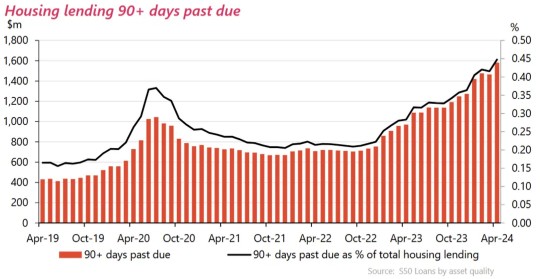
Changes in banks’ non-performing loan ratios over the past five years (Source: S50 loans asset quality)
From January to April this year, the total value of loans 90 days overdue increased by NZ$309,000,000, or 24.3%. Over the past 12 months, total overdue loans increased by 611,000,000, a rise of 63%.
The non-performing loan ratio will continue to rise
Clearly, rising unemployment is an important factor behind the increase in non-performing loans.
During the surge in interest rates—for example, average one-year fixed mortgage rates rose from 2.3% to 7.2% over the past three years—very low unemployment was widely seen as a factor helping homeowners meet their repayments. However, unemployment has now begun to rise rapidly. According to Stats NZ, the unemployment rate increased from 3.4% in the March quarter of 2023 to 4.3% in the March quarter of 2024. The Reserve Bank of New Zealand forecasts that it will rise to 4.6% by the end of the current quarter, ending in June.
Reassuringly, the Reserve Bank of New Zealand said in its Financial Stability Report released in May 2024 that the non-performing loan ratio remains within its expectations so far. It expects the ratio to continue climbing to around 0.7% by the end of this year, still well below the level seen during the global financial crisis.

Another major factor determining whether borrowers face greater repayment pressure is how long interest rates remain at their current high levels.
Monthly mortgage data released by the Reserve Bank of New Zealand shows that most borrowers are currently fixing their rates for 12 months or less, suggesting growing expectations that interest rates will fall soon. Last week, the Treasury was also strongly forecasting rapid interest rate cuts in September and December, in the second half of this year. However, the Reserve Bank of New Zealand has dampened those expectations by maintaining that domestic inflation remains too high. The Bank forecasts that a reduction in the Official Cash Rate will not be possible until the second half of 2025, which is bound to disappoint homeowners hoping for lower mortgage rates within the next 12 months.
Property market expectations hit rock bottom

Independent economist Tony Alexander
The latest monthly real estate agent survey released by independent New Zealand economist Tony Alexander shows that buyers’ FOMO, or fear of missing out, has almost entirely disappeared. Now, 55% of agents believe house prices in their area are falling, compared with 37% last month and 26% in January. He believes this sharp deterioration in market sentiment may reflect growing concerns about employment. To some extent, the survey figures suggest that even if interest rates begin falling at the end of this year, we will not see much of a turnaround in the residential property market until employment begins to recover.
Another notable survey finding is that only around 5% of real estate agents this month reported seeing more first-home buyers in the market. That is down from 21% last month, 55% in January, and the peak of 66% in August 2023. This suggests concerns about future employment are causing young first-home buyers to pull back. With an increasing number of new listings to choose from, they are in no hurry to buy.