
Rates cut! Reserve Bank announces OCR reduction to 5.25%, with Kiwibank and ASB first to lower mortgage rates…
The Reserve Bank forecasts the OCR will fall to 5% or lower by the end of this year, and to 4.5% or lower by June 2025
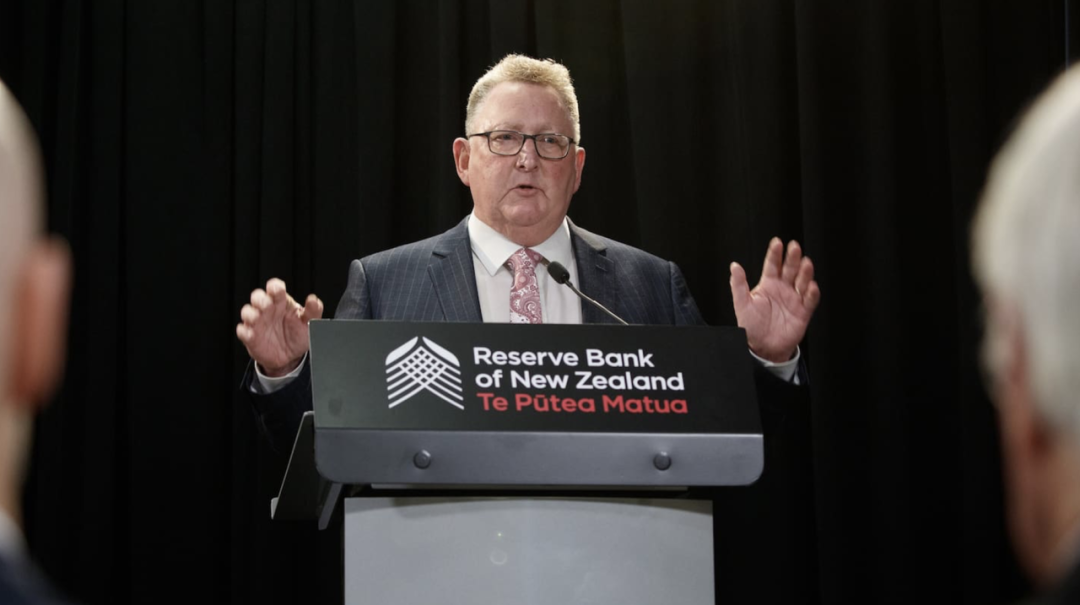
The Reserve Bank of New Zealand made a major announcement today, cutting the Official Cash Rate (OCR) by 25 basis points to 5.25%。This is the Reserve Bank’s first rate cut in four years. It said it was confident inflation had been brought under control and expected it to remain stable within the 1–3% target range. The Reserve Bank forecasts the OCR will fall to 5% or lower by the end of this year, and to 4.5% or lower by June 2025.
Why did the Reserve Bank cut the OCR?
According to the Reserve Bank of New Zealand’s report, annual consumer price inflation is returning to the Monetary Policy Committee’s target range of 1% to 3%. The bank noted that economic growth remained below its expected trend and inflation was falling in advanced economies.
Discussing possible reasons for the current economic weakness, the Monetary Policy Committee said restrictive monetary policy and the effects of earlier or larger fiscal tightening could be suppressing domestic demand. Declining net migration could also be a factor.
Discussing fiscal policy, the committee noted that government spending was falling as a share of the economy, with contractionary effects already evident and expected to continue. However, it said there was uncertainty over whether tax cuts would stimulate consumption. Although they could boost demand, households might remain more cautious about spending in the current economic environment.
Kiwibank and ASB mortgage rates
fall in response
Kiwibank moved quickly, becoming the first bank to respond to the Reserve Bank of New Zealand’s monetary policy adjustment. It immediately announced a 0.25% cut to mortgage and variable business lending rates. Kiwibank chief customer officer Elliot Smith said: “We’re pleased to respond quickly to the Reserve Bank’s adjustment and bring customers lower rates. In the current high-interest-rate environment, we know any reduction in lending rates can significantly improve loan and mortgage affordability and give customers greater financial flexibility.”
ASB became the second major bank to respond to the OCR cut, lowering all fixed and floating lending rates at almost the same time. ASB cut its floating mortgage rate by 25 basis points, from 8.64% to 8.39%, while its Orbit rate fell from 8.74% to 8.49%. Its 6-month lending rate fell 10 basis points, from 6.99% to 6.89%, and its 1-year rate fell 26 basis points, from 6.85% to 6.59%. ASB’s 18-month rate fell 34 basis points, from 6.49% to 6.15%, while its 2-year rate dropped below 6%, falling 26 basis points to 5.99%. Its longer-term rates, covering 3, 4 and 5 years, all fell 10 basis points to 5.89%.
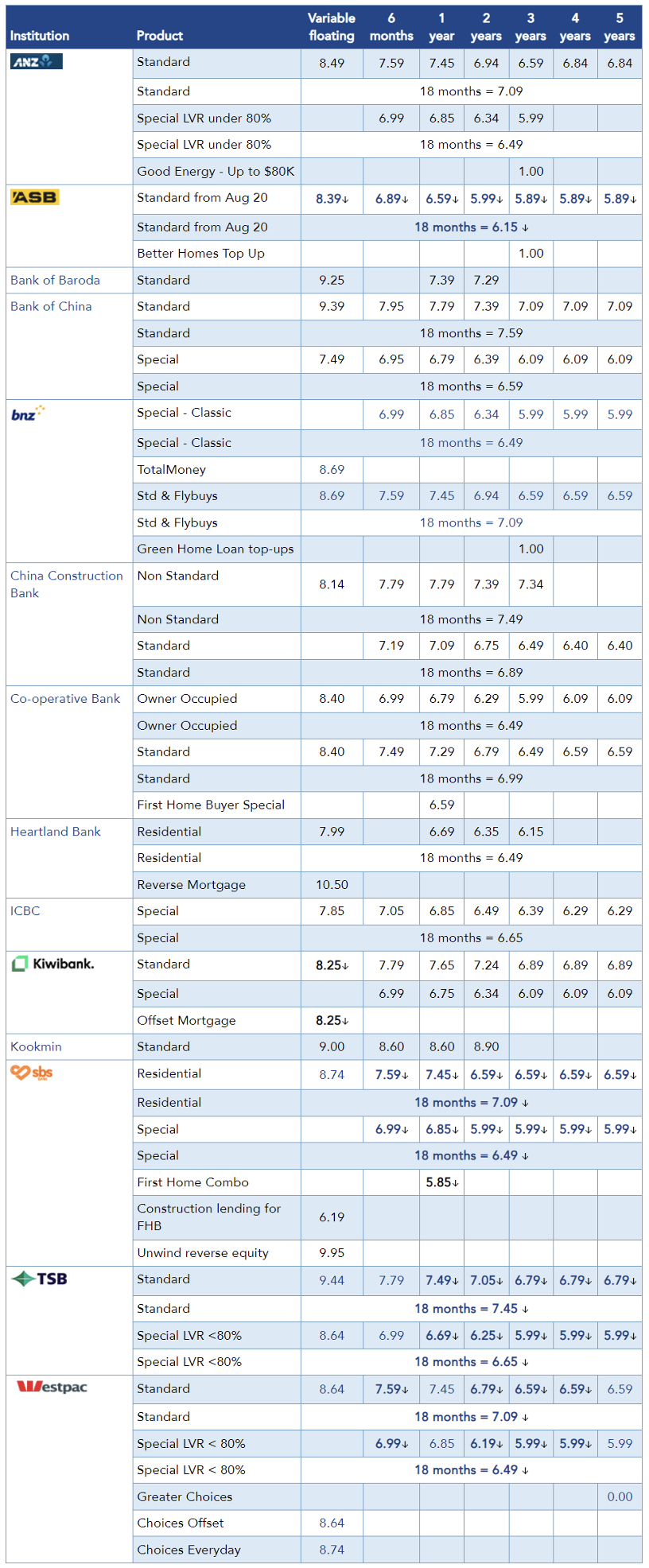
Source: www.interest.co.nz/borrowing
How high is New Zealand’s current OCR by global standards?
New Zealand’s OCR had remained at its peak of 5.5% since May 2023. Although this had placed considerable financial pressure on many New Zealand homeowners, it was relatively moderate compared with soaring rates in some countries. Since 1999, New Zealand’s OCR has reached as high as 8.25%, between July 2007 and June 2008. By comparison, current interest rates still seem relatively manageable.
Globally, however, interest rates in some countries at the time appeared insignificant compared with New Zealand’s 5.5%. For example, Venezuela’s current rate is as high as 59.25%. Although this is its lowest level in four years, it still reflects hyperinflation caused by the country’s prolonged economic and political crisis. Meanwhile, Türkiye’s rate is also as high as 50%. Although its central bank has held it at this level for four consecutive decisions, inflation remains inadequately controlled and the situation could deteriorate further.
Argentina is another country with high interest rates, currently at 40%. Although down from 50% in May, this is still the lowest level since June 2022. Nevertheless, Argentinians continue to face heavy financial burdens.
In sharp contrast with these high-interest-rate countries, some countries have rates far below New Zealand’s. Fiji’s overnight policy rate, for example, had remained at 0.5% since November 2011, before being cut further to 0.25% in March 2020 to support investment and economic growth. Similarly, Japan’s rate is just 0.25%. Although Japan raised rates this March for the first time in 17 years, its longstanding low-interest-rate policy has aimed to improve export competitiveness by weakening the yen.
New Zealand is not alone at 5.5%: interest rates in the United States, Peru, Mali, Côte d’Ivoire and Niger are also 5.5%. These global interest rate patterns reflect countries’ policy choices in addressing their respective economic challenges. Although New Zealand’s rate is not low, it still indicates a relatively prudent monetary policy stance by global standards.
What changes lie ahead for the market?
What should we expect in the period ahead? Economists at New Zealand’s major commercial banks have offered different answers.
Kiwibank
✦

Kiwibank chief economist Jarrod Kerr
Kiwibank chief economist Jarrod Kerr described this monetary policy statement meeting as “the Super Bowl for economists”, attracting a similar level of attention. He stressed that past restrictive monetary policy had caused considerable pain for households and businesses while effectively bringing high inflation under control. He said almost all economic data had been disappointing and well below the Reserve Bank of New Zealand’s expectations. In particular, rapidly rising unemployment and weak economic confidence indicated that the economy had been in recession for two years.
Kerr also said Kiwibank’s economists had strongly recommended that the Reserve Bank begin cutting rates today and continue at every subsequent monetary policy statement meeting until rates reached 2.5%. They believe that, with the neutral interest rate around 2.75% according to the Reserve Bank of New Zealand, policy needs to return to a less restrictive, neutral setting, and some stimulus may even be necessary.
Westpac
✦
Westpac chief economist Kelly Eckhold said that although economic activity was currently weak, this was helping domestic inflation pressures ease gradually. He believes the pace and extent of policy easing will depend on how quickly inflation pressures diminish. Eckhold also noted that Westpac’s latest forecasts showed weak economic growth and rising unemployment. He expects the OCR to fall to 5% by the end of this year and to 4.5% in May 2025. In early 2026, it will reach a low of 3.75%.
Westpac does not expect the Reserve Bank to follow a “more abrupt or prolonged easing path”, because domestic inflation remains elevated. Instead, it expects the Reserve Bank of New Zealand to take a cautious, data-dependent approach.
BNZ
✦
BNZ economists had already forecast that the Reserve Bank would cut rates by 25 basis points today. Their reasoning was that inflation had been beaten and the economy was going backwards. Delaying cuts could increase pressure on the economy. However, BNZ head of research Stephen Toplis said considerable uncertainty remained over which meeting the Reserve Bank of New Zealand would choose to begin cutting rates. They were more confident in their view that the OCR would be 100 basis points lower by February next year.