
Property auctions bounce back as the sales rate hits a two-month high! This week’s key developments for property investors
Overall, economic conditions remain weak and still need support from looser monetary policy through cuts to the official cash rate (OCR).

One: The auction market warms up! 320 properties offered in a week, with the sales rate exceeding 40%
As spring arrives, New Zealand’s property auction market is gradually warming up, with a substantial increase in residential properties offered in the latest week and a significant rise in successful auction sales. According to interest.co.nz, 320 residential properties went to auction in the week from 14 September to 20, a marked increase from 230 the previous week. This was the first time in two months that the weekly number of properties offered at auction had exceeded 300. Of these, 139 sold under the hammer, compared with 94 the previous week. The overall sales rate rose to 43%.
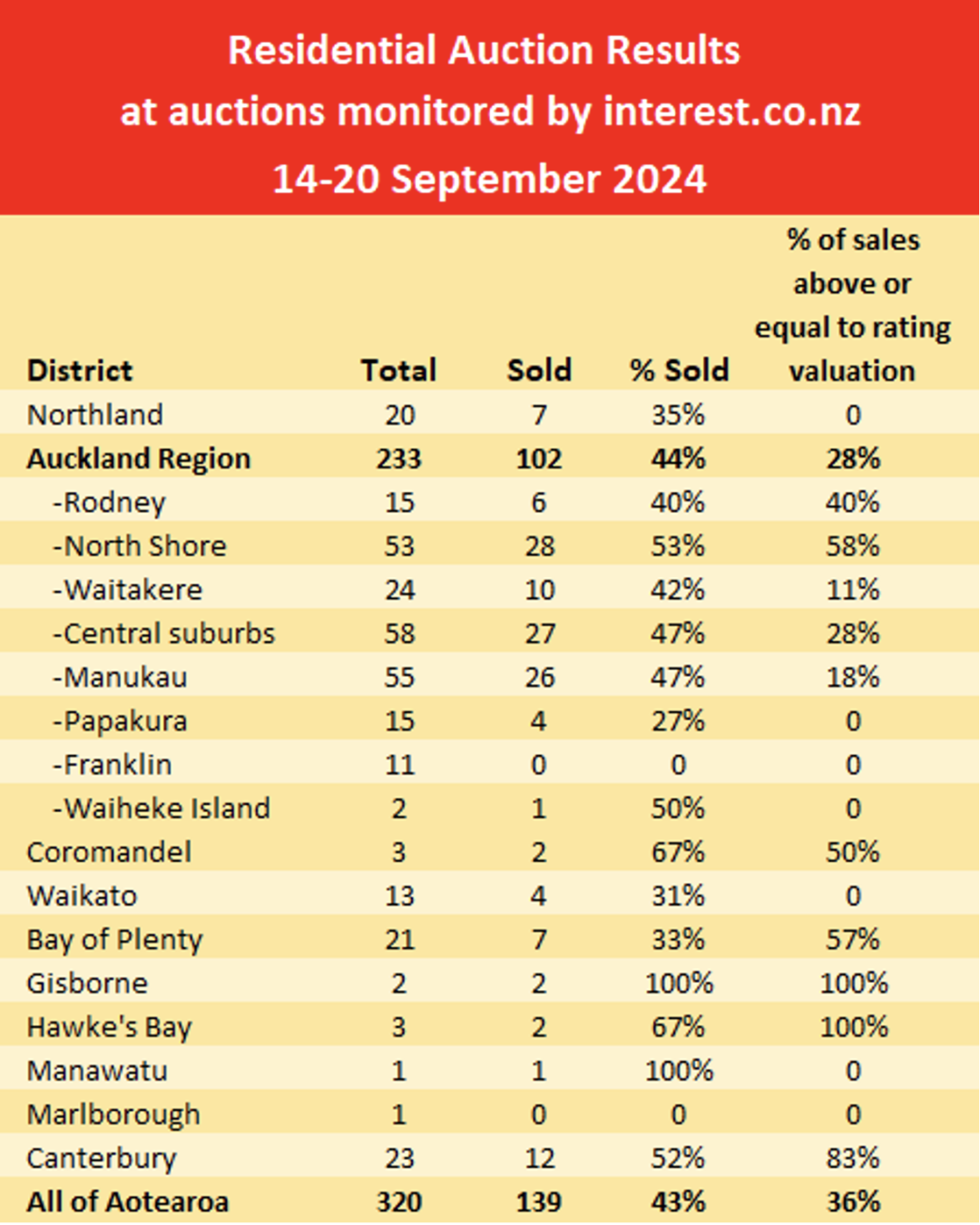
Overview of last week’s property auction sales (Source: interest.co.nz)
Auction sales rates have risen slowly but steadily over the past six weeks. Throughout winter, they held between 30% and 33%, but have exceeded 40% in recent weeks. The significant increase in auction volumes over the past week was concentrated mainly in Auckland. This rise in sales volumes is unsurprising, as property sales activity usually picks up at this time of year. However, buyers remain cautious on price: only a third of the properties sold achieved prices at or above their assessed values.
Two: GDP falls, but the economy performs better than the Reserve Bank expected
New Zealand’s GDP fell 0.2% in the second quarter of this year, slightly better than the Reserve Bank of New Zealand’s forecast of -0.5%. Revisions to earlier quarterly economic data also mean that we did not actually enter a recession late last year. However, the strict definition of a recession—two consecutive quarters of negative GDP growth—makes little difference to how businesses and consumers feel or to the practical effects of economic conditions. With our population continuing to grow, GDP per capita actually fell 0.5% this quarter and 2.7% over the past year. A growing population alongside falling overall consumption effectively means that ordinary New Zealand households are under greater financial pressure than businesses.
Overall, economic conditions remain weak and still need support from looser monetary policy through cuts to the official cash rate (OCR).
Three: Will timely economic indicators show a slight improvement?
The August New Zealand Activity Index (NZAC), due out this Tuesday, is worth watching. ANZ’s September Consumer Confidence Index, due out this Friday, is also one to look out for.
There is reason to believe that both of these latest indicators may improve, which would be welcome news. Of course, a full economic recovery would eventually slow or halt further cuts to the official cash rate, but that remains a long way off.
Four: More refinancing between banks ahead?
This Wednesday, the Reserve Bank of New Zealand will release its August mortgage lending statistics. CoreLogic chief property economist Kelvin Davidson predicts that the gradual upward trend in mortgage activity may continue, partly because loan-to-value ratio (LVR) rules were eased from 1 July. Refinancing between banks has also increased recently as people seek the best mortgage rates and potential cashback offers, making the forthcoming breakdown of these figures particularly interesting. House sales have remained subdued in recent months, but further interest rate cuts are expected to help drive a broader market recovery in spring.
Five: Sales activity rises, but from a low base
CoreLogic recorded 6320 property transactions nationwide in August, up 1.6% on the same month last year. This was the 15th increase in the past 16 months. The only exception was June 2024, when the timing of the Matariki public holiday affected the figures: this year’s holiday fell in June rather than July, reducing the total. However, the starting point remains very low. Sales as a proportion of the existing housing stock in both 2022 and 2023 were the lowest on record, at less than 4%. Even with this growth, sales remain well below the long-term average. In fact, the August figure was about 15% below what we would normally expect for that month.
Six: Are first-home buyers still the market’s main force?
Against this backdrop, CoreLogic’s latest buyer classification data shows that first-home buyers remain a leading force in the market. In August, their share of purchases held at a record high of 27%, while the number of first-home purchases was also substantial. Using KiwiSaver towards a deposit remains an important source of support, while looser LVR restrictions have also increased the lending available to buyers with smaller deposits. Lower house prices and less competition from other buyer groups are further factors favouring a purchase now.
The latest forecasts suggest that first-home buyers may no longer enjoy such favourable buying conditions in 2025. Indeed, some smaller investors using mortgages have already begun returning to the market over the past few months. Although this is not yet a major shift, these investors still face challenges breaking even at current mortgage rates. Looking ahead, continued cuts to the official cash rate, together with 80% interest deductibility, rising to 100% from 1 April next year, and looser LVR rules could make property investors a key group to watch over the next 12–18 months.