
Another major bank joins the rate-cut battle! As deflation fears loom, could the Reserve Bank of New Zealand slash the OCR by 50 basis points next week?
In the short term, rate cuts may help curb inflation and boost economic activity, but if the cuts are too cautious, New Zealand could face the risk of deflation.

ANZ today announced cuts to its fixed mortgage and term deposit rates, mostly by 10 basis points, putting its rates among the market leaders. The adjustment comes just a week before the Reserve Bank of New Zealand's official cash rate (OCR) review on 9 October.
ANZ's cuts include a 16-basis-point reduction in its one-year fixed mortgage rate and a 15-basis-point reduction in its nine-month term deposit rate to 5.20%. Only a few of ANZ's term deposit rates now exceed 5%, a stark contrast with earlier levels above 6%. Other banks are expected to join this latest “rate-cut battle” soon.
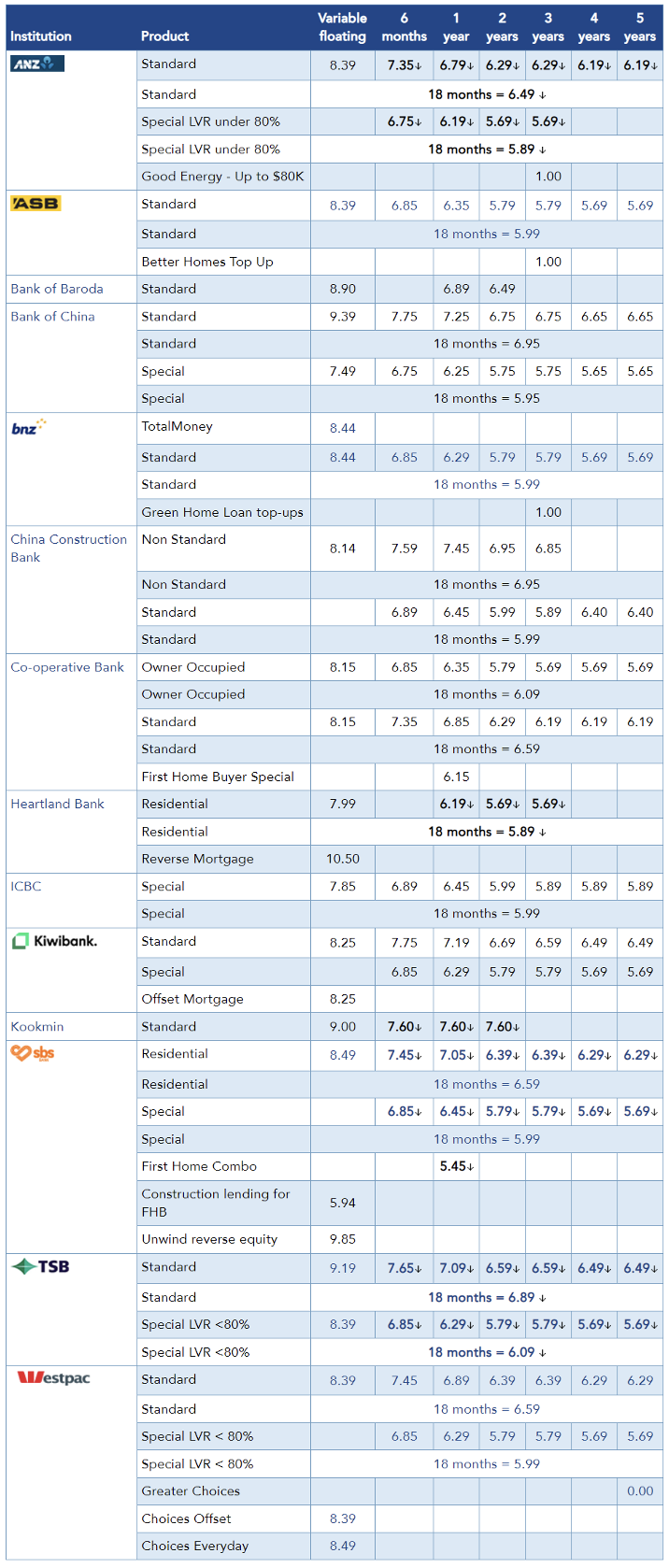
Latest bank lending rates. Source: interest.co.nz/borrowing
As the Reserve Bank's next monetary policy statement meeting approaches, some economists warn that New Zealand could face deflation if the bank fails to cut rates quickly. Markets expect the bank could cut the OCR by 25 to 50 basis points next week. Despite short-term optimism about rate cuts, New Zealand's economy has already experienced two recessions since the Reserve Bank began its last rate-hiking cycle and may now be in a third. Although unemployment remains relatively low and increased net migration has provided some economic support, GDP per capita has fallen for two consecutive years. This indicates that the economy remains under strain, with the outlook for 2025 still uncertain.
Economists have recently been debating “soft landings” and “hard landings”, particularly as inflation pressures have eased. What is the difference? Put simply, it is whether policymakers can raise interest rates to curb inflation without tipping the economy into recession. Avoiding recession is a “soft landing”; the opposite is a “hard landing”.
Deflation risk draws closer
The New Zealand Institute of Economic Research's (NZIER) Quarterly Survey of Business Opinion (QSBO) and ANZ's monthly Business Outlook survey show that although business confidence has recovered, the improvement is largely based on expectations of lower interest rates. In reality, most businesses experienced a difficult third quarter. In September, 32% of businesses reported declining trading activity, while 41% faced higher costs. Only 3% could pass those costs on to consumers, reducing profits for many businesses and forcing them to cut jobs.

BNZ head of research Stephen Toplis
BNZ head of research Stephen Toplis said the QSBO results were so weak that the Reserve Bank could underestimate how quickly inflation was falling, allowing it to drop well below the 2% target. His team forecasts inflation could fall to 1.7% by the end of 2025. Meanwhile, in September, 22% of retailers reported lowering their selling prices, further increasing the risk of deflation. Toplis said: “Only twice in history have the results been weaker than this, suggesting inflation could fall below 1%.”
Expectations of a rate cut next week strengthen

ANZ economist Miles Workman
While most economists expect the Reserve Bank to cut rates by 25 basis points at its October meeting, some analysts, including ASB economist Mark Smith, believe a 50-basis-point cut is also possible. Smith said the economy remained weak and urgently needed looser monetary policy to boost activity and prevent a further downturn. ANZ economist Miles Workman stressed that although business confidence had recovered, this was largely based on expectations of lower interest rates. If the Reserve Bank fails to act quickly enough, inflation could fall too rapidly or even turn into deflation, creating fresh difficulties for New Zealand's economy. To avoid this, the bank needs to be careful without being overly cautious.
The property market's mixed picture

Independent economist Tony Alexander
In the property market, independent economist Tony Alexander said activity among first-home buyers and investors had increased, with more people attending open homes and auctions. However, house price growth remains slow, indicating that buyers still have the upper hand. This means better affordability for homebuyers, but the outlook is less promising for builders who rely on rising prices to drive demand for new homes. Residential building companies have received more enquiries since the Reserve Bank began cutting rates, but these have yet to translate into actual sales. Industry participants say further rate cuts are key to prompting developers and homebuyers to act.
International factors and long-term challenges
Meanwhile, global economic conditions are also putting pressure on New Zealand's economy. In particular, China's economic weakness has hurt New Zealand exports, around a third of which depend on China. Residential construction activity is also expected to keep falling until the end of 2025, while local governments plan substantial increases in taxes and charges. Electricity supply and pricing issues are adding to the difficulties facing the economic recovery.
Future interest rate cuts will undoubtedly offer businesses and consumers some breathing space, but UBS economists warn that the risk of deflation will become more pronounced if rates are not cut quickly enough. Meanwhile, the New Zealand Treasury's latest update notes that many businesses expect demand and activity to remain weak for the rest of 2024, with a possible recovery in 2025, particularly if interest rates fall.
Overall, the challenges facing the Reserve Bank of New Zealand are far more complex than simply controlling inflation. In the short term, rate cuts may help curb inflation and boost economic activity, but if the cuts are too cautious, New Zealand could face deflation. Businesses and consumers are looking to the Reserve Bank to respond quickly and effectively through future monetary policy to prevent New Zealand's economy from entering a third recession.