

← Back to articles

Major boost for first-home buyers! Inflation drops sharply to 2.2%, with another 50 basis point OCR cut possible in November!

“The greatest regret would be the Reserve Bank of New Zealand responding too slowly to ease monetary policy, potentially leaving economic scars and causing widespread job losses.”

Inflation falls to 2.2%, with markets forecasting another 50 basis point OCR cut

  Yesterday (16 October), Stats NZ released the latest Consumers Price Index (CPI), with inflation falling to 2.2%, its lowest level since March 2021. The result was slightly weaker than the market consensus.   Import (or tradables) inflation fell 1.6% year on year, mainly driven by vegetable prices falling 18% and petrol prices falling 8%.   Domestic (non-tradables) inflation remained elevated because of increases in council rates (up 12.2%) and rents (up 4.5%). However, non-tradables inflation of 4.9% was below many economists’ expectations.   
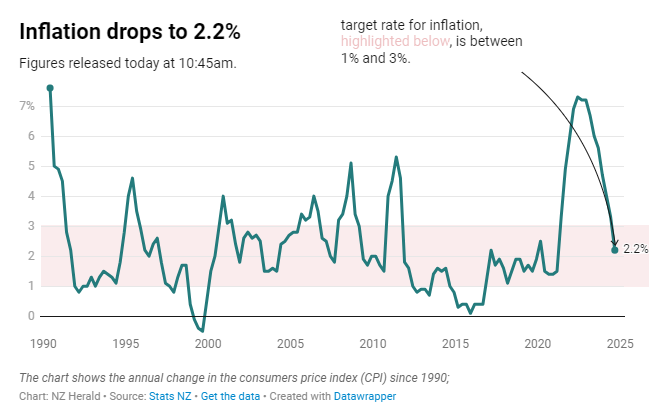
Image credit: NZ Herald   The figures prompted markets to fully price in a 50 basis point interest rate cut and assign a 40% probability to a 75 basis point cut. The New Zealand dollar fell around 0.2%.   “The Reserve Bank of New Zealand should be delighted with these inflation figures,” said BNZ head of research Stephen Toplis. “While we cannot declare inflation completely gone, it has all but disappeared for now.”   Toplis said he understood the logic of a 75 basis point cut in November, but did not consider it particularly likely.    “The logic is that the economy is weaker than expected and inflation is lower than expected, so the central bank must quickly bring the cash rate to a neutral level,” he said.    However, a “larger negative shock” would be needed for the central bank to cut by 75 basis points in November.    ANZ senior economist Miles Workman shared a similar view.   “The slightly softer tone of core inflation measures may give some momentum to discussions of a 75 basis point cut,” he said. “But we would probably need to see weaker-than-expected third-quarter labour market figures for the central bank to consider this.”    Unemployment and wage figures will be released on 6 November.    Workman said non-tradables inflation remained too high to be described as “consistent with headline inflation running sustainably at 2%”.    But he warned that the lagged effects of monetary policy meant the Reserve Bank of New Zealand could “cause unnecessary pain” if it waited to remove monetary restraint.   “Monetary policy must be forward-looking, and looking ahead, domestic inflation will face further downward pressure,” he said.   “While there are many structural reasons to believe some parts of the CPI basket, such as council rates, insurance and electricity, may run hotter over the next few years than they have historically—for example, weather-related risks and infrastructure—there is also ample evidence that the Reserve Bank of New Zealand has created enough economic slack to restrain inflation cyclically.”    In fact, some indicators suggested the Reserve Bank of New Zealand had been “a little slow” to cut rates. This increased the risk that it might have to move monetary conditions into stimulatory territory, he said.    Abhijit Surya, Australia and New Zealand economist at Singapore-based Capital Economics, who raised the possibility of a 75 basis point cut last week, believed the odds were increasing.   “The weaker-than-expected third-quarter CPI figures strengthen our confidence that the Reserve Bank of New Zealand will ease policy more aggressively than most expect,” he said.    Surya said the figures all but guaranteed that the Reserve Bank of New Zealand would cut rates by another 50 basis points at its meeting on 27 November. “   After all, the bank described its policy stance as ‘still restrictive’ at last week’s meeting,” he said. “If anything, the Reserve Bank of New Zealand is now more likely to opt for a larger 75 basis point cut.”    Either way, the CPI figures reinforced his earlier forecast that the Reserve Bank of New Zealand would ultimately lower the rate to 2.25%, below the terminal rate of 3% expected by markets.    ASB senior economist Mark Smith said, “We expect annual CPI inflation to hover around 2%, potentially falling below 2% within the next 12 months.”   “The greatest regret would be the Reserve Bank of New Zealand responding too slowly to ease monetary policy, potentially leaving economic scars and causing widespread job losses.”    Given the Reserve Bank of New Zealand’s longstanding “least regrets” policy strategy, this suggested further aggressive rate cuts were on the way. ASB still expected a 50 basis point cut in November, taking the OCR to 4.25%, and forecast an eventual OCR of 3.25%.


How first-home buyers can choose an interest rate

  First-home buyers welcomed the central bank’s 50 basis point OCR cut last week. Jeff Royle, a mortgage broker at iLender, said, “Falling interest rates are certainly good news, and the timing is right. But what first-home buyers really need to watch is the banks’ test rates, or stress rates.”    Royle said stress rates had peaked at around 9.15% and were now close to 8%. This gave first-home buyers more room when assessing how much they could borrow, he said. “The rate to watch is the rate you are assessed at, rather than the rate you actually pay. I think it will fall to around 7% by the end of the year.”    Eugene Bartsaikin, a mortgage specialist at Twine Financial Advisers, said the right fixed-rate term for first-home buyers depended on their circumstances. “Some people may choose the shortest fixed-rate term, betting that rates will fall. Yes, rates are falling, but will they fall far enough to offset the premium on short-term rates?”   
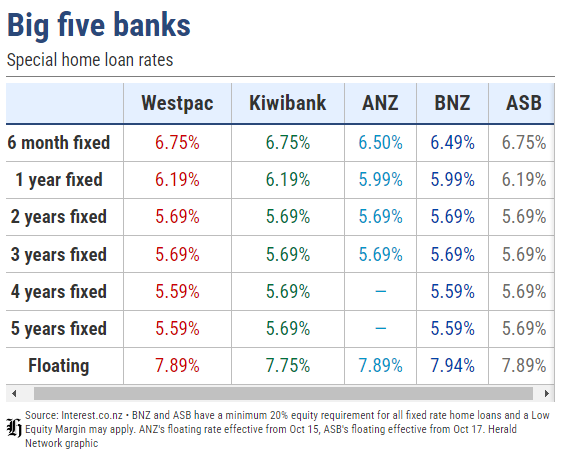
Image credit: NZ Herald   Bartsaikin said borrowers needed to weigh up the pros and cons of six-month, one-year and potentially even floating rates. “When rates start getting closer together, we can use a strategy of staggering fixed-rate terms, because we do not know exactly what will happen, but we can manage this by spreading the risk。”    He also said borrowers could view a one-year rate as two six-month periods, with the second period effectively enjoying a lower rate because of the difference between rates. Although consecutive six-month terms could result in a lower rate in the second period if rates fell further, they would be unlikely to match the current one-year rate。    Bartsaikin also said borrowers needed to remember the debt-to-income ratios introduced by the central bank earlier this year. “They are not really relevant at present, but as interest rates fall further, they will become guardrails against excessive borrowing.”    He believed the latest changes showed that the market was entering a new cycle, making planning ahead essential. “Banks are under considerable pressure at present, so approval times are getting longer,” Bartsaikin said. He encouraged those considering entering or remaining in the property investment market to prepare early, as the next phase was about to begin. 


*The views in this article come from reporting in the business section of The New Zealand Herald.