
Authoritative data: New Zealand construction productivity has stalled for 30 years. Can it be turned around? Here are the solutions!
At the annual gala dinner of the New Zealand Building Expo and Summit on 9 August, the New Zealand Chinese Building Industry Association (NZCBIA) launched its 2024 NZCBIA Annual Construction Industry Report.

At the annual gala dinner of the New Zealand Building Expo and Summit on 9 August, the New Zealand Chinese Building Industry Association (NZCBIA) launched its 2024 NZCBIA Annual Construction Industry Report.
Commissioned by NZCBIA and written by prominent New Zealand economist Shamubeel Eaqub, the report provides an annual update on New Zealand’s building, construction and property sectors. By discussing productivity and potential solutions, it aims to improve understanding of the construction industry’s role and clarify opportunities for progress.
In issue 26 of YIJU magazine, we have prepared a series of articles introducing the report’s main findings. Today, we begin with the first: ‘How to improve New Zealand’s construction productivity: why productivity has stalled and how to address it’.
Stagnant productivity
Stagnant productivity has long been a problem for New Zealand’s construction industry. There has been little improvement since the early 90s of the 20th century, a pattern common across OECD countries.
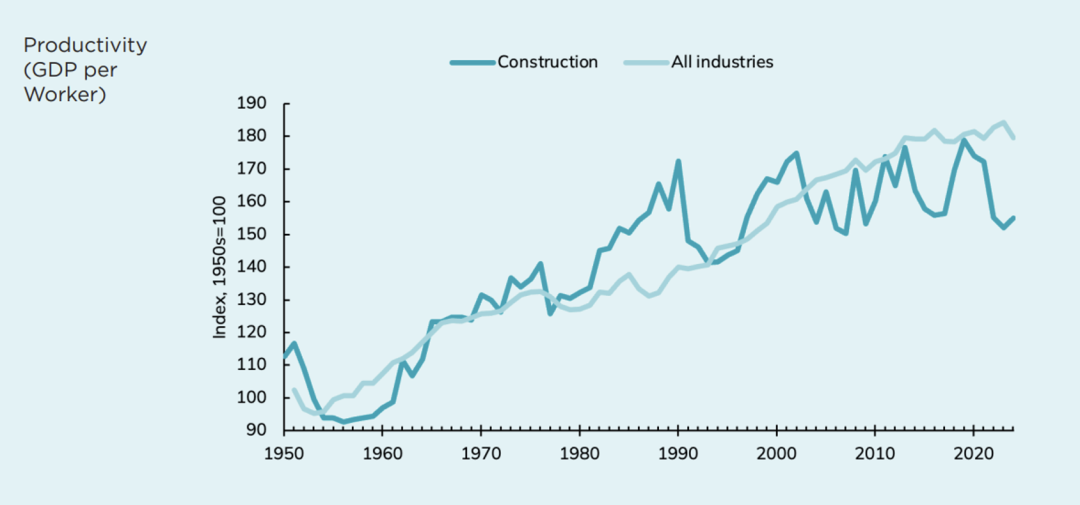
New Zealand’s construction productivity improved from the late 1950s to 1990, but has since stagnated (see Figure 1). Current productivity is close to its 1985 level, meaning the industry has failed to achieve significant productivity growth for more than 30 years.
Figure 1: New Zealand’s construction productivity has barely improved since the beginning of 1990
Source: Author’s estimates based on raw data from Stats NZ
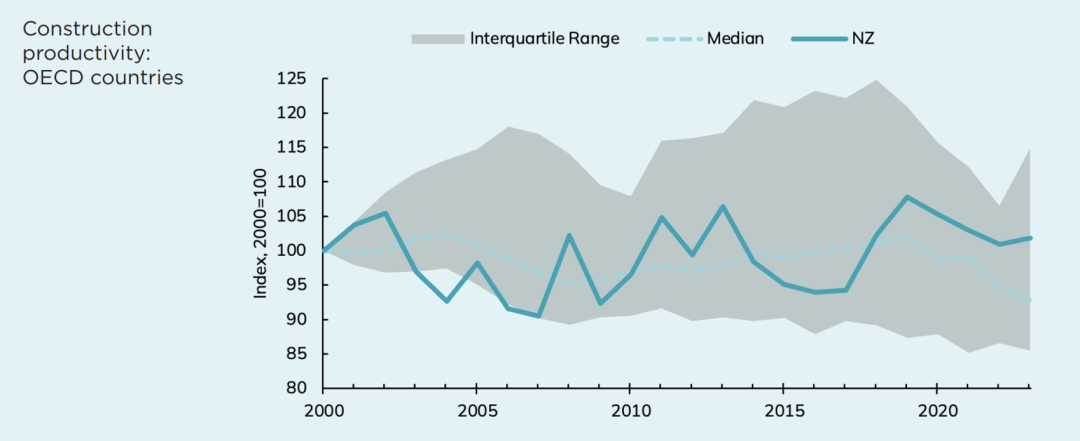
Compared with other OECD countries, New Zealand’s construction productivity performance is weak, but not exceptionally poor (see Figure 2). This reflects a widespread productivity problem in construction: the building process is complicated by considerable variation in location, site conditions, timing, weather, methods and materials. Much of the work is also labour-intensive and affected by factors beyond direct control, including workers moving between multiple sites, sequential stages and setup processes, and highly technical, hazardous and bespoke work requirements.
Figure 2: New Zealand’s challenges are not unusual among OECD countries
Source: Author’s estimates based on raw data from Stats NZ
Productivity improvements are also heavily influenced by business size. Data from 2023 shows that large firms with more than 200 employees had productivity nearly 20% above average. By contrast, firms with no employees, meaning self-employed people, and those with 6–9 employees had productivity more than 10% below average. This lower productivity is equivalent to employing an additional 11,000 people in construction without increasing output.
The dynamic nature of construction makes it difficult to identify and address productivity weaknesses. Interdependencies between tasks can compound the problem. Poor supervision, for example, can lower worker morale, leading to high staff turnover and rework, while supply chain problems can increase costs and delay financing. These variables can affect work productivity or productivity within financial models. Understanding these issues therefore requires a more structured approach.
International experience in improving productivity
The UK’s transformation programme
Learning from international experience can help New Zealand find a viable path forward. We begin with the UK’s construction industry transformation programme.
The UK Government is committed to improving efficiency and productivity through technological innovation, sustainability and regulatory reform. It has pledged £170,000,000, alongside an industry contribution of £250,000,000, to support the adoption of new technologies and innovative practices. Its main priorities include technological innovation, sustainability and regulatory reform.

In technological innovation, the UK is prioritising substantial investment in new technologies, embedding artificial intelligence, digital design and off-site manufacturing in businesses to improve project planning, reduce costs and lift productivity.
On sustainability, many industries still face challenges in obtaining guidance on green technologies and implementing them. The Government is therefore using measures such as the Building Safety Levy and biodiversity net gain initiatives to ensure the environmental sustainability of building projects and the safety of construction work.
In regulatory reform, the new UK Procurement Act 2023 introduces more flexible and transparent procurement processes, while the Building Safety Act and related levies aim to address fire safety defects.
Through collaboration among multiple parties, the UK construction industry is expected to make significant progress in the maturity of management systems, reducing rework, lowering staff turnover and cutting construction delays.
Australia streamlines industry permitting
While the UK is improving construction productivity through technological innovation and flexible procurement policies, Australia is optimising productivity by streamlining and digitising permitting processes to accelerate project approvals.
Australia has introduced several initiatives to simplify construction permitting, particularly to support renewable energy and major infrastructure projects.
These include one-stop services and digital tools, priority pathways and fast-track approval systems, and coordination between federal and state governments.
One-stop services allow developers to manage all permit applications through a single portal. This simplifies the process and reduces the time needed for approval.
Some projects, particularly those involving renewable energy, can apply for priority approval. Measures also provide for permits to be granted automatically if the approving authority fails to make a decision within a specified period.
Finally, the Australian Government encourages states to align their building permit guidelines with federal standards, creating a more consistent, less bureaucratic process and removing the effects of overlapping regulation.
Following these measures, the number of regulatory procedures fell from 14 to 10, and permit approval times dropped by 38 days to 112 days, 25% below the global median.
Lessons for New Zealand
Although construction productivity problems are complex and policy measures have had limited effects, international experience offers three types of strategy that New Zealand can draw on:
Reduce uncertainty: More accurate information, more effective coordination and clearer policy signals can give participants across the construction system greater confidence to scale up production and complete work on time. These measures affect how value is created in construction, without affecting costs. This strategy generally operates at institutional and industry levels.
Streamline processes: Interventions such as standardisation, faster approvals and investment in automated production can reduce the influence of decision-making layers and ease the burden on workers. With industry-level support, streamlining processes can often be effective across industries and construction sites.
Improve skills: This means improving the education and skills of both current construction workers and the potential future workforce. As more key roles depend on migrant workers, foundational skills such as reading and spoken communication become essential. Improving skills generally requires a system-wide, forward-looking approach.
Government, industry and businesses can all take action to improve productivity.
Government
As a regulator, the Government can reduce friction by addressing land fragmentation and increasing transparency in capital operations. As a purchaser, it can improve project efficiency by standardising infrastructure projects. Specific measures include:
Reduce uncertainty: Use policies such as planning reform, coordination on net zero and better contractual frameworks to reduce land fragmentation and strengthen confidence in deploying capital.
Streamline processes: The Government can set key performance targets and promote industry standardisation to simplify processes, encourage competition and support innovation, including through innovative funding models such as tax relief.
Improve skills: The Government can systematically develop the skills of the future workforce to meet future economic challenges.
Industry and clients
How the industry and its clients operate determines on-site practices and work dynamics. Clients can improve site productivity through collaborative negotiations and value-based contracts. The industry can reduce waste and uncertainty on construction sites by promoting standardisation and prefabrication.
The following measures can help the industry improve its productivity while complementing government policy:
Reduce uncertainty: The construction industry should work with the Government to simplify policy, encourage collaboration to optimise contracting models, support the Government’s net-zero goals, improve contractual frameworks and drive changes in policy and practice.
Streamline processes: The industry should lead training, improve transparency, promote standardised construction, reduce waste and lower uncertainty.
Improve skills: The construction industry can develop frontline training on behalf of businesses, build industry knowledge and retrain the existing workforce.
Clients can also support site productivity by negotiating and signing contracts that consider value beyond cost, adding incentives to traditional contracts, paying promptly, allowing longer construction periods and ensuring early collaboration among everyone involved in design.
Businesses
Improving productivity is especially important for businesses because it is within their direct control and can deliver substantial returns. Investing in technology and processes can help businesses strengthen control over construction despite the many widespread and sometimes uncontrollable variables. They can also focus on their employees, who are their greatest asset and risk.
Businesses can reduce variability and complexity by improving internal processes and encouraging industry collaboration. Retraining and frontline training can effectively improve the skills of the existing workforce:
Reduce uncertainty: Businesses should take responsibility for streamlining processes and managing risk. Large firms in particular can support small and medium-sized businesses by investing in alternative contracting strategies and early planning.
Streamline processes: Businesses can support industry collaboration by improving transparency, reducing process complexity and standardising business practices, while using advanced technologies and raw materials to improve efficiency.
Improve skills: Businesses can keep employees’ skills current and retain those skills through retraining and frontline training, using online platforms and practical training to strengthen learning outcomes.