
Early signs of a housing market rebound as prices quietly rise in six regions! This week’s key developments for property investors
Stats NZ’s latest monthly employment data shows that job numbers in September were unchanged from August, although August also recorded no significant growth.

1
Has New Zealand’s housing market bottomed out? Latest data reveals price trends
The latest OneRoof-Valocity data suggests New Zealand house prices may have bottomed out. Although interest rate cuts by the Reserve Bank of New Zealand have slowed price declines, house prices remain under pressure in many parts of the country. By the end of October, the national average house price had fallen 0.7% over three months to $957,000, a smaller decline than previously.
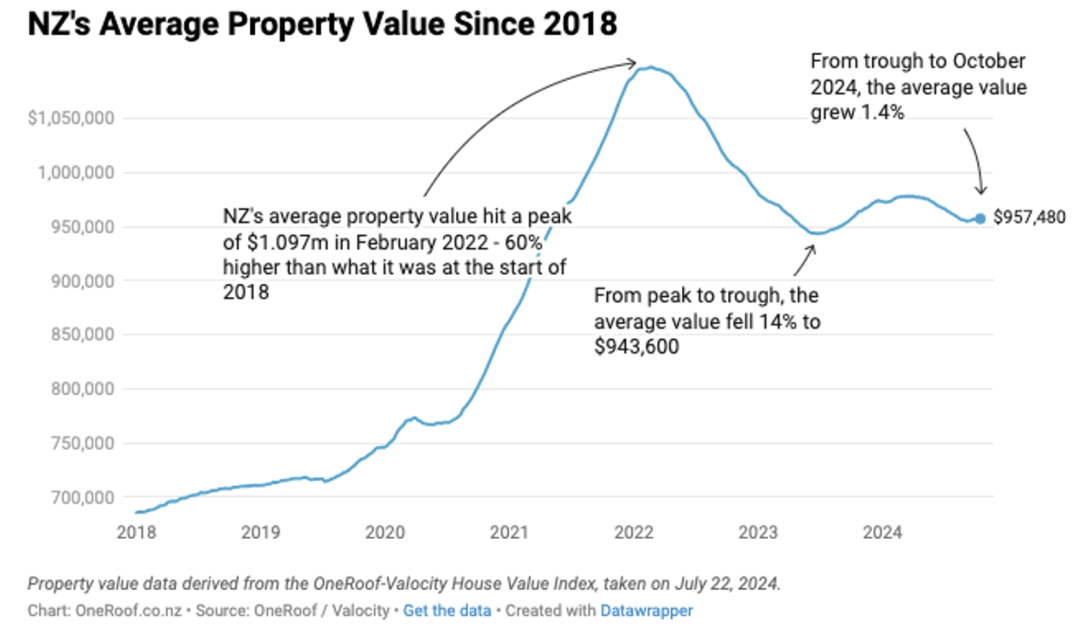
Chart of changes in New Zealand’s average house price since 2018 (Source: OneRoof)
Following Official Cash Rate (OCR) cuts in August and October, buyer enquiries on OneRoof rose by nearly 20%, with open home attendance and auction competition also increasing. OneRoof editor Owen Vaughan says that although house prices have yet to rebound significantly, increased market activity and stronger competition among buyers indicate that upward pressure on prices is building. However, a weak economy and expectations of rising unemployment in 2025 could limit price growth.
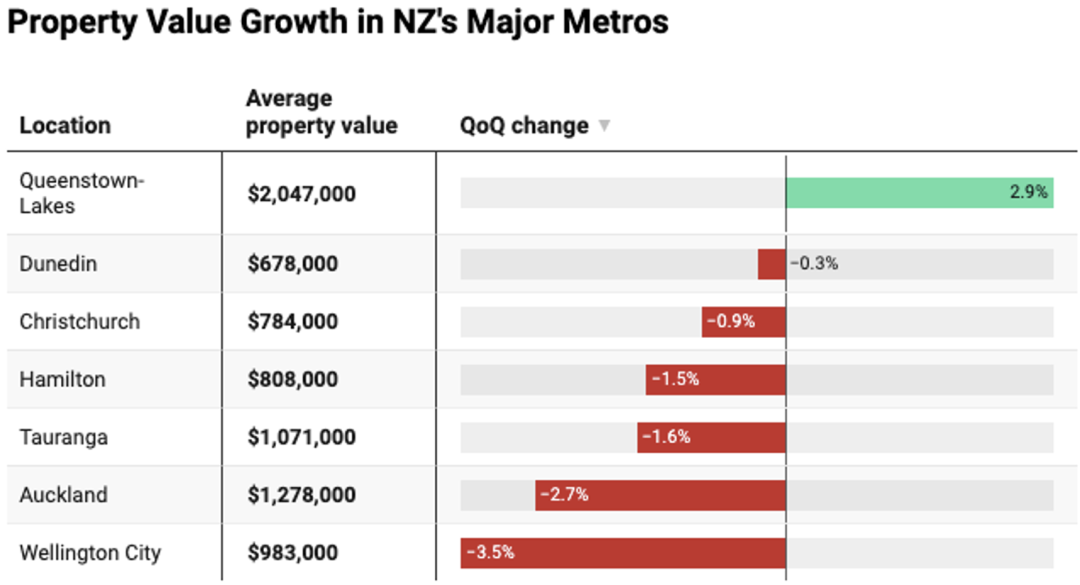
Chart of quarterly house price changes in New Zealand’s main cities (Source: OneRoof)
The data shows that six regions recorded house price increases over the quarter. The West Coast and Southland grew by more than 1%, while Canterbury, New Zealand’s second-largest property market, also recorded a slight increase of 0.1%. House prices in Auckland, Wellington and Northland (Northland) continued to fall, although the declines slowed. Some areas, including Queenstown Lakes and Runanga on the West Coast, recorded significant house price growth, while others, including Karikari Peninsula in Northland and Whitford in Auckland, saw substantial declines.
2
Employment growth has largely stalled
Stats NZ’s latest monthly employment data shows that job numbers in September were unchanged from August, although August also recorded no significant growth. While these figures may look reasonable on the surface, they are often revised down in subsequent releases. Moreover, although employment figures were stable in August and September, total employment has fallen by around 31,000 jobs since its March peak and by 21,000 year on year. This has undoubtedly reinforced buyers’ caution about the housing market’s short-term outlook.
Continuing house price declines indicate that the risk of unemployment and uncertainty about future job prospects have outweighed the support lower interest rates provide to the housing market. Although prices may be close to bottoming out, an end to the downturn would not necessarily mean a rapid recovery. In 2025, stretched housing affordability, a backlog of properties on the market and potentially further unemployment pressures could all significantly constrain the market’s upside.
3
Labour market data due out
This Wednesday, Stats NZ will release its final labour market figures for the third quarter. CoreLogic chief property economist Kelvin Davidson expects unemployment to rise from 4.6% in the second quarter to around 5%, or slightly below. If unemployment meets expectations, an OCR cut of 50 basis points is expected on 27 November. However, if unemployment exceeds expectations and reaches 5.5% or higher, this could fuel market expectations of a 75-basis-point OCR cut.
4
Early signs of recovery in construction
Stats NZ data released last week showed that new building consents approved in September rose 2% year on year. Although modest, this was the second increase in the past three months. Since the annual consent total fell to 34,000 in June, it has stabilised at around 33,600, suggesting the decline in building consent approvals may be nearing its bottom. Meanwhile, the government’s announcement last week that it would reduce council building inspection requirements is also expected to substantially streamline the construction of new homes.
5
Financial Stability Report due out
This Tuesday, the Reserve Bank of New Zealand will release its latest six-monthly Financial Stability Report (FSR). Although the housing market section released in advance last week summarised market conditions, it revealed no major new policies or detailed data breakdowns. Interested investors may wish to follow the release.