
Can house prices rebound 7% after the 2024 downturn? Revealing the 100 hottest New Zealand suburbs for buyers in 2025!
After high interest rates and a subdued market in 2024, New Zealand’s housing market could see a fresh dawn in 2025.

After high interest rates and a subdued market in 2024, New Zealand’s housing market could see a fresh dawn in 2025. As mortgage rates gradually fall, expectations of a recovery in house prices are strengthening, while property hotspots are shifting from traditionally expensive areas towards affordable, long-undervalued suburbs with growth potential. The newly released list of “100 New Zealand suburbs to watch in 2025” reveals hidden contenders across the country. From East Tamaki in eastern Auckland to areas surrounding central Christchurch, these suburbs are becoming new favourites among buyers. For buyers seeking opportunities in a recovering housing market, these emerging areas could be promising places to watch in 2025.
The 2024 downturn and signs of recovery
The property market was subdued in 2024. Although listings surged early in the year, economic uncertainty and high interest rates quickly eroded market confidence. High interest rates dampened buyers’ willingness to purchase, keeping sales volumes low and leaving some properties unsold. As CoreLogic chief economist Kelvin Davidson put it, the year’s overall performance was disappointing: growth was confined to the early months, while economic uncertainty rapidly drained market activity towards year-end. However, sentiment improved slightly as interest rates began showing signs of falling late in the year. Many experts expect the market to improve in 2025 as interest rates fall and investors return.
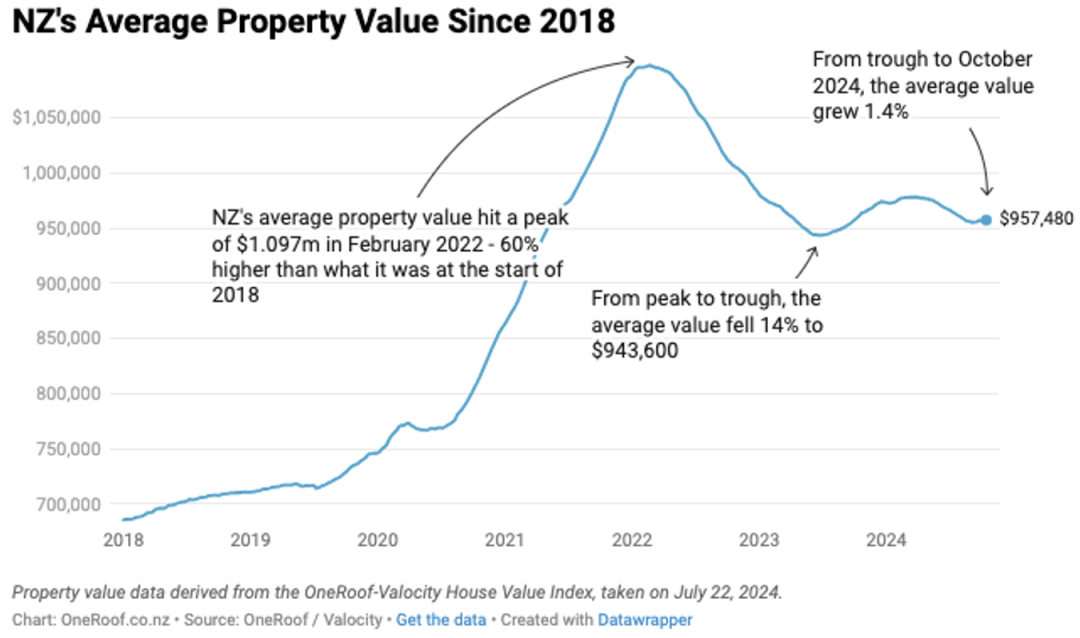
Chart of changes in New Zealand’s average house price since 2018 (Source: OneRoof)
Kiwibank chief economist Jarrod Kerr says falling interest rates are the key to a market recovery. He expects house prices to rise by 5%–7% in 2025, although factors including the newly introduced debt-to-income (DTI) restrictions will constrain that growth. Meanwhile, ASB economist Nick Tuffley offers a more optimistic forecast, suggesting house price growth could reach 10%.
Map of suburbs with growth potential for 2025 released
As the property market recovers, suburbs with growth potential are also set to emerge across New Zealand. OneRoof and Valocity have jointly analysed 100 promising suburbs nationwide. These areas are relatively affordable and have become increasingly popular with buyers since the pandemic, standing out particularly for affordability, infrastructure and employment opportunities.
According to data in the New Zealand Construction Industry Annual Report published by the New Zealand Chinese Building Industry Association, although the construction industry faces stagnant productivity, new technologies and design improvements have already revealed significant growth potential in some communities. This provides strong support for areas such as East Tamaki and Otahuhu, which are gradually becoming new choices for homebuyers.
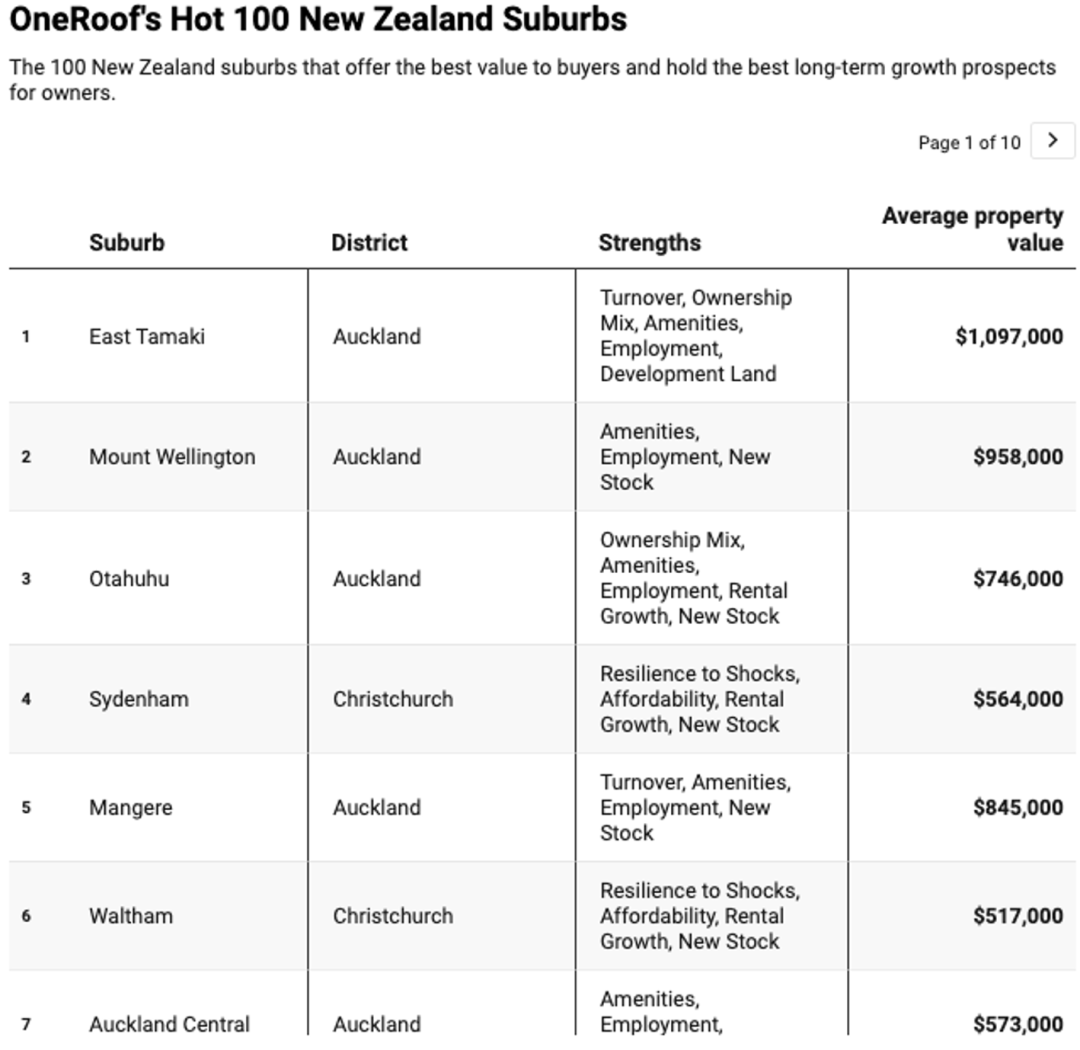
OneRoof’s 100 hottest areas for homebuyers in 2025
(Full list available at: https://www.oneroof.co.nz/news/revealed-the-hot-100-new-zealand-suburbs-to-watch-in-2025-46348)
Among residential suburbs across New Zealand’s cities, East Tamaki in eastern Auckland topped the list, closely followed by several suburbs in southern Auckland, including Mt Wellington, Otahuhu and Onehunga. These areas are close to major transport routes. As transport networks improve and suburban development becomes denser, many previously overlooked areas are attracting buyers’ attention. Compared with traditionally upmarket areas such as Remuera, these suburbs offer affordable prices and good local amenities, making them particularly popular with first-home buyers.
Valocity senior research analyst Wayne Shum points out that these areas’ potential lies not only in lower prices, but also in a strong community atmosphere and steadily improving amenities. From Otara to East Tamaki, suburbs initially popular with first-home buyers are increasingly becoming sought-after choices for people buying their next home. They offer particularly good value for families hoping to get their children into desirable school zones.
New lifestyles and changing homebuying choices
Changes in people’s lifestyles since the pandemic are also a key factor driving property markets in different areas. More people are choosing to settle outside city centres because remote working has removed the need to commute. Areas with good transport connections and public amenities have become a new choice for homebuyers. Auckland suburbs such as Mt Wellington and Onehunga, for example, are widely popular for their convenient public transport, shopping centres and affordable house prices. Bayleys’ Chris Farhi points out that these areas’ convenience allows residents to enjoy high-quality amenities without living in the city centre.

More importantly, prices in these areas are relatively affordable. For example, a standalone house in Mt Wellington costs only as much as an apartment in Ellerslie. Their combination of affordability and an appealing living environment has attracted many first-home buyers and young families. Tom Rawson, who heads Ray White’s South Auckland operations, says some areas that once carried a stigma are gradually shedding those prejudices. He points out that these communities have a wealth of church groups, sports facilities and community activities, which greatly promote community harmony. He adds that even traditionally upmarket areas such as Remuera receive negative news coverage: “Change is always difficult to avoid, whatever the area.”
Looking ahead over the next 20 years, many experts believe these promising suburbs will attract more development and residents as the housing market gradually recovers. Bayleys’ Chris Farhi says areas with convenient transport and good public amenities will be central to the next wave of population and economic growth. He says further residential intensification in areas such as Mt Wellington and Otahuhu will push house prices higher. Tony Jenkins, who heads Harcourts Holmwood, also says areas surrounding central Christchurch, such as Sydenham and Waltham, could become upmarket neighbourhoods comparable to Auckland’s Mt Eden or Ponsonby within the next 10 years. Property developers are carrying out conversions and renovations, bringing fresh housing options to these areas.
Overall, although the housing market’s performance in 2024 was lacklustre, signs of recovery and the rise of promising suburbs give us hope for 2025. For homebuyers, the future housing market is about more than simply pursuing high prices: it is about finding areas with a sense of community and development potential that balance price with quality of life. Buying a home is not only a financial decision, but also involves choices about lifestyle and family. In New Zealand’s diverse and rapidly evolving property market, 2025 could be the ideal time to explore these promising suburbs.