
Mortgage refixing window approaches! More than NZ$70,000,000,000 in mortgages to be repriced within six months: how should borrowers respond? This week’s key events for property investors
In its Financial Stability Report released last week, the Reserve Bank discussed potential mortgage repayment difficulties and loan default risks arising from higher unemployment, while noting that lower mortgage rates would help cushion these risks.

1
Mortgage refixing window approaches, with seventy billion New Zealand dollars in home loans facing change
The latest Reserve Bank of New Zealand figures show that more than half of New Zealand’s mortgages will have their interest rates reset within the next six months. Since the start of the year, mortgage borrowers have increasingly chosen short fixed terms to take advantage of anticipated rate cuts. Since August, the Reserve Bank has lowered the Official Cash Rate (OCR) from 5.5% to 4.75%, with further reductions expected. Banks have already cut their mortgage rates in anticipation.
At the end of September, outstanding mortgages nationwide totalled nearly NZ$364,500,000,000, of which NZ$146,400,000,000 consisted of short-term fixed-rate loans with terms of six months or less, with a further NZ$3,980,000,000 in floating-rate loans, together accounting for 51.1%. This share has risen sharply from last year, reflecting borrowers’ expectations of rate cuts and their responsiveness to market developments. The increase is substantial compared with the share of just 36.9% in 2023.
Looking ahead, the Reserve Bank will conduct its final OCR review of the year on 27 November. Markets widely expect another cut of at least 50 basis points to 4.25%, with even a greater than one-in-four chance of a substantial 75 basis point cut. However, history shows that OCR adjustments do not necessarily align with mortgage rate movements. Banks have already adjusted their rates since the start of the year in anticipation of cuts. Market participants need to watch how the size and pace of future cuts affect their mortgage costs and the broader economic environment. Whatever the outcome of the upcoming OCR review, mortgage borrowers’ choices will play an important role in the economic recovery ahead.
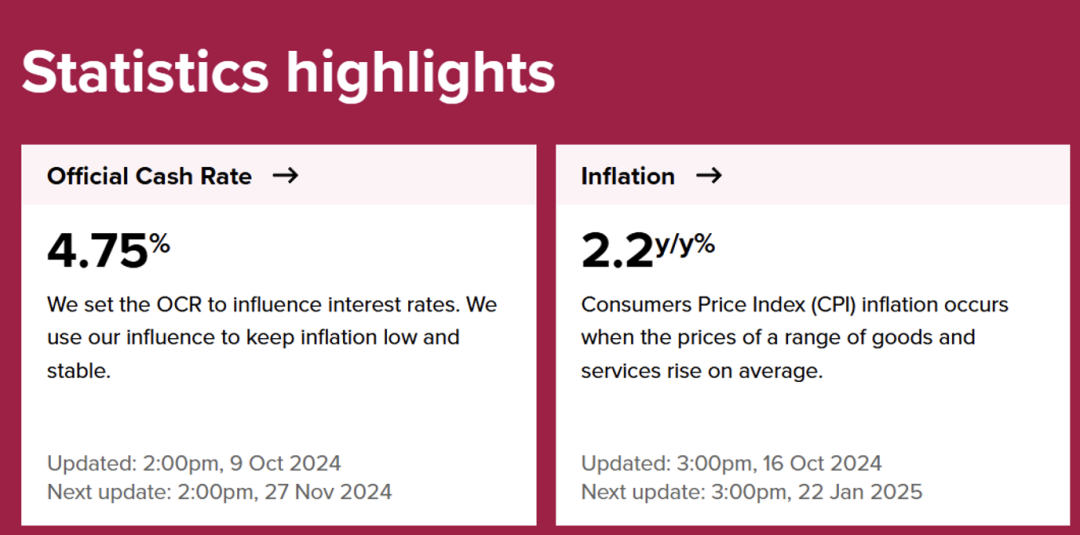
The Reserve Bank will release its OCR update at 2:00 pm on 27 November
2
Will a weak labour market continue to hold back the property market recovery?
According to figures released by Stats NZ last week, unemployment rose from 4.6% in the second quarter to 4.8% in the third quarter. Excluding the temporary increase during the pandemic, this is the highest reading since mid-2017. Although the latest unemployment figure was below most analysts’ expectations, it offers little reason for excessive optimism. Employment still fell by 0.5% over the same period, or around 16,000 people, while the rise in unemployment was partly ‘hidden’ by people giving up their job searches and leaving the labour force. This is clearly not a good sign. Overall, the labour market remains weak, with negative implications for the economy and property market. However, weak employment figures also increase the likelihood of the Reserve Bank cutting the OCR by 50 basis points at the end of this month.
In its Financial Stability Report released last week, the Reserve Bank discussed potential mortgage repayment difficulties and loan default risks arising from higher unemployment, while noting that lower mortgage rates would help cushion these risks. Overall, despite some risks, New Zealand’s financial system, particularly its banking sector, is still considered sound.
3
Could net migration and rent growth continue to slow?
Stats NZ’s upcoming releases this week of net migration figures for September and rental price data for October are particularly important for investors. Although policies such as mortgage interest deductibility are moving in investors’ favour, whether rent growth slows remains an important factor for property investors assessing investment returns.
4
The share of high debt-to-income lending could rise again

The Reserve Bank will release its latest mortgage lending data by debt-to-income ratio (DTI) on Wednesday. With the new DTI rules now in force, these figures will attract close attention. Although the share of high-DTI lending may rise slightly, the new rules have yet to affect the market in the short term because of the 20% allowance for high-DTI loans.